If you are building or restructuring a B2B website, you do not need hundreds of pages on day one. You need a small set of pages that (1) search engines can understand quickly and (2) buyers can use to reduce risk and decide to talk to you.
In practice, many SMEs lose months to publishing activity that does not translate into inbound leads. The fix is usually less complicated than it sounds: launch with the right core page types first, then scale content that supports them.
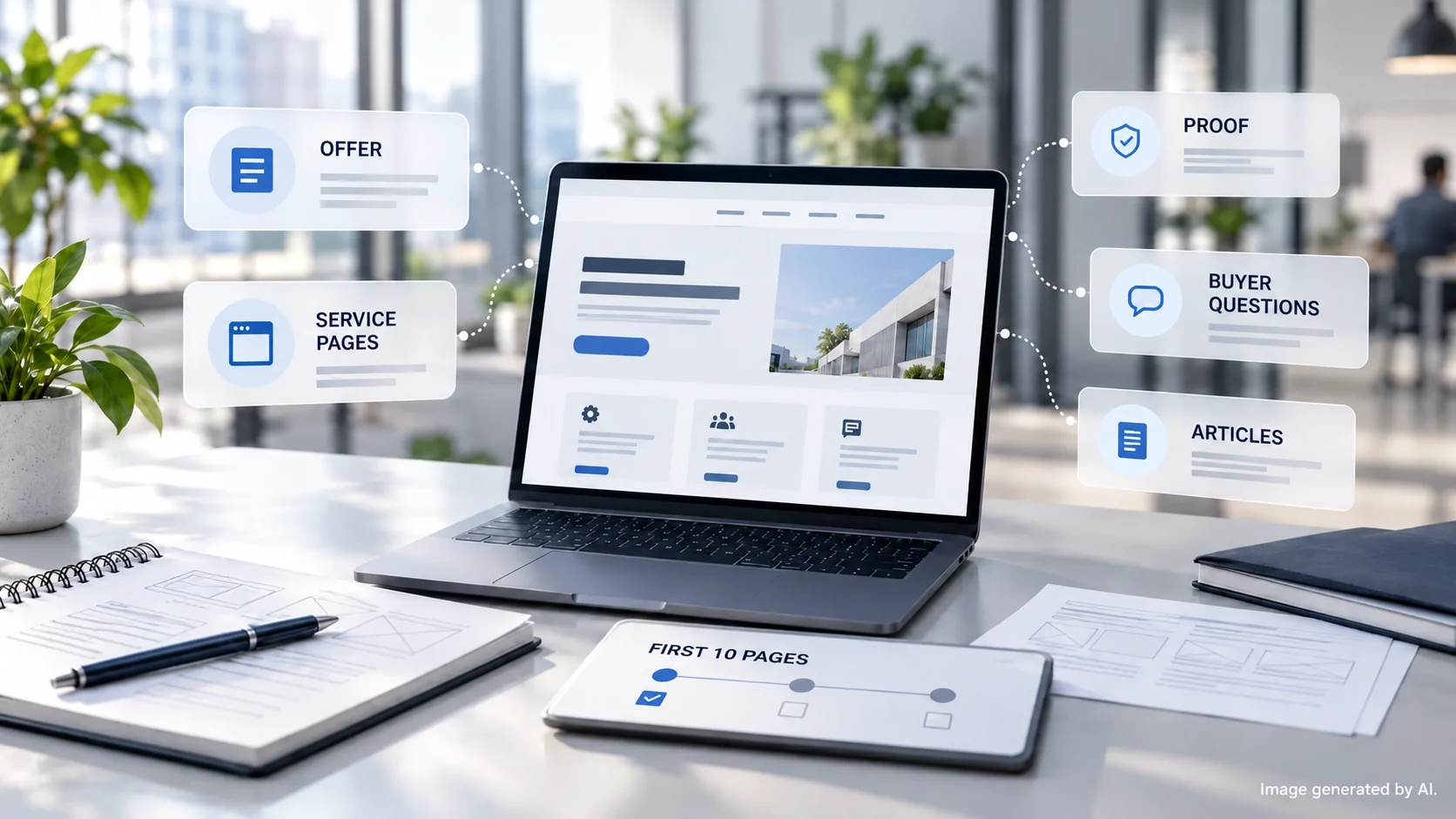
Below is an illustrative “first-ten-URL plan” you can follow, including why each page exists, which buying questions it helps answer, and how the pages should connect for both Google and AI-powered answer environments.
Why website architecture drives B2B growth - and GEO
For B2B, organic rankings are rarely about a single keyword. They are about whether your site structure clearly communicates what you do, who you help, and which pages should satisfy each stage of the buying journey.
At a practical level, website architecture affects three things:
Crawling and indexing: a clean URL hierarchy and internal linking so search engines can reliably discover your key pages.
Relevance and intent matching: when your page types match how buyers search (by problem, context, or solution), each URL becomes a target for a cluster of related queries.
Conversion credibility: B2B visitors evaluate risk. Your pages must communicate outcomes, evidence, and next steps - not just descriptions.
And because search is changing, architecture matters beyond classic SEO. In Generative Engine Optimization (GEO), AI-driven systems look for coherent, extractable information - which tends to come from consistent templates, clear headings, and evidence-led structure.
Here is a quick comparison you can keep in mind while planning your pages:
| Channel / model | What it looks for | What your site should do |
|---|---|---|
| Google (classic search) | Technical accessibility, relevance to queries, link signals | Clear hierarchy, strong internal linking, intent-matched page types |
| AI answer engines (GEO) | Extractable, well-structured explanations; consistent context | Scannable pages with predictable sections; evidence and FAQs |
| Buyer decision process | Risk reduction, proof, and clarity on process | Case studies, service scopes, FAQs, and obvious conversion paths |
Practical insight: if you only “build content” without defining page responsibilities (homepage = positioning, solution = problem-to-outcome, case study = evidence), you end up with pages that feel interchangeable. That is when traffic appears, but leads do not.
Phase 1: Trust & navigation foundation (Homepage, About, Contact)
Start by making it easy for buyers (and crawlers) to understand what you do and where to go next. These three pages reduce uncertainty before you ask for a lead.
1. Homepage (the positioning hub)
Why this page exists: it is your site’s storefront and internal compass. It should tell buyers what you do, who it is for, and what changes after they work with you.
Which decision it helps: “Is this relevant to my situation?” and “Should I explore solutions or services?”
What to include (keep it outcome-led):
Outcome-led messaging (avoid feature-only copy).
Navigation to your major commercial pages (solutions, services, use cases/industries, resource hub, and contact).
Trust elements: proof where appropriate (logos if you can use them), clear “why us”, and signposting to case studies.
Consistency: clear headings and internal links that help search engines map your offer.
Practical insight: treat the homepage as a map. If your main links go to the right commercial pages, you will reduce bounce and improve how confidently both users and crawlers interpret your site.
2. About Us (the trust gap closer)
Why this page exists: it supports E-E-A-T by showing real experience and helping buyers trust your approach and people.
Which decision it helps: “Can we work with you?” and “Do you understand our world?”
What to include:
Relevant experience: what you have delivered and the types of organisations you typically support.
Methodology: how work starts, how you keep quality consistent, and how you communicate progress.
Team/leadership overview with clear roles (only what is accurate and useful).
Specifics that can be cross-checked by looking at your case studies and other pages.
Practical insight: for SMEs, buyers often invest as much in leadership and process credibility as they do in outcomes. Your About page should make that visible.
3. Contact (friction removal)
Why this page exists: if visitors are ready, you should not force them to hunt. Contact pages also support conversion trust.
Which decision it helps: “What is the simplest next step?”
What to include:
A simple form and a minimal set of fields.
Clear response expectations based on your operating reality.
Multiple ways to reach you if you truly support them.
Relevance to your core audiences and outcomes (mirrors what you say elsewhere).
Practical insight: you can improve lead quality by aligning contact CTAs to the same outcome language used on solutions and services pages.
Phase 2: Commercial engines (Solutions, Services, Use cases)
Now you build the pages that capture commercial intent. These are the URLs that should rank, convert, and feed internal links into your proof pages.
4. Solutions / Product pages (the problem-to-outcome landing)
Why this page exists: it prevents your homepage from becoming a generic brochure and gives search engines a clear target for bottom-of-funnel demand.
Which decision it helps: “Is this the right solution for our problem?”
What to include:
One solution per page where possible.
A problem-to-outcome narrative: what changes after adoption, and who it is for.
An implementation overview that is realistic, not vague.
Internal links to relevant services, supporting FAQs, and at least one relevant case study.
Practical insight: if your copy is written in internal shorthand, buyers struggle to map it to their questions. Write solutions in the buyer’s language: what they need to decide, not what you need to tell.
5. Service pages (how you deliver, and what you actually do)
Why this page exists: if you sell ongoing work, service pages clarify scope and reduce perceived risk.
Which decision it helps: “Can you deliver this reliably?”
What to include:
Scope and deliverables (what is included and what is not).
USPs and differentiators stated clearly.
Process stages (discovery, planning, execution, reporting, optimisation - or your version).
Evidence: testimonials or case studies where relevant.
6. Use case / Industry pages (context-led conversion)
Why this page exists: many B2B buyers search by context. Use case and industry pages bridge the gap between general services and buyer-specific intent.
Which decision it helps: “Will this work for our environment and constraints?”
What to include:
Buyer persona alignment (decision-makers, evaluators, influencers, users).
Vertical-specific challenges and why your approach fits.
Solution mapping: which solutions and services are relevant.
Proof where possible (case studies that match the context).
Practical note: avoid dozens of thin pages. Prioritise the verticals or use cases where you can provide clear outcomes and evidence.
Phase 3: Proof & conversion endpoints (Case studies, Demo)
Commercial traffic is only useful if it converts. These two pages support consideration-stage intent and turn curiosity into action.
7. Case studies / Customer success (evidence-led evaluation)
Why this page exists: case studies answer “Can you do this for someone like us?” and strengthen your commercial pages.
Which decision it helps: “Are we confident enough to proceed?”
What to include:
Clear context: starting point, constraints, and goals.
What you did: structured approach and deliverables.
Outcomes: only when you can present accurate, defensible data.
An evidence checklist (the reasoning and specifics that reduce buyer doubt).
To make your case studies easier to evaluate, use our evidence checklist approach: What makes a B2B SEO case study credible - an evidence checklist for buyers.
8. Demo / Free trial landing page (single-intent CTA)
Why this page exists: for many B2B offers, this is the highest-intent endpoint. If it is unclear or unfocused, SEO traffic will not convert fully.
Which decision it helps: “What happens next, and what do we need to do?”
What to include:
Single focus: one primary offer and one primary call to action.
A value statement that matches how buyers evaluate your solutions.
Lead qualification approach so follow-up is appropriate.
Trust elements: relevant proof, FAQs, and links back to related solutions or services.
Practical insight: if visitors arrive from different intents (solution pages vs. informational articles), your demo page must still reinforce the same outcomes - without forcing users to read the entire site to figure out whether you are right.
Phase 4: Authority builders (Resource hub, FAQ)
These pages help you win informational demand, strengthen internal linking, and make it easier for AI systems to extract answers from your site.
9. Blog / Resource hub (intent-led authority)
Why this page exists: your resource hub captures informational searches and builds topical authority that supports your commercial pages.
Which decision it helps: “Do we understand this enough to trust you?” and “Is your approach credible?”
What to include:
A clear information architecture (categories/topics that map to your commercial themes).
Intent-based planning: align articles with stages of the buying journey.
Conversion pathways: internal links to solutions/services/demos and key FAQs.
Practical insight: do not treat publishing as the finish line. With our performance-based approach, Rebell Way builds a repeatable content growth system: research, topic planning, structured content creation, publishing on your site, monitoring, and then expanding or refreshing what earns visibility.
10. FAQ (friction reduction and GEO-friendly structure)
Why this page exists: FAQ captures long-tail buyer questions and answers objections before a lead reaches out. It also provides structured content that AI answer environments can extract.
Which decision it helps: “What do we need to know before we commit?”
What to include:
High-frequency questions from sales calls, onboarding, and support themes.
Short, direct answers followed by a little context.
Page-level targeting: questions that tie back to solutions, services, demo, and case studies.
Practical note: you can repurpose recurring operational questions into Q&A content. That reduces repeat tickets and improves long-tail coverage.
If you want a framework for extracting questions from operational inputs, the same thinking applies across industries: Turn product returns and support tickets into better e-commerce content.
Next steps: Turn the foundation into a growth system
These ten pages are the start. The next step is scaling organic discovery without turning your website into a collection of disconnected posts.
Build a short sequence for creating your “first ten”
Confirm your offer and naming: before writing, lock the core offer language that you will use across homepage, solutions, and services.
Draft homepage, About, and Contact: these pages set the buyer’s expectations and make your navigation reliable.
Publish the commercial engines: create solutions, service pages, and use case/industry pages with clear outcomes and internal links to proof.
Add case studies and the demo/lead endpoint: this is where intent becomes credibility.
Launch the resource hub and FAQ: then start supporting the commercial pages with intent-led articles and structured Q&A.
Review performance and refine: expand topics that gain traction, and update pages that are getting traffic but not converting.
Where Rebell Way fits (without turning it into a retainer debate)
If you want measurable outcomes and you do not have bandwidth for a full in-house SEO/content team, Rebell Way can help you turn your expertise into structured SEO and GEO content - and measure it using real visibility and traffic data (for example, from Google Search Console and analytics).
We typically start with an Organic Growth Audit / Website Potential Assessment to check whether the site foundation supports content-led growth - so you know what to build first and what to avoid.
Explore Rebell Way’s performance-based organic growth approach
If you are restructuring or migrating, you should also decide whether to refresh existing content or publish new pages based on evidence. This decision is easier with a clear framework: Refresh existing B2B content or publish new - a Search Console decision framework.
FAQ
How many core pages does a new B2B website need for SEO?
For most B2B launches, start with a focused set of core page types. A “first ten” structure is enough to establish clarity for crawlers and credibility for buyers before scaling supporting content.
Should I build industry pages or solution pages first?
Build solution (and service) pages first if you sell ongoing offerings or have clear service scopes. Then add use case/industry pages to match buyer context and map those contexts to the solutions and proof you already have.
How do AI search engines (GEO) evaluate B2B websites?
They tend to favour consistent, structured information that can be extracted and summarised. Scannable page templates, clear headings, and evidence-led sections (including FAQs) improve extractability.
What’s the biggest mistake founders make when planning a B2B website?
Creating pages without defining their role in the buyer journey. Each page type needs a clear job: positioning, matching intent, building trust, and enabling a low-friction next step.