
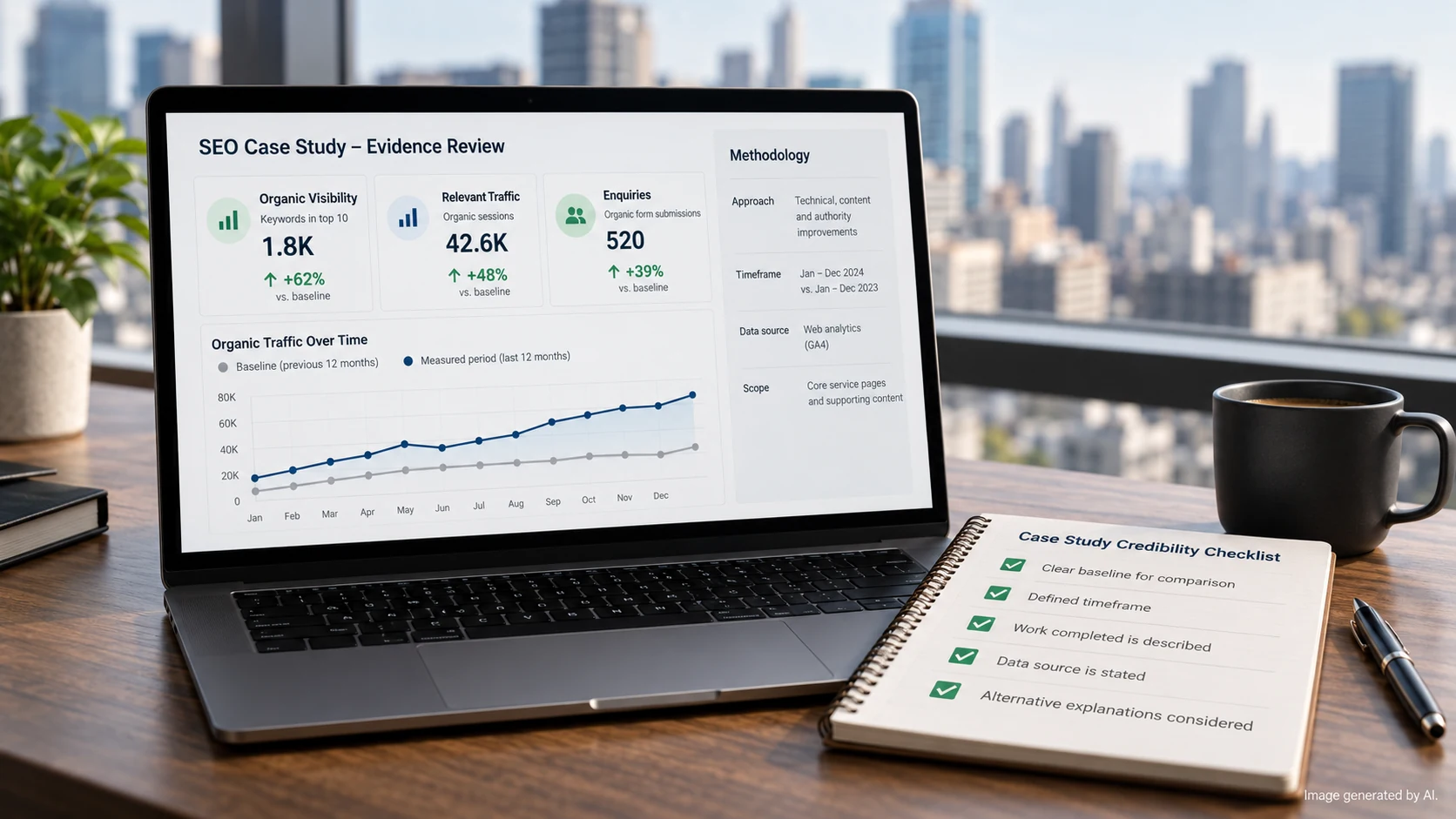
In 30 seconds: if a B2B SEO case study does not show evidence of qualified demand (and ideally pipeline/revenue influence), treat it as marketing collateral, not proof. The credible ones connect specific actions to business outcomes, explain the context (ICP, topic focus, positioning), and describe how performance was monitored after publishing - including for AI-driven discovery (GEO).
Use the checklist below while comparing agencies. It is designed for the questions a B2B founder or managing director should ask before believing charts.
Traditional vs. Credible B2B SEO Case Studies at a Glance
If you only skim one section, skim this. The buyer question is not "Did they get traffic?" It is "Was the visibility relevant, and did it translate into the outcomes my sales team needs?"
| What you see in the case study | Signals of credibility | Signals of risk |
|---|---|---|
| Organic charts | Breakdown by query intent and commercial page influence | Ranking/session increases without qualified lead or pipeline context |
| Content volume | Topic planning linked to buyer questions and cluster-to-page mapping | "Published X articles" with no explanation of why those topics mattered for your buyers |
| AI / GEO mention | Clear workflow for knowledge grounding, structure, and factual consistency | Buzzwords with no safeguards, no standards, and no explanation of how AI visibility is measured |
| Timeframe | Milestones with honest lag and what changed when | Full-time results with no timeline and no caveats |
Practical insight: When you evaluate a case study, you are looking for a method you could repeat - not a one-off storyline. Credibility comes from traceable evidence, not polish.
The most common problems in B2B SEO case studies
Many B2B SEO case studies look convincing at first glance. They show impressive charts of organic sessions, content volume, or ranking movement. Executives do not buy SEO to collect visits; they buy it to fund growth.
The gap is usually one (or more) of these:
- Vanity metrics without a conversion story - e.g., traffic spikes with no evidence of demos, trials, qualified pipeline, or sales-qualified leads.
- Deliverables without outcomes - e.g., "40 articles" but no proof those pages matched buyer intent, supported commercial pages, or performed after launch.
- No business context - e.g., the case study does not explain ICP, topic scope, positioning, or where in the funnel the traffic came from.
- Publishing treated as the finish line - e.g., no post-publish measurement, no iteration plan, and no evidence of refreshing or expanding what worked.
So when you see these patterns, you are not just facing a "bad agency". You are facing a case study format that makes outcomes hard to evaluate. That is exactly why you need an evidence checklist.
The B2B SEO case study evidence checklist (what to verify)
Think of this section as a buyer checklist you can use in calls, email threads, and comparison documents.
Check 1: Pipeline/revenue evidence - not just traffic spikes
Credible evidence looks like: the case study explicitly connects organic discovery to business outcomes such as pipeline, qualified opportunities, sales-qualified leads, or revenue influence - with enough detail for you to understand what is being measured.
Challenge these claims:
- If they claim "500% traffic increase": ask which queries drove the increase and how many converted into demos, trials, lead captures, or sales-qualified activity.
- If they claim ranking gains: ask which rankings were for buyer-intent queries mapped to your offer and sales cycle.
- If they claim "more inbound leads": ask what counts as a qualified lead in your context (and how that was validated).
Why this matters: SEO is a pipeline lever. A credible case study shows outcomes and conversion logic, not only the activity that produced the visibility.
Practical insight: If you have limited time to review, request a one-page "measurement map" for the period shown: which KPI(s) moved, what data source(s) were used (e.g., Google Search Console, analytics, CRM), and which pages contributed.
Check 2: Business context - ICP, positioning, and topic-market fit
Credible evidence looks like: the case study explains how the work was grounded in the business: ICP clarity, positioning, and why specific topics were prioritised based on buyer decision criteria.
What to look for (specificity wins):
- ICP clarity: Who was targeted and what pain points or decision jobs did the content address?
- Buyer-journey coverage: Is there a cluster plan that includes comparisons, alternatives, implementation, integration, compliance, or "how to choose" questions (depending on your sector)?
- Knowledge-grounded production: Do they show evidence that drafts used internal context, product realities, constraints, and differentiators - not generic website content?
What to challenge: if the case study reads like a content volume exercise, ask how they ensured the topics matched the buyer questions that your sales team actually uses to close.
In my experience reviewing B2B sites, the most reusable case studies are the ones that show how the agency translated expertise into structured content assets that directly match buying criteria.
Check 3: GEO and the AI search era - measured with safeguards
Visibility is no longer just ten blue links. Buyers discover answers through AI-powered experiences and answer environments. That shifts what "good results" should look like.
Credible evidence looks like: the case study describes how strategy includes Generative Engine Optimization (GEO) alongside traditional SEO, and explains how content is kept accurate and aligned with the company’s real offering.
What to look for in practice:
- Structure that supports retrieval: content that is easy for AI systems to understand and reference.
- Factual consistency: a workflow that reduces contradiction and "generic AI" output.
- Buyer question alignment: topics mapped to what your audience asks when evaluating solutions.
What to challenge: ask how they prevent content from becoming high-volume, low-utility. A credible agency should describe evidence standards and a knowledge-grounding approach, not just mention AI.
Practical insight: When GEO is claimed, ask what they do differently at the content-creation stage (sources used, fact checks, how internal expertise is captured, and how inconsistencies are corrected) - because that is where accuracy is won or lost.
Check 4: End-to-end system execution - discovery to optimisation
Credible evidence looks like: the case study is not just "we published X articles". It describes an end-to-end system: topic discovery, content planning, structured creation, publishing, internal linking, measurement, and then iteration.
Specifically, look for evidence of:
- Topic planning from buyer research and intent (not only keyword lists).
- Format choice that matches how B2B buyers compare and decide (e.g., service pages for high-intent queries, comparisons/alternatives for evaluation stages).
- Measurement with business relevance (not only rank tracking).
- Continuous optimisation after publishing - including refreshes, cluster expansion, and improvements driven by search data.
What to challenge: if the case study ends at publication, it is incomplete. Ask what changed after the first period of performance and how they decided what to update next.
In credible systems, "iteration" is a defined step - not a hope. For example, deciding whether to refresh existing B2B content or publish new assets should be tied to evidence from Search Console. If you want a framework for that approach, see Refresh existing B2B content or publish new a search console decision framework.
A buyer-proof example (hypothetical, annotated)
Below is a hypothetical case study excerpt - annotated to show what you should confirm before accepting a claimed result. (It is intentionally anonymised and not a real client story.)
- Starting point (evidence required): "At launch, we had 900 impressions for non-brand queries in Search Console and an average position of 34 for service-intent keywords." - Buyer questions: Which period? Is it non-brand only? What exact property and filtering rules were used?
- Time period (evidence required): "Over 6 months (Jan-Jun), we improved performance for a cluster of 18 questions around solution selection." - Buyer questions: What months? What milestones happened when? Was anything changed besides content (site redesign, ads, sales changes)?
- Exact work done (evidence required): "We mapped buyer questions to 6 comparison articles, 2 implementation explainers, and 2 service pages. Each article included internal links to relevant service pages and a structured FAQ section." - Buyer questions: Can they list URLs or content IDs? How were internal links implemented? Did the service pages receive updates too?
- Data source (evidence required): "We reviewed non-brand query performance in Google Search Console and tracked demo conversions in analytics. Leads were validated as sales-qualified via CRM stage movement." - Buyer questions: Which CRM stages count? How were offline conversions handled? Are they using last-click, assisted conversions, or a defined attribution model?
- Brand vs non-brand (evidence required): "Non-brand impressions grew from 900 to 6,200 (approx.) while brand impressions stayed flat." - Buyer questions: How did they define brand terms? Did they exclude named competitors? Are they reporting the same filtering method both periods?
- Relevance of traffic (evidence required): "Top queries after optimisation were 'how to choose', 'pricing model for X', and 'implementation timeline for Y' - matching decision-stage intent." - Buyer questions: Can they show query intent categorisation? How did they validate relevance to the sales cycle?
- Alternative explanations (evidence required): "We did not change ad spend or sales team capacity. The sales cycle length remained stable." - Buyer questions: What else could explain the change? Any PR coverage? Competitor changes? Seasonality?
What to ask before you accept the result: "Can you show the underlying query list or page set that drove the impact, and explain how you mapped those to pipeline outcomes in our buying context?" If they cannot, treat the result as directional at best.
That mapping step matters because even strong SEO performance can be irrelevant if the content answers different questions than your buyers ask or supports pages that do not convert for your offer.
Practical insight: When a case study uses broad numbers, ask for the smallest evidence unit: the page cluster and the query set. If they cannot share those, it is hard to judge relevance - which is what you are paying to improve.
How Rebell Way approaches credibility is consistent with this evidence logic: content is planned from buyer questions and company context, published on the client’s own site, then monitored and expanded based on real performance data in Google Search Console and analytics - with GEO considered as part of the discovery system. The goal is to align incentives with measurable visibility and traffic quality, not just publishing activity.
How to evaluate ROI and impact claims
ROI claims can be useful - but they must be interpretable. If an agency is serious, it should be able to explain the logic behind the numbers and the assumptions used.
Use these prompts to keep the discussion grounded:
- What ROI is measured against: compared to current spend, paid media alternatives, or the cost of the retainer?
- Funnel logic: which topics or page clusters influence which stages of your pipeline?
- Attribution approach: how do they connect organic discovery to leads and opportunities? Even if attribution is imperfect, the method should be clear.
- Timeframe realism: how did they model lag? What milestones occurred when?
- Break-even reasoning: in B2B markets, the "when" matters as much as the "what". Ask for a timeline that shows impact building rather than a fantasy acceleration.
Important: if the case study cannot articulate assumptions behind its ROI model, treat the claim as unverified.
If you want proof beyond charts, ask the agency to show evidence of how their system created relevant demand and how they would replicate that for your context.
Next steps: pressure-test with an Organic Growth Audit
You do not have to start with promises. A credible evaluation starts with evidence about your site - including what is realistic for your market, your buyer journey, and your content coverage.
Ask the agency for an Organic Growth Audit or Website Potential Assessment and expect them to answer three things clearly:
- Where pipeline-aligned content can be built (and what it should target).
- How outcomes will be measured beyond traffic.
- How the process supports continuous optimisation and GEO readiness, not just publishing.
If you want to see how Rebell Way structures this kind of work, visit Rebell Way.
FAQ
What makes a B2B SEO case study credible?
Credible case studies show business context (ICP, positioning), explain what was done, provide evidence of relevant non-brand demand, and connect performance to qualified outcomes such as pipeline or sales-qualified leads.
Should a B2B SEO case study include revenue impact?
It should, or at least show measurable influence on qualified outcomes (pipeline, sales-qualified leads) and how those were tracked. If it only shows traffic or rankings, it is not enough for most B2B buyers.
How important is GEO (Generative Engine Optimization) for B2B?
It matters when buyers discover solutions through AI answer environments. A strong case study should show how content is structured, grounded in company knowledge, and protected from generic, inaccurate output.
How long should it take to see ROI from B2B SEO?
SEO impact typically builds over time. A credible case study includes a timeframe with milestones and realistic lag, rather than reporting end-state results without a timeline.
What questions should I ask about attribution in SEO case studies?
Ask what data sources are used (Search Console, analytics, CRM), which KPI defines qualification, what attribution method is used, and what alternative explanations were considered during the measurement period.