
Author: Paweł Karczewski | Published: 2026-06-03
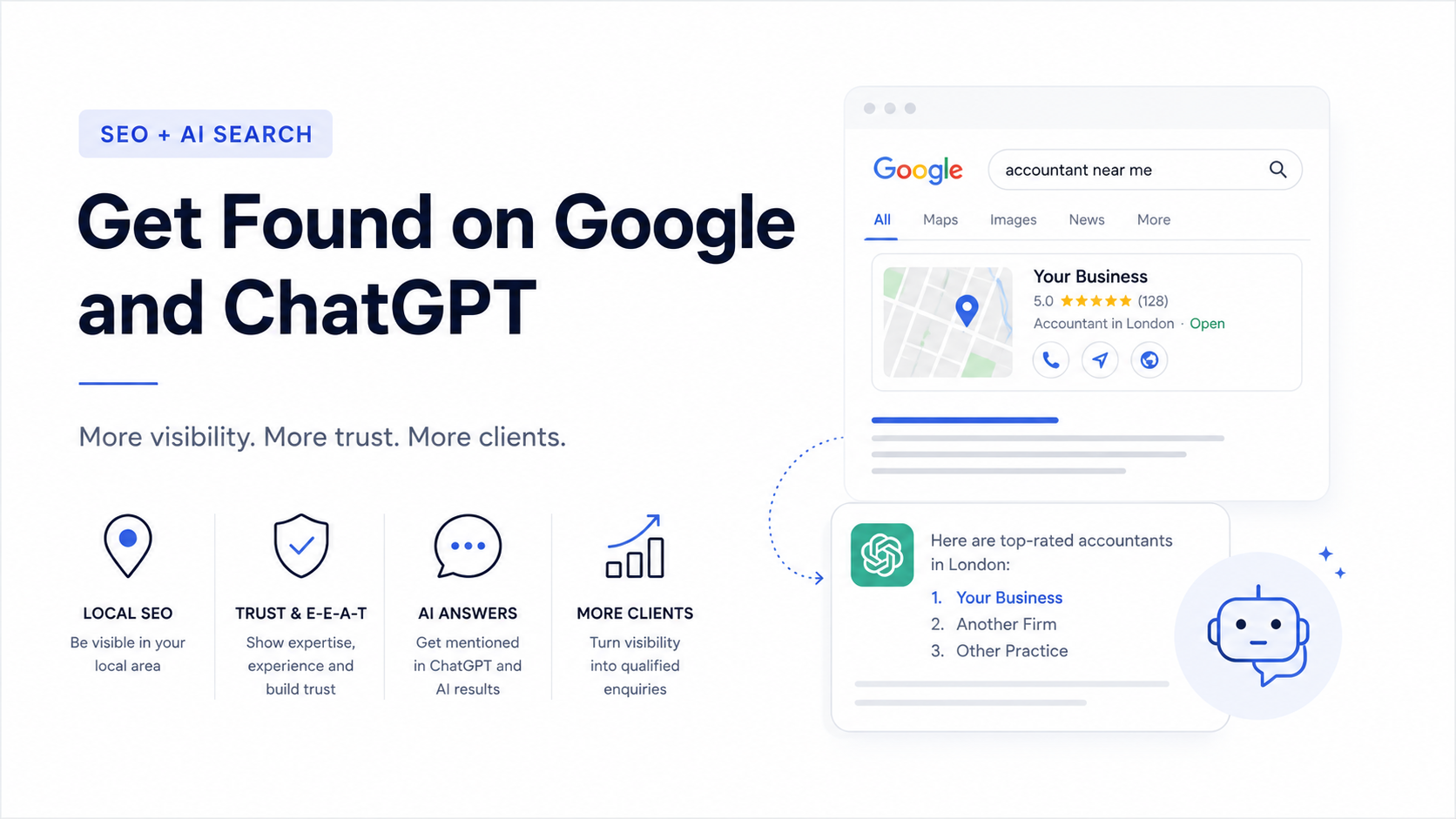
If you run a service business in the UK (accountancy, law, dentistry, architecture, consultancy), you probably still get a good share of work from referrals. But referrals now come with a second step: people check you on Google, scan reviews, and increasingly ask AI tools which firms to contact.
That shift creates a frustrating gap: you might be excellent at your job, yet invisible online or outperformed by a competitor who simply explains their services more clearly and has stronger local signals.
Table of contents
Why SEO for service businesses is different (and more trust-driven)
SEO for a service business is rarely about persuading someone to click “Buy now”. It is about reducing risk in the buyer’s mind. Prospective clients want confidence that you:
- Handle cases like theirs (relevance).
- Operate in their area (local intent).
- Are credible and compliant (trust).
- Explain the process and costs clearly (certainty).
That is especially true for “Your Money or Your Life” topics (finance, legal, health). Google explicitly focuses on quality and trust for these topics via its quality guidelines and E-E-A-T concept (Experience, Expertise, Authoritativeness, Trust). You can read Google’s own explanation in its documentation on creating helpful, reliable, people-first content.
AI search adds one more layer: tools like ChatGPT may summarise options and mention businesses based on what they can understand and corroborate across sources. Your job is to make your website and brand signals easy to interpret, consistent, and specific.
Personal insight: When we analyse Search Console data for content-led projects, the biggest wins usually come from clarity, not cleverness. The sites that grow fastest explain “who this is for”, “what it includes”, and “what happens next” in plain language, then support that with strong internal linking and clean service page structure.
Local SEO vs AI search: what you are optimising for
| Channel | What the user wants | What tends to rank/recommend | What you should focus on |
|---|---|---|---|
| Google local results (Map Pack) | A nearby provider they can trust | Google Business Profile strength, reviews, proximity, relevance | Google Business Profile, consistent NAP, review strategy, local landing pages |
| Google organic results | Proof, detail, options | Strong pages that match intent, demonstrate expertise, and answer questions | Service pages, topical authority, internal links, helpful FAQs |
| AI answers (ChatGPT and similar) | A short list of recommended options and next steps | Entities and sources that are clear, consistent, and well-described online | AEO: structured content, clear “about” info, citations, and consistent brand signals |
| Referrals + brand search | Confirmation you are the right choice | Strong brand SERP: reviews, accurate listings, authoritative content | Brand protection: ensure you dominate searches for your name and key partners |
Local SEO fundamentals for UK practices and firms
If you do only one thing this quarter, make it Local SEO. For most service businesses, Local SEO is the fastest path to qualified leads because the intent is immediate: “accountant near me”, “emergency dentist in Manchester”, “family solicitor in Leeds”.
1) Get your Google Business Profile right
Your Google Business Profile (GBP) is the foundation of the Map Pack. Start with Google’s own guidance on improving your Business Profile, then check the essentials:
- Primary category: choose the closest fit (do not dilute with dozens of categories).
- Services: list your actual services with plain descriptions (e.g., “Self Assessment tax returns”, “Conveyancing”, “Invisalign consultation”).
- Service area or address: ensure it reflects how you operate.
- Photos: real team, office, signage (credibility matters).
- Opening hours: accurate, including bank holidays if relevant.
- Reviews: steady, ethical review requests; respond professionally.
2) Keep NAP consistent across the web
NAP = Name, Address, Phone number. If your address or phone differs across directories, professional bodies, and social profiles, you create doubt for both users and algorithms.
- Use one canonical business name everywhere (avoid switching between “Ltd”, abbreviations, or partner names).
- Use the same phone format (and the same number) on your website and listings.
- Keep your address formatting consistent (suite/floor details included or not, but be consistent).
3) Build a small set of location pages (only if you genuinely serve them)
If you serve multiple areas, location pages can work well, but only when they contain real value. A good location page includes:
- Specific services offered in that area.
- Who it is for (e.g., “SMEs”, “private patients”, “first-time buyers”).
- Practical details: travel/parking, remote options, typical timelines.
- Links to relevant service pages (not just a generic contact page).
Avoid spinning near-identical pages for dozens of towns. That tends to underperform and can weaken perceived quality.
Personal insight: One common mistake we see in professional services is relying on a single “Services” page with a long list. Breaking that into focused, well-written service pages often improves both rankings and enquiry quality because it aligns with how people search (one problem at a time).
How to show up in ChatGPT and AI answers (AEO)
People increasingly ask AI tools questions like:
- “Who is a good tax accountant in London for contractors?”
- “What should I ask a family solicitor before hiring them?”
- “Find a dentist in Manchester that offers clear aligners and has good reviews.”
Even when the AI does not directly “rank” websites, it tends to summarise what it can confirm from clear online sources. This is where Answer Engine Optimization (AEO) matters: making your expertise easy to extract, cite, and trust.
What AI systems look for (in practice)
- Clarity: explicit service descriptions, pricing approach (even ranges or “how fees are calculated”), and process steps.
- Consistency: business details align across your site, GBP, and other profiles.
- Evidence: reviews, case types handled, credentials and memberships (only if real and current).
- Structured information: pages that answer specific questions cleanly.
On-site AEO checklist for a typical UK firm
- Create one page per core service: not just “Accountancy”, but “Self Assessment”, “Corporation Tax”, “VAT”, “Bookkeeping for SMEs”. Same concept for law and clinics.
- Add an FAQ block on each service page: 5-8 short Q&As reflecting real client questions.
- Define your ideal client: a simple “Who this is for” section reduces ambiguity.
- Explain your process: steps from enquiry to delivery, including expected timelines.
- Publish supporting articles for long-tail questions: these capture early-stage searches and feed internal links back to service pages.
For more background on how Google thinks about structured data and eligibility for rich results, see the official structured data documentation. While AI answers are not identical to Google rich results, the same discipline (clear structure, consistent entities, explicit answers) helps across channels.
How to write content that AI can quote accurately
Use plain, specific language and avoid vague marketing claims. A strong paragraph for AEO often looks like this:
- Statement: “We help UK contractors with Self Assessment tax returns.”
- Scope: “Including expenses, dividend income, CIS, and pension contributions.”
- Process: “We request documents via a secure checklist, review for missing items, then submit and confirm the final calculation.”
This is the opposite of “we offer high-quality services”. It gives a model (and a human reader) something concrete to work with.
Personal insight: In content strategies we have seen succeed across multiple markets, the “long tail” is not a nice-to-have. Targeting specific questions (rather than only the biggest commercial keywords) is often what builds momentum. Once your site consistently answers niche queries well, your broader service pages tend to lift too.
Content that builds trust (E-E-A-T) in YMYL industries
For accountants, lawyers, and healthcare providers, ranking is tightly connected to trust signals. Think of your content as part of your client onboarding: it should prevent misunderstandings and set expectations.
What to include on key pages (without overloading them)
- About page: what you do, who you help, where you operate, and how clients typically work with you.
- Service pages: outcomes, scope, what is included/excluded, and what you need from the client.
- Proof points: testimonials/reviews (where permitted), professional memberships (only if verifiable), and relevant policies.
- Contact page: address, phone, email, hours, and a clear “what happens after you get in touch”.
Topic clusters that work for service businesses
If you want sustainable organic growth, build topical authority around the problems your best clients have. Examples:
- Accountants: contractor tax, property income, VAT thresholds, limited company vs sole trader.
- Law firms: timelines and steps for conveyancing, child arrangements, employment disputes, wills and probate.
- Dentists/clinics: treatment options, aftercare, pain concerns, costs explained, suitability criteria.
- Architects: planning permission basics, typical project phases, budget ranges, common pitfalls.
Each cluster should link back to a core service page and include a few long-tail supporting posts. This makes it easier for both Google and AI systems to understand your niche and your credibility in it.
Brand protection: do not ignore searches for your own name
When someone hears about you through a referral, they usually search your brand. Ensure those searches lead to:
- Your homepage and key service pages.
- Accurate GBP listing and consistent directory profiles.
- Clear, up-to-date contact details.
This is a low-effort, high-impact part of SEO because it supports conversion, not just visibility.
Site structure and technical basics that support visibility
You do not need a perfect website to compete, but you do need a site that search engines and users can navigate confidently.
A practical structure for most firms
- /services/ with separate pages for each major service
- /locations/ only where you truly serve and can add real local detail
- /insights/ or /blog/ for supporting long-tail content
- /about/, /contact/, and key trust pages (privacy, terms where relevant)
Mobile vs desktop: make both work for the way clients decide
In many service categories, mobile drives discovery (people researching while commuting or between meetings), while desktop often drives decision-making (longer reading, form completion, printing details).
That means:
- Mobile pages must load quickly and be easy to scan.
- Desktop layouts should make it effortless to compare services, find fees/process details, and complete enquiry forms.
This is not about chasing vanity metrics. It is about removing friction at the exact moment someone is deciding whether to trust you.
Scaling content without losing quality (a realistic workflow)
Most owners are time-poor. You cannot spend all week writing content, and you also cannot publish thin pages that risk damaging trust. The answer is a workflow that combines speed with review.
A practical approach looks like:
- Plan: choose 6-10 core services and 20-40 supporting questions clients ask repeatedly.
- Draft: create first drafts with a consistent structure (scope, process, FAQs, internal links).
- Review: do a quick professional accuracy pass - especially for legal/financial/clinical claims.
- Publish: ensure each piece links to a relevant service page and is easy to navigate.
- Iterate: update pages based on enquiries and Search Console queries.
If you want to scale drafting without lowering standards, Rebell Way supports this kind of process by generating structured SEO/GEO article drafts from your company context and client profile, then guiding review and publication in a workflow. The goal is not to “autopublish AI content”, but to reduce blank-page time while keeping human accountability. For a deeper look at scaling responsibly, see our article on how to scale article production without compromising quality.
Authority also grows through relationships, not shortcuts. Ethical content partnerships can help you earn relevant mentions and links over time. If that is on your radar, we also break down a non-spammy approach in our guide to building content partnerships without spammy link building.
Next steps: a simple 30-day plan
If you want a focused, realistic start (without turning marketing into a second job), use this 30-day plan:
Week 1: Local foundation
- Audit your Google Business Profile categories, services, hours, and photos.
- Standardise NAP across your website and major listings you control.
- Choose 3-5 core services you most want enquiries for.
Week 2: Service pages that convert
- Build or rewrite one page per core service.
- Add a short FAQ block and “What happens next” section to each.
- Make sure contact details are visible and consistent site-wide.
Week 3: Long-tail content that brings qualified leads
- Write 2-3 supporting posts answering real client questions.
- Internally link each post to the most relevant service page.
- Add simple definitions where needed, but stay practical and UK-specific.
Week 4: AEO tidy-up
- Ensure your About and Contact pages are clear and specific.
- Check that each service page states who it is for and what is included.
- Update one older page based on new questions you received this month.
If you want a faster way to draft and organise this content while keeping control of accuracy and tone, explore how Rebell Way supports SEO and AI-ready content workflows for service businesses and teams.
FAQ
Why is my service business not showing up in ChatGPT responses?
Usually it is a clarity and consistency issue. If your services, location, and credibility signals are not easy to confirm (on your site, Google Business Profile, and other reliable sources), AI tools have less to work with. Strengthen service pages, FAQs, and consistent business details first.
Do lawyers, accountants, and dentists need a different SEO strategy than online stores?
Yes. Service SEO is more trust-driven and local-intent heavy. Instead of product pages, you need strong service pages, Local SEO (especially Google Business Profile), and content that answers high-stakes client questions accurately.
What is AEO and how is it different from SEO?
AEO (Answer Engine Optimization) focuses on making your content easy for AI systems to extract and summarise as direct answers. SEO focuses on ranking in search results. In practice they overlap: clear structure, FAQs, and strong topical coverage help both.
How long does SEO take for a UK service business?
Local improvements (GBP cleanup, NAP consistency, better service pages) can influence enquiries in weeks, while broader organic growth from content typically takes months. The timeline depends on competition, your starting point, and how consistently you publish and improve pages.
How can a UK consultancy build topical authority quickly without publishing low-quality content?
Start with a tight cluster: one strong page for each core service plus a small set of long-tail articles that answer real client questions. Use a consistent structure, review for accuracy, and interlink everything. Scale only when your process for quality control is reliable.