
What Is SEO in 2026? How Agencies Must Adapt to Scale and Protect Margins
If you run SEO for multiple clients, you already know the textbook definition of SEO. The real question in 2026 is practical: what does SEO mean as a deliverable when search results are increasingly influenced by AI, and when your biggest constraint is not strategy but production capacity?
In 2026, SEO is best understood as an operating system for visibility. It combines technical accessibility, content that satisfies intent, and authority signals - delivered through a repeatable workflow that protects quality, turnaround time, and margins.
This article reframes SEO for agency owners and account managers. It focuses on how search is changing, what your clients will actually pay for, and how to scale content production without creating operational chaos.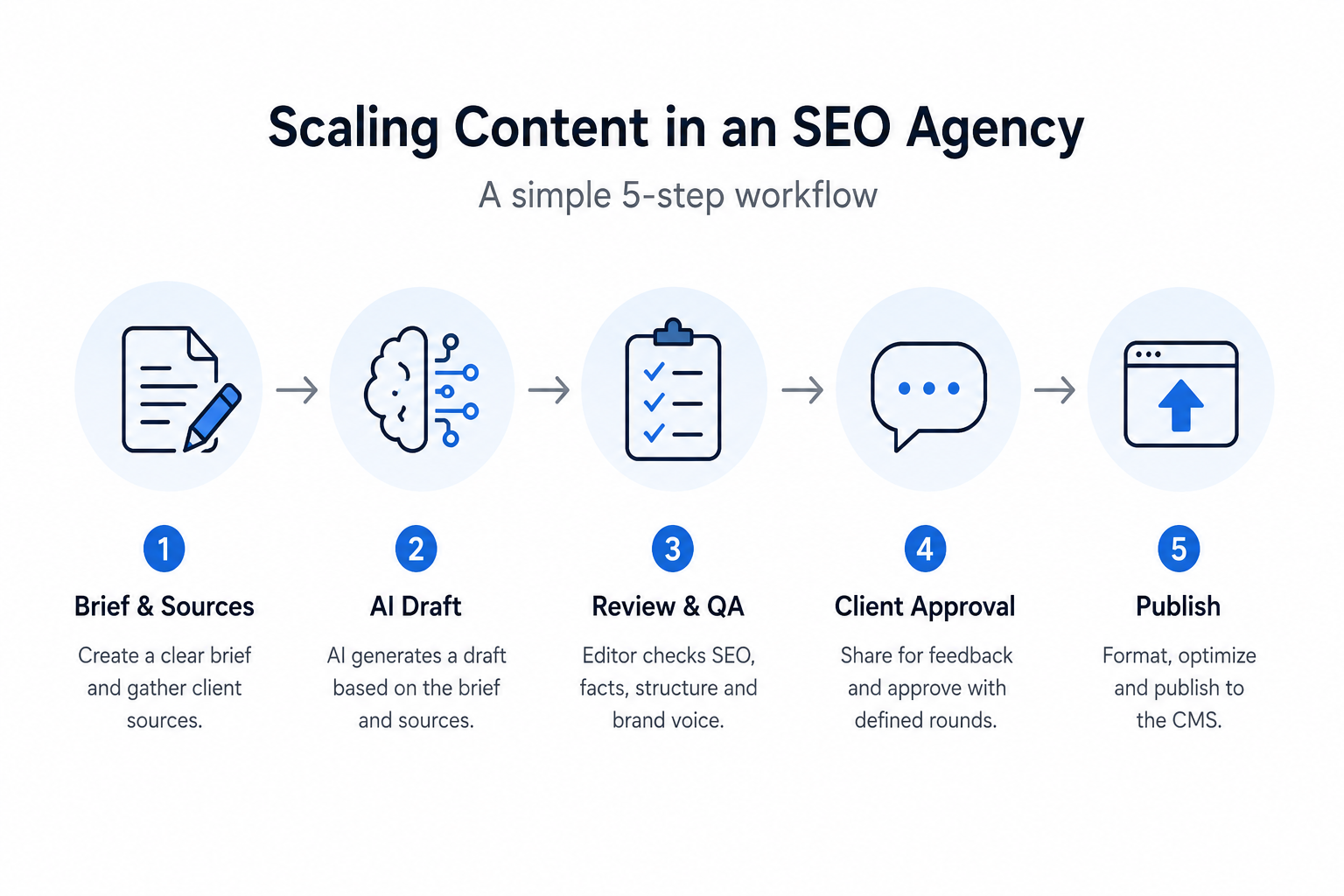
The Evolution of SEO in 2026: Moving Beyond the Basics
SEO used to be explained as "ranking in Google." In 2026, that definition is too narrow for agencies because the surface area of search has expanded:
- AI-shaped SERPs: More results are summarized, rewritten, or answered directly in the interface. Visibility is no longer only "blue links."
- Intent compression: Users expect faster answers. Pages need clearer structure, stronger topical focus, and sharper takeaways.
- Higher client expectations: Clients want predictable delivery, consistent tone across content, and fewer review cycles - especially when they approve content internally.
So, in an agency context, SEO in 2026 is the ability to consistently ship search-aligned assets that earn impressions and clicks across classic results and AI-influenced experiences, while maintaining a process your team can repeat across accounts.
How AI Is Rewriting the Rules of Search in 2026 (and What Agencies Should Do)
AI is not a single update you react to once. It changes how content is evaluated, surfaced, and trusted. For agencies, the impact shows up in deliverables and workflows.
1) From keywords to intent and entities
Keyword targeting still matters, but the winning pages in 2026 typically do three additional things:
- Define the problem precisely (who it is for, what situation, what constraints).
- Cover the decision path (alternatives, trade-offs, implementation steps, failure modes).
- Use consistent terminology so search systems can map the page to entities and relationships.
Agency implication: briefs must be tighter. A generic brief produces generic content, which produces weak performance and long approval loops.
2) Search Generative Experience (SGE) style results and "citation-ready" content
As AI-generated answers become more common in search, content that gets referenced tends to be:
- Well-structured: clear headings, short paragraphs, explicit definitions and steps.
- Specific: frameworks, checklists, examples, and boundaries (what works, what does not).
- Credible: aligned with practical experience, not vague generalities.
Agency implication: you need an internal standard for "citation-ready" writing (structure, clarity, and completeness) and a QA step that enforces it before content goes to the client.
3) Increased sensitivity to quality signals
In AI-heavy search, low-quality or templated pages are easier to filter out. The content that survives tends to show stronger E-E-A-T signals:
- Experience: written from real operational perspective (what agencies actually do, what fails, what to watch).
- Expertise: correct use of concepts, constraints, and prioritization.
- Trust: transparent scope, accurate claims, and consistent brand voice.
Agency implication: AI can accelerate drafts, but human review and a defined editorial process are not optional if you want repeatable results and fewer revisions.
Why Content Production Is Your Agency's Biggest Bottleneck
Most agencies do not struggle with knowing that content is important. They struggle with delivering it reliably across many clients.
Common bottlenecks we see in agency operations include:
- Inconsistent copywriter quality across freelancers and internal teams.
- Brief drift: strategy exists, but briefs are too vague or not updated after client feedback.
- Approval friction: content bounces between account manager, client, and writer with no clear decision owner.
- Source chaos: notes in Slack, docs in Drive, comments in email, and no single place to build client context.
- Publishing delays: content is "done" but not uploaded, formatted, or internally linked.
In 2026, this bottleneck directly affects margin. If a post takes three rounds of edits and two weeks of waiting, your effective cost per article skyrockets.
The 3 Pillars of Modern SEO: An Operational View for Agencies
You can still explain SEO through on-page, off-page, and technical. The difference in 2026 is that agencies must package these as repeatable systems, not one-off tasks.
On-page SEO = a scalable content system
For agencies, on-page SEO is not just "write an article." It is the ability to consistently ship pages that match intent, convert, and are easy to evaluate.
Operationally, that means:
- Client-specific content guidelines: tone, forbidden claims, compliance notes, preferred terminology.
- Standardized brief template: primary intent, secondary questions, internal links to include, CTA rules.
- Editorial QA checklist: structure, completeness, differentiation, and factual safety.
- Refresh workflow: update and consolidate content when performance shifts or SERPs change.
Off-page SEO = authority building with controlled risk
In an agency context, off-page SEO is less about chasing random links and more about running an authority program that is measurable and defensible.
Operationally, that means:
- Prospecting and partner management (sites, niches, quality thresholds).
- Editorial alignment so guest content supports the client brand and topical authority.
- Process controls to avoid low-quality placements that create long-term risk.
If you need a structured way to collaborate with publishing partners and manage guest posting opportunities, Rebell Marketplace can support outreach and exchanges in one place while keeping the focus on long-term authority building.
Technical SEO = predictable crawlability and performance
Technical SEO is still foundational, but for agencies it must be operationalized. Clients do not pay for "technical SEO" as a concept - they pay for fewer problems and faster execution.
Operationally, that means:
- Clear technical baselines per platform (WordPress, Shopify, Webflow, Wix, WooCommerce, etc.).
- Repeatable audits with prioritized fixes (what matters now vs later).
- Deployment workflow (tickets, owners, QA, and release notes).
Workflow Efficiency: Delivering High-Quality Content at Scale
If your agency wants to scale content in 2026, speed alone is not the goal. The goal is throughput without quality collapse.
A practical content workflow that scales across accounts typically has these stages:
1) Client context setup (once, then maintained)
- Define the client profile: audience, offer, positioning, tone, and compliance constraints.
- Store key references: product pages, brand terms, past content, and internal notes.
- Maintain a living list of topics and priorities tied to the SEO strategy.
2) Briefing (every piece of content)
A brief that reduces revisions includes:
- Search intent: what the reader wants to achieve and how you will satisfy it.
- Angle: what makes this piece different (framework, process, point of view).
- Required sections: specific questions to answer, boundaries, and examples to include.
- Internal linking notes: which existing pages to reference (and why).
- Approval criteria: what the client will check and who signs off.
3) Drafting with guardrails (AI-assisted, human-led)
AI can accelerate drafting, but only when it has constraints and context. The agency-ready approach is to:
- Generate drafts from structured briefs, not from a single prompt.
- Use source materials (notes, PDFs, internal docs) to reduce hallucinations and align with the client business.
- Enforce style rules so content reads like the client, not like a generic template.
Rebell Way AI Content Workspace fits this model: you can define a business context, create client-specific profiles, upload sources (including PDFs), build a knowledge base, and move drafts through review and approval before publishing to platforms like WordPress, Shopify, Webflow, Framer, Wix, and WooCommerce.
4) Editorial QA (non-negotiable in 2026)
A lightweight QA process protects results and margins. Use a checklist that covers:
- Intent satisfaction: does the content actually answer the query?
- Structure: clear H2/H3 hierarchy, scannable sections, actionable steps.
- Originality: a clear point of view or process, not recycled generalities.
- Claims safety: no invented data, no unsupported promises.
- Client fit: correct terminology, offer alignment, compliance notes.
5) Client approval that does not stall delivery
Approvals fail when feedback is vague and ownership is unclear. Reduce cycle time by:
- Defining one decision maker on the client side.
- Using comment categories (factual, legal/compliance, tone, scope) so edits are fast.
- Limiting rounds with clear expectations (for example: one consolidated review round, then final proof).
- Keeping history visible so no one reopens previously resolved discussions.
6) Publishing and updating (where many agencies leak time)
Publishing is part of the deliverable. Standardize:
- Formatting and on-page elements (headings, TOC if used, CTA blocks).
- Internal links, metadata, and category/tag logic.
- Post-publish checks (indexing, canonical, basic performance validation).
- A refresh cadence for top pages and declining pages.
Managing Copywriter Quality in the AI Era
In 2026, agencies often have a blended team: in-house editors, freelancers, and AI-assisted drafting. Quality management becomes a system design problem.
What tends to work operationally:
- One editorial standard: define what "good" looks like with examples and a scorecard.
- Specialization by vertical: fewer writers per niche increases consistency and reduces factual errors.
- Editor-led feedback loops: reusable notes so writers improve and revisions drop over time.
- Source-first writing: require references when content touches claims, processes, or nuanced topics.
The goal is not to remove humans from the process. It is to give humans better inputs, clearer checks, and fewer repeatable tasks.
What to Tell Clients: How to Redefine SEO Deliverables in 2026
Clients may still ask for "X blog posts per month," but agencies that protect margins package SEO more intelligently. Consider reframing deliverables as:
- Topical clusters (pillar plus supporting pages) tied to business outcomes.
- Content operations (briefing, production, QA, publishing, refresh) with clear SLAs.
- Authority program (partner placements, digital PR, guest posting) aligned with topical goals.
- Reporting that matches the new SERP reality (visibility, assisted conversions, and content contribution, not only rankings).
Frequently Asked Questions
How is AI changing SEO content production in 2026?
AI speeds up drafting and research synthesis, but it raises the bar for quality and differentiation. Agencies win by adding stronger briefs, source-backed writing, and consistent editorial QA, so output increases without turning into generic content.
How can SEO agencies scale content without losing quality?
By standardizing the process: client profiles, repeatable brief templates, defined QA checklists, and an approval workflow with clear ownership. Tools help, but the system (inputs, checks, publishing discipline) is what protects quality.
What is the most efficient workflow for client content approval?
Set one client decision maker, require consolidated feedback, categorize comments (facts vs tone vs compliance), and limit review rounds. Keep context and revision history in one workspace so content does not get stuck across email threads and docs.
Conclusion: SEO in 2026 Is a Production System, Not a Definition
For agencies, SEO in 2026 is the ability to deliver visibility and growth through a repeatable operating model: strategy translated into briefs, drafts grounded in client context and sources, rigorous QA, predictable approvals, and reliable publishing.
If you are trying to scale output across multiple clients, focus less on writing faster and more on building a workflow that keeps quality stable. That is how you protect margins while meeting the demands of AI-shaped search.