
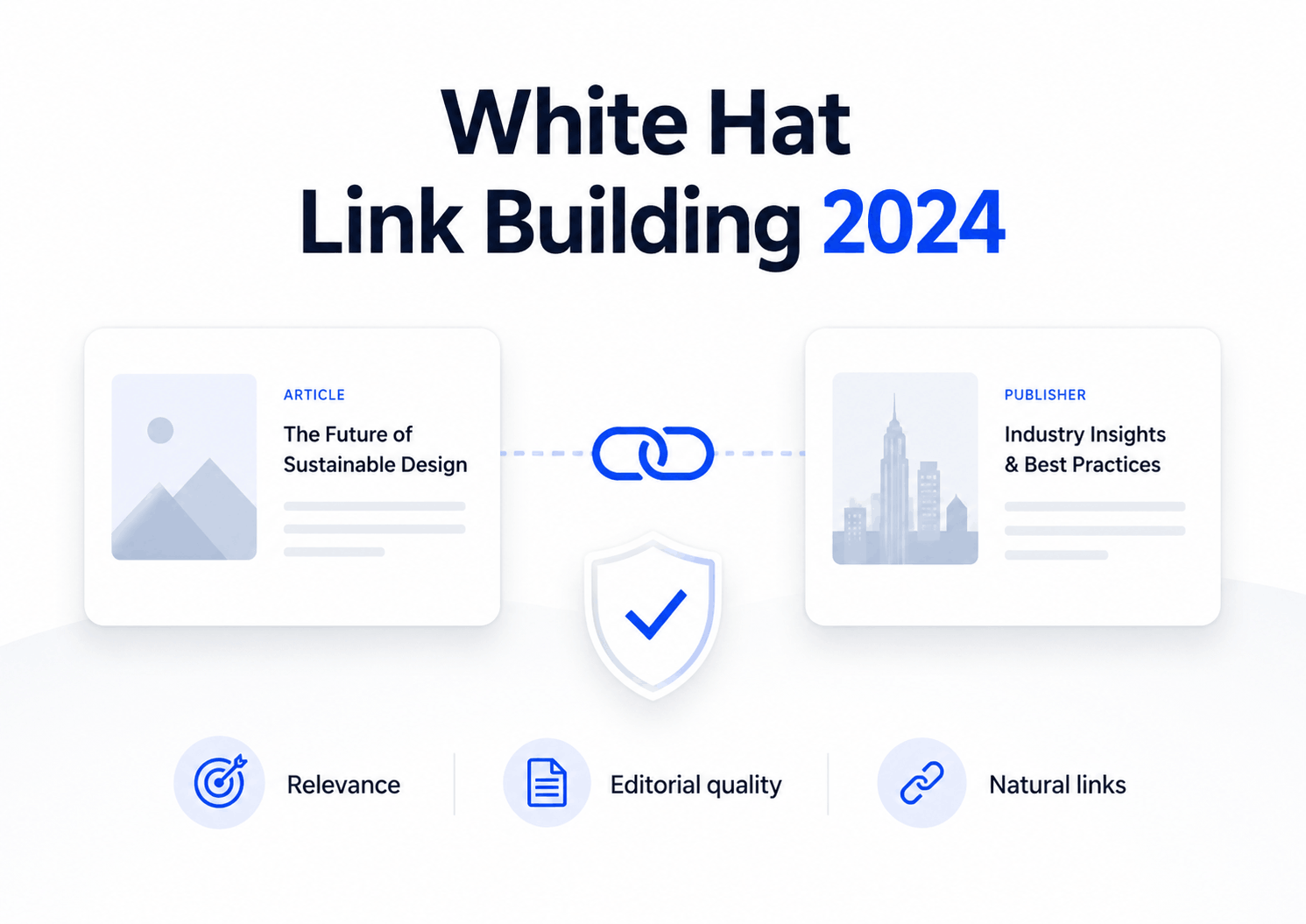
If you work in SEO or growth, you already know the definition of white hat link building. The real question in 2024 is execution: how do you earn relevant links at scale without drifting into “exchange-for-links” behavior that looks manufactured, low-value, or outright manipulative?
This guide is written for people who care about editorial quality, audience fit, and durable search equity - and who want content partnerships (guest posting, article exchange, co-marketing) to look and behave like real publishing, not a link scheme.
Featured-snippet definition: what white hat link building means in 2024
White hat link building is the process of earning backlinks through editorially justified mentions and placements created because your content, product, data, or expertise helps another publisher serve their audience. In 2024, “white hat” also means your process is auditable: you can explain why the link exists, why the partner published it, and why it improves the reader’s experience - not just rankings.
Why “article exchange” is not automatically spam (and when it is)
Article exchange gets a bad reputation because many teams treat it like a shortcut: two sites swap posts, insert exact-match anchors, and call it “partnership.” That pattern is easy to detect and rarely benefits readers.
Quality-first article exchange is different. It is closer to editorial collaboration:
- Relevance first: partners overlap in topic and audience intent, not just “DR/DA.”
- Editorial control: the host site can say “no,” request revisions, and enforce its standards.
- Natural linking: links support the argument and cite useful resources, not forced anchors.
- Long-term relationship: the goal is repeat collaborations, co-marketing, and distribution - not a one-off link.
My practical rule: if you would be comfortable showing the exchange to an editor (or a client’s legal/compliance team) and explaining the business rationale beyond “we needed links,” you’re probably on the right side of the line.
What Google actually cares about (so you can stay safe)
Google’s link spam policies focus on manipulative intent and unnatural patterns - especially when links are placed primarily to influence rankings rather than help users. If you do guest posting or partnerships, you should be familiar with these resources:
- Google Search Essentials: Spam policies
- Google: Link schemes
- Google: Creating helpful, reliable, people-first content
You do not need to fear every collaboration. You do need to avoid predictable footprints: repetitive anchors, templated bios, identical topic angles across multiple domains, and exchanges that exist only to trade PageRank.
The white hat partnership mindset: you are building a publishing network
In mature SEO programs, link building is not a separate activity. It is a distribution layer for great content and credible expertise. When you approach partnerships like publishing, a few things change:
- You invest in topics that partners want, not topics you can “place.”
- You write for their audience stage (awareness, consideration, evaluation), not yours.
- You measure outcomes beyond links: referral traffic, leads, brand search lift, newsletter signups.
Quality-first guest posting: the editorial standard checklist
If you want guest posting to be white hat in 2024, treat it like an editor would. Here is the checklist I use when evaluating whether a post will build authority instead of just “getting a backlink.”
1) Audience fit (the most underrated filter)
Ask: will the host site’s readers genuinely care about this topic? If the audience is founders and operators, don’t pitch a purely technical SEO piece. If the audience is SEO professionals, don’t pitch a beginner “what is SEO” post.
Actionable test: review the top 20 posts on the partner blog. If your proposed post would not be in their top 20 by usefulness and specificity, you should change the angle (or pick a different partner).
2) Relevance and topical proximity
Topical relevance is what keeps partnerships aligned with white hat principles. In practice, that means:
- Choose partners whose core content overlaps with your product category or expertise.
- Avoid “general marketing” sites if your niche is specialized (unless the angle is genuinely broad and still useful).
- Prioritize sites with a clear editorial focus and consistent publishing cadence.
3) Editorial standards (proofreading is not enough)
Strong partner sites have standards around:
- Originality and unique examples
- Claims supported by sources or data
- Clear structure (H2/H3), scannability, and practical takeaways
- Author transparency (real author, bio, and credentials)
4) Link placement rules that keep it natural
Most problems happen here. This is the white hat approach:
- Use branded or partial-match anchors most of the time. Exact-match anchors should be rare and only when they read naturally.
- Link deep when it helps (a relevant guide, research page, tool page). Avoid forcing everything to the homepage.
- Cite other sources besides your own site. A post that only links to the author’s domain is a footprint.
- Keep link count reasonable. If you need five links to your site to “make the post worthwhile,” the topic is probably not right.
Advanced article exchange: a framework that avoids link-scheme footprints
If you do article exchange, use a framework that creates diversity and editorial rationale. Here is a structure that works well for B2B content teams and agencies.
Step 1: Define partnership tiers (not all partners are equal)
- Tier A (strategic): closest topical overlap, highest editorial standards, best distribution potential. Aim for ongoing collaboration.
- Tier B (tactical): relevant enough, good quality, fewer distribution advantages. Use occasionally.
- Tier C (avoid): vague niche, thin content, aggressive outbound linking, “write for us” pages with no standards.
Step 2: Exchange value, not just posts
Instead of “I publish yours, you publish mine,” design a package that looks like real collaboration:
- A guest post + newsletter mention
- A guest post + webinar recap + social threads
- A co-authored guide + shared templates
- A case study swap (each side publishes the part relevant to their audience)
Step 3: Stagger timing and vary formats
Publishing two posts on the same day on two sites with mirrored links is an obvious footprint. Instead:
- Stagger publication by 2-6 weeks.
- Vary content types (guide vs. case study vs. opinionated playbook).
- Don’t force reciprocal links inside the main body. Reciprocity can exist at the partnership level without being mechanically mirrored in-page.
Step 4: Keep an “editorial agreement” (lightweight but real)
A simple one-page agreement reduces friction and increases quality. Include:
- Topic approval workflow
- Editorial requirements (originality, examples, tone)
- Linking guidelines (anchors, number of links, no forced exact-match)
- Disclosure expectations (author bio, conflicts of interest if relevant)
- Distribution commitments (what each side will do after publishing)
How to vet content partners (beyond DR/DA)
Metrics are useful, but relying on a single score is how teams end up on sites that look strong on paper and weak in reality. Here is a vetting system you can run in under 30 minutes per site.
1) SERP footprint and topical authority
- Does the site rank for terms in its niche, or only for random long-tail?
- Do their best pages look like real resources or thin listicles?
- Is there a consistent topical cluster around their core theme?
2) Editorial credibility signals
- Named authors with bios and real profiles
- Clear “About” page and company details
- Reasonable ad density and UX
- Recent publishing activity (not a blog that died 18 months ago)
3) Outbound link profile (quick manual review)
Open a few recent posts and scan outbound links:
- Do they link out to legitimate brands and sources?
- Or do they link heavily to unrelated SaaS, crypto, gambling, pills, etc.?
- Do posts look like “guest post dumps” with keyword-stuffed bios?
4) Indexation and quality sanity checks
Simple checks that catch many bad partners:
- Search site:domain.com topic and see if the content quality is consistent.
- Look for signs of spun content, duplicated templates, or AI content with no editorial review.
- Ensure pages load fast and are mobile-friendly (a poor UX site rarely provides durable value).
Digital PR as white hat link building: a modern workflow
Digital PR can look intimidating, but the strongest programs are surprisingly operational. The goal is to give publishers something they can use: data, expertise, or a story tied to timely demand.
Digital PR workflow (repeatable)
- Pick a story angle that matters now (market shifts, benchmarks, risk, cost, regulation, consumer behavior).
- Create an asset: original dataset, mini-study, calculator, template, or expert roundup with real names.
- Build a targeted media list (not a generic blast). Segment by beat and audience.
- Pitch with proof: one compelling insight + why it matters + what you can provide (data, quote, chart).
- Follow up like a human. Editors respond to clarity and usefulness, not volume.
- Repurpose into partner content: guest posts, newsletters, webinar talking points, and sales enablement.
If you do this consistently, links become a byproduct of publishing value, not the only KPI.
Content that earns links in 2024: what actually works
For advanced teams, “write great content” is not actionable. Here are formats that repeatedly earn editorial links when executed well:
- Original research: benchmarks, surveys, aggregated anonymized usage data, or systematic SERP studies.
- Opinionated playbooks: step-by-step processes with decision points, tradeoffs, and examples.
- Templates: vetting scorecards, outreach briefs, editorial guidelines, content briefs.
- Case studies: what you tried, what failed, what changed, what moved, and what you’d do next time.
- Comparison pages with integrity: transparent criteria, real limitations, and evidence.
My field notes: why most “ethical link building” programs stall
I see the same blockers across SEO teams and founders:
- They chase placements, not partners. A list of sites is not a network.
- They underinvest in editing. One excellent guest post can outperform ten mediocre ones.
- They over-optimize anchors. This creates the exact footprint they’re trying to avoid.
- They don’t build distribution. If a post goes live and nobody promotes it, it’s weaker for everyone.
The fix is boring, but it works: fewer partners, higher standards, better assets, and a repeatable workflow.
Where Rebell Way fits: workflow + partner discovery without the spam
Most teams fail at white hat link building for one of two reasons: they can’t produce quality content consistently, or they can’t find partners who match their standards.
Rebell Way AI Content Workspace (content production with guardrails)
Rebell Way AI Content Workspace helps you produce publish-ready drafts faster, but the important part is the workflow: you can define your business context, build a knowledge base from your sources, and review drafts before publishing to platforms like WordPress, Shopify, Webflow, Framer, Wix, and WooCommerce. Used correctly, it reduces the “thin content” risk because you can enforce structure, internal guidelines, and editorial review before anything goes live.
Rebell Marketplace (partner discovery for real collaborations)
Rebell Marketplace should be treated as a place to discover content collaboration opportunities - guest posts, article exchanges, and partner publishing - with an emphasis on relevance and editorial fit. It’s not a shortcut to low-quality link schemes. The best outcomes come when you use it to build a small roster of partners you can collaborate with repeatedly, improving quality and consistency over time.
Measurement: how to prove white hat link building is working
Links are only part of the story. If you’re reporting to stakeholders, track:
- Partner quality: topical fit, editorial standards, referral relevance
- Referral traffic: visits and engagement from partner posts
- Conversions: assisted conversions, demo requests, newsletter signups
- Brand demand: growth in branded search and direct traffic
- SERP movement: not just one keyword - the cluster around your core pages
Common mistakes to avoid (even if you’re experienced)
- Publishing “SEO-first” guest posts that don’t match the host audience intent.
- Overusing exact-match anchors across multiple referring domains.
- Making every post transactional instead of building a partnership pipeline.
- Ignoring the host site’s UX (slow, ad-heavy pages reduce value and durability).
- Forgetting internal linking on your own site once you earn new links (capture and distribute equity).
FAQ: white hat link building, guest posting, and article exchange
Is guest posting still white hat in 2024?
Yes, when it’s editorially justified and written to serve the host site’s audience. It stops being “white hat” when it becomes mass-produced, low-quality content created primarily for anchor text and PageRank.
Is article exchange risky?
It can be if it’s done mechanically (mirrored links, identical timing, forced anchors). It’s far safer when you treat it as a real partnership with editorial standards, staggered publishing, and clear audience relevance.
How many links should a guest post include?
As few as necessary. One contextual link to a genuinely relevant resource is often enough. Add other citations when they strengthen the piece, even if they don’t point to your site.
Should links be dofollow or nofollow?
Think in terms of editorial policy, not entitlement. Many reputable publishers use nofollow or sponsored attributes by default. A strong partnership still delivers value via brand exposure, referral traffic, and trust - and can lead to natural editorial mentions later.
Conclusion: ethical link building is partnership-led distribution
White hat link building in 2024 is not about “getting links.” It’s about earning visibility through content that deserves to be referenced and distributing it through partners who share your standards.
If your goal is to scale this without compromising quality, focus on two levers: produce genuinely useful assets consistently, and build a small network of relevant publishing partners you can work with long term. That’s exactly where a workflow tool like Rebell Way AI Content Workspace and a partner discovery layer like Rebell Marketplace can support a quality-first strategy - without turning article exchange into a spammy shortcut.