
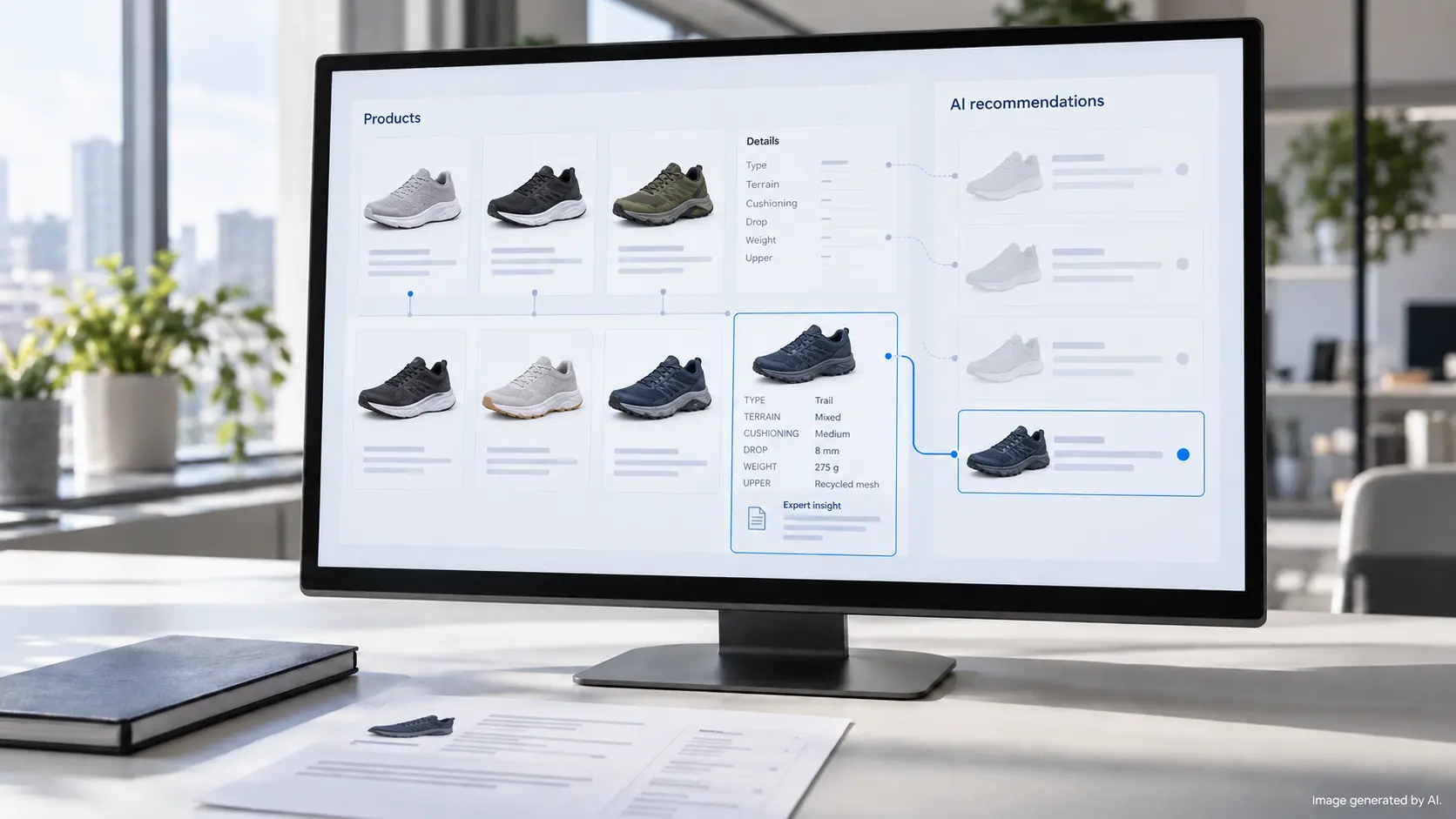
If you manage an online store, you have probably felt the shift: customers still Google, but they also ask AI tools what to buy, which brand is best, and what fits their use case. When your products do not show up in those answers, your competitor gets the click (or the purchase) without paying for ads - and your customer acquisition cost (CAC) quietly goes up.
The frustrating part is that “doing SEO” does not automatically mean you will be visible in AI answers. AI systems often summarise, compare, and recommend based on how clearly your site explains products, policies, and differences - not just how well a page is optimised for a single keyword.
This article breaks down the most common AI visibility mistakes e-commerce managers make, plus the practical fixes that tend to move the needle.
What AI visibility means for e-commerce
For an online store, “AI visibility” usually shows up in three ways:
- AI summaries in search results (for example, Google AI Overviews) that answer a buying question and link to a few sources.
- AI answer engines where a user asks: “best trainers for flat feet under £100” and gets a short list of recommended products or brands.
- Shopping-like AI experiences that pull product details such as price, availability, delivery, and returns into an answer.
In all three, the system needs clean, trustworthy inputs: structured product data, clear policies, consistent information across the site, and content that explains the “why” behind recommendations.
Personal insight: When store owners tell me, “Our products are great, but AI never mentions us,” the issue is rarely the product. It is usually that the website does not make key facts easy to extract: ranges, fit, compatibility, delivery cut-offs, returns, or what makes one model better for a specific use case.
SEO vs GEO (AI visibility) - why you need both
Traditional SEO is still the foundation. But AI-driven discovery adds new requirements: your content needs to be easy to summarise, your brand needs to be referenced in relevant contexts, and your product information needs to be structured in a way machines can read reliably.
| What you are optimising | Traditional SEO (Google organic) | GEO / AI visibility (AI Overviews, ChatGPT-style answers) |
|---|---|---|
| Main goal | Rank pages for queries and earn clicks | Be cited, summarised, and recommended in answers |
| What tends to win | Strong intent match, authority, internal linking, technical SEO | Clear entities (brand/product), structured data, “explainable” content, consistent facts |
| Typical content focus | Category pages, product pages, buying guides, comparisons | Buying guides, comparisons, FAQs, policy clarity, use-case explanations that AI can quote |
| Key technical signals | Indexation, crawlability, Core Web Vitals, canonicalisation | Product-related schema, clean faceted navigation, stable URLs, consistent attributes across pages |
| Measurement | Rankings, impressions, clicks, revenue from organic | Brand/product mentions, referral traffic from AI tools (when available), overlap with commercial conversions |
You do not need to choose. The practical approach is: protect and grow search revenue with SEO, while shaping your product and supporting content so AI systems can confidently pull, compare, and cite it.
5 mistakes costing your store AI visibility (and fixes)
1) Chasing “AI traffic” while your commercial pages stay thin
A common pattern: teams publish generic blog posts because “AI likes content,” while category and product pages stay bare. AI answers and Google AI Overviews often lean on pages that explain selection criteria, trade-offs, and definitions - not just marketing copy.
Fix: Upgrade your commercial pages and build supporting content that links back to them.
- Add a short “How to choose” section to category pages (materials, sizing/fit, compatibility, use cases).
- Strengthen product pages with scannable specs, comparisons, and “who it is for” guidance.
- Create buying guides and comparisons that naturally funnel to categories and product ranges.
Personal insight: If your team is time-poor (most are), start with one revenue-driving category. Improve the category page and publish one supporting guide that answers the top 5 pre-purchase questions your customer service team hears.
2) Relying on mass-produced AI content that says nothing new
Generic AI content tends to be interchangeable: it repeats obvious points, avoids specifics, and rarely reflects what makes your products genuinely different. That is a problem for SEO and for AI visibility. AI systems tend to trust content that is specific, consistent, and grounded in real product details.
Fix: Use AI as a drafting assistant, not a substitute for your knowledge.
- Feed drafts with your own sources: product sheets, FAQs, returns policy, delivery rules, sizing guides, and real customer questions.
- Require every article to include store-specific examples (materials you actually stock, delivery cut-offs you actually offer, sizing conventions you actually use).
- Remove filler. If a paragraph does not help someone choose a product, it does not belong.
3) Publishing answers that are hard for AI to extract
AI tools and search features often pull short passages, lists, and definitions. If your content buries the key answer in long paragraphs, you are making it harder to be cited.
Fix: Write for humans first, but format so machines can reliably quote you.
- Open key sections with a direct 1-2 sentence answer.
- Use descriptive headings that match real questions (for example, “Is X compatible with Y?”).
- Use bullets for criteria, steps, and comparisons.
- Keep terminology consistent (do not alternate between three names for the same product type).
4) Ignoring technical barriers: faceted navigation, duplication, and messy URLs
Many online stores unintentionally create thousands of low-value URLs through filters (size, colour, brand, price). This can waste crawl budget and dilute signals. It can also confuse AI systems if near-duplicate pages compete for the same concept.
Fix: Make faceted navigation intentional.
- Decide which filter combinations deserve indexation (high-demand “money” filters) and prevent the rest from being indexed.
- Ensure canonical tags, parameter handling, and internal linking reinforce your chosen “primary” URLs.
- Keep product availability, price, and variants consistent and up to date, especially if you serve multiple markets.
Personal insight: When AI visibility drops or becomes inconsistent, technical duplication is often a silent contributor. If the same product appears across many URLs with slightly different titles or breadcrumbs, it is harder for systems to pick the one “true” page to cite.
5) Tracking the wrong metrics (and missing the commercial impact)
If you only track rankings and sessions, you might miss what is happening: fewer clicks from informational queries, more “zero-click” answers, and shifting demand toward comparison-style searches. AI visibility is not a vanity metric. It affects CAC and the share of demand you capture without paid spend.
Fix: Measure visibility in a way that links to revenue.
- In Google Search Console, monitor changes in impressions and clicks for buying-guide and comparison queries (even when clicks drop, impressions can tell you demand is there).
- Track organic landing pages that assist conversions (not only last-click).
- Create a simple monthly “AI mention log” for your brand, top categories, and hero products, then compare against your organic performance trends.
Technical GEO: schema and data that actually matter
Structured data does not guarantee AI visibility, but it removes ambiguity. For e-commerce, it is one of the highest-leverage fixes because it helps machines understand your products, offers, and policies.
Prioritise these schema types and related data hygiene:
Product schema (and complete attributes)
- Include consistent product identifiers (SKU/MPN/GTIN where applicable).
- Use accurate attributes: brand, colour, size, material, model, and variant handling.
- Ensure images, price, currency, and availability are current.
Offer data (price, availability, delivery and returns clarity)
AI answers often include practical buying constraints: “in stock,” “ships to the UK,” “free returns,” “delivery in 2-3 days.” Make sure your site presents these clearly and consistently, and that structured data reflects reality.
Breadcrumb and organisation signals
- Use breadcrumb markup so systems understand category relationships.
- Make your brand (company name, contact details, policies) easy to find and consistent across the site.
FAQ schema (selectively, for real questions)
Do not add FAQs everywhere. Add them where they remove friction and reflect real pre-purchase questions: sizing, compatibility, warranty, returns windows, and delivery cut-offs.
If you run Shopify or WooCommerce, many themes and plugins output some schema automatically. That is helpful, but it is rarely “done.” The gaps are usually in completeness and consistency, especially across variants, out-of-stock products, and sale pricing.
Content structure that AI can extract and cite
To improve the chances that AI systems quote or cite you, your content needs to answer specific questions with clear language and stable facts. For e-commerce, the best-performing formats tend to be:
- Buying guides: “How to choose X for Y use case” with criteria and trade-offs.
- Comparisons: “X vs Y” where you explain differences and who each option is for.
- Use-case pages: “Best X for small kitchens / eczema / commuting / gifting” (only if you can be specific and truthful).
- Policy explainers: delivery, returns, warranty, sizing, care instructions - written in plain English.
Practical formatting checklist (use it as a pre-publish QA):
- Does each page have one clear purpose and one primary question it answers?
- Is there a short “answer-first” paragraph near the top?
- Are the criteria written as a list that could be quoted?
- Do you include concrete product attributes (dimensions, materials, compatibility), not just adjectives?
- Do you link to the relevant category or product pages where the user can act?
If you want more ideas on formats that support product discovery, Rebell Way has a related piece here: https://www.rebellway.com/blog/top-content-formats-that-boost-product-discoverability-on-google-and-ai-platforms.
How to measure AI visibility and commercial impact
AI visibility measurement is imperfect, but you can still build a system that is good enough for decision-making.
Start with what you can measure reliably
- Organic demand and capture: Search Console impressions and clicks for your key categories and buying-guide queries.
- Revenue contribution: organic-assisted conversions in analytics (not only last click).
- Content-to-commerce paths: how often buying guides lead to category/product views.
Add “AI visibility signals” without overcomplicating it
- Track brand and product name prompts monthly: “best [category] UK”, “alternatives to [competitor]”, “is [your brand] good for [use case]”. Record whether you are mentioned and what sources are cited.
- Watch for shifts in query mix: more comparisons, fewer generic “what is” queries, more “best for” and “vs” patterns.
- If you spot a query where AI answers dominate, prioritise content that directly addresses the decision criteria and links to your commercial pages.
The key is to tie visibility to business outcomes. If AI answers reduce clicks on informational queries, your job is to ensure the customers who still need detail (and are close to purchase) can find you through category pages, comparisons, and “best for” content that supports conversion.
Where Rebell Way fits (without adding workload)
Many e-commerce teams know what they should do here, but execution is the bottleneck: limited time, too many products, and no repeatable process that connects content to commercial pages and measurement.
Rebell Way focuses on building that repeatable system. Instead of producing isolated articles, the work is structured around a content growth workflow designed to improve visibility in Google and AI-powered search while supporting category and product performance. Depending on what you need, that can include:
- Organic Growth Audit / Website Potential Assessment: to identify where technical issues, content gaps, and search opportunities are blocking growth.
- SEO & GEO Content Growth System: turning your internal knowledge (products, FAQs, policies, customer questions) into structured content that can rank and be cited.
- Content Publishing & Optimisation: publishing on your site, monitoring performance, and expanding what starts to gain traction instead of constantly chasing new topics.
If you want to understand which AI visibility mistakes are costing your store the most - and what to fix first - start with an Organic Growth Audit with Rebell Way.
FAQ
What is Generative Engine Optimisation (GEO) for e-commerce?
GEO is the practice of making your products, brand, and supporting content easier for AI systems to understand, summarise, and cite. For e-commerce, it usually means stronger product data, clearer policies, and content that explains decision criteria (not just keywords).
Why my products aren’t found in AI answers?
Common reasons include incomplete or inconsistent product information, weak supporting content (guides/comparisons), technical duplication from filters and variants, and a lack of clear, quotable answers about use cases, delivery, returns, and differences between products.
Which schema markup is most important for Google AI Overviews in online stores?
Product-related structured data is typically the priority: Product with accurate offers (price, currency, availability) and consistent identifiers and attributes. Breadcrumb markup helps with category relationships, and selective FAQ schema can help where it answers real pre-purchase questions.
How do I get my products featured in ChatGPT-style search?
Focus on making product facts consistent and easy to extract (structured data and clear on-page specs), and publish content that answers buying questions with concrete criteria and comparisons. Then link that content to the relevant categories and products so the path to purchase is obvious.
Can I track traffic from AI search engines in Google Analytics?
Sometimes. Some AI tools may pass referral data, but it is inconsistent. A practical approach is to combine analytics (organic-assisted conversions and landing page performance) with manual tracking of brand/product mentions for your key prompts, then prioritise content that supports commercial outcomes.