
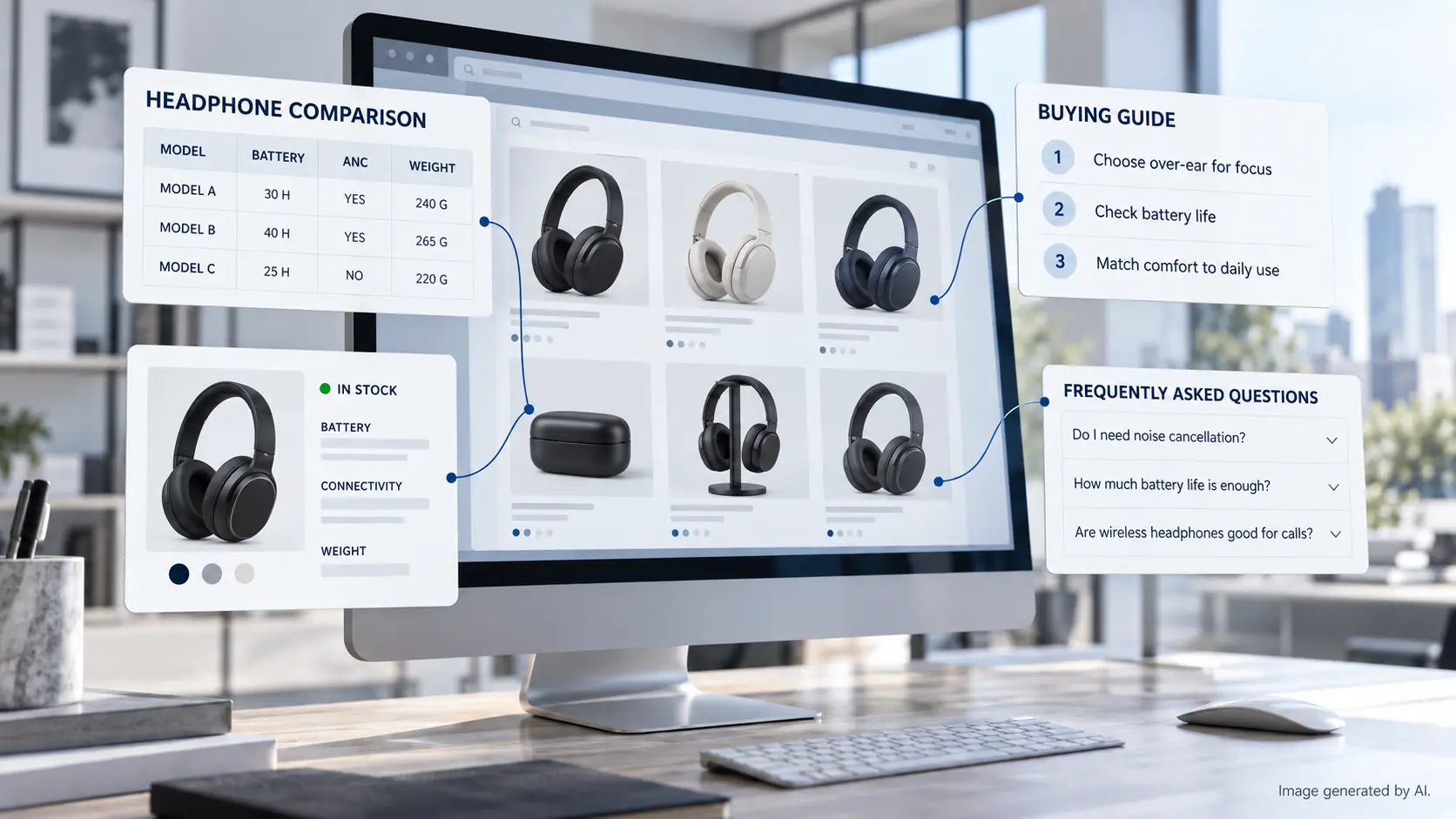
Paid acquisition costs rarely go down for long. So if you manage an e-commerce site, organic discoverability is not a "nice to have" - it is often the only scalable way to grow category traffic and product revenue without constantly increasing spend.
The catch: discovery is changing. Customers still use Google, but they also ask longer, more specific questions in AI environments (Google AI Overviews, ChatGPT, Gemini, Perplexity). If your site content is thin, unstructured, or unclear, these systems struggle to extract reliable answers about what you sell and when it is the right choice.
Key takeaway: the best content for e-commerce SEO and AI search is not one magic blog post. It is a set of repeatable content formats (category content, comparisons, buying guides, FAQs, and product copy) that are written for humans and structured for machines.
How AI changes product search (and what it rewards)
Traditional SEO often starts with a keyword and a landing page. AI-driven discovery often starts with a question, a constraint, and a preference.
Instead of searching for "running shoes", a shopper asks: "best running shoes for flat feet under £100" or "which air purifier is best for allergies in a small bedroom". AI systems then try to produce a single answer. To do that well, they need:
- Clear product facts (price, availability, materials, sizes, compatibility, delivery constraints)
- Context (who a product is for, what problem it solves, when to avoid it)
- Structure (tables, lists, definitions, well-labelled sections, consistent terminology)
- Trust signals (policy pages, detailed category explanations, FAQs that reflect real buyer questions)
Personal insight: A common mistake I see on e-commerce sites is treating "content" as a separate marketing layer. In reality, your category pages and product pages are the content AI engines rely on most. If those pages are thin, your blog cannot fully compensate.
SEO vs GEO: what is different for e-commerce?
Generative Engine Optimisation (GEO) is not a replacement for SEO. It is an extension: you still need crawlable pages and rankings, but you also need content that AI can quote, summarise, and confidently use to recommend products.
| Area | Traditional SEO focus | GEO (AI search) focus |
|---|---|---|
| Primary output | Ranking pages in results | Being cited, summarised, or recommended in answers |
| Best-performing structure | Optimised landing pages and internal links | Structured, extractable sections (FAQs, specs, comparisons, definitions) |
| Query style | Short keywords | Conversational, constraint-based prompts (budget, use case, compatibility) |
| Data requirements | Good on-page content, backlinks, technical SEO | All SEO basics plus strong entity clarity and robust schema (Product, Offer, FAQPage) |
| Measurement | Rankings, clicks, organic revenue | All SEO metrics plus monitoring of AI-driven impressions/citations where available and shifts in long-tail demand |
Personal insight: Treat GEO like product merchandising for machines. Your job is to reduce ambiguity: make it easy for a system to understand what the product is, who it is for, and how it compares to alternatives.
How AI reads your store: entities, schema, and context
If you want better product discoverability tips that hold up across Google and AI platforms, you need to understand what these systems consume. In simple terms, they pull from three layers:
1) Entities (what things are)
AI systems build knowledge around entities: your brand, product types, materials, features, compatible models, conditions, and use cases. Help them by using consistent naming and clearly defining relationships, for example:
- Brand + product type ("Brand X stainless steel water bottle")
- Material, capacity, dimensions, care (dishwasher safe?)
- Use case and constraints (for commuting, for small spaces, for sensitive skin)
2) Structured data (how facts are labelled)
Schema markup helps search engines and AI systems extract reliable facts. For e-commerce, the most important are usually:
- Product schema with key attributes (brand, GTIN where applicable, images)
- Offer details (price, currency, availability)
- AggregateRating/Review if you collect reviews and can mark them up accurately
- FAQPage for high-intent FAQs on categories or guides
- Article schema for editorial content (buying guides, comparisons)
3) Page context (how information is framed)
Even with schema, the surrounding copy matters. AI systems tend to prefer content that is:
- Explicit (states who it is for and why)
- Comparable (explains trade-offs and alternatives)
- Up-to-date (no outdated claims or discontinued products in "top" lists)
Top content formats that boost product discoverability
Below are the content types for AI search and Google that consistently support category and product performance. The point is not to publish all of them at once. Start with the formats closest to revenue: categories and products, then build supporting assets (guides, FAQs, comparisons) that strengthen those commercial pages.
1) Category and collection pages (your primary discovery engine)
Category pages are often where organic revenue is won or lost. They are also the pages most likely to be used as a source when AI systems summarise your range.
Why AI likes it: it can interpret the category as a "set" of options and match the set to a query like "best [product type] for [use case]".
How to optimise:
- Write a short, useful intro (150-300 words) that explains the range and key decision criteria, not marketing slogans.
- Add scannable buying criteria in bullet points: sizing, materials, compatibility, power, safety, care, warranty terms (only if true and consistent).
- Target long-tail modifiers naturally (budget, room size, skin type, activity, age group) in subheadings and copy.
- Use internal links to the right subcategories and to one or two high-value buying guides.
- Support faceted navigation safely (avoid indexation bloat). Use canonicalisation rules and noindex for low-value filter combinations when appropriate.
Example section you can add to a category page: "Who this category is for", "How to choose", "Common mistakes", "FAQs".
2) Comparison pages (including "X vs Y" and "best for" round-ups)
Comparison content captures high-intent users who are close to buying and need a final push. It also maps perfectly to how AI assistants answer questions: by weighing options.
Why AI likes it: structured comparisons make it easy to extract differences and recommend a choice based on constraints.
How to optimise:
- Use a clear comparison table (price band, key features, ideal user, pros/cons, compatibility).
- State the decision rule: "Choose A if..., choose B if...".
- Keep it fair. Overly biased "us vs them" copy can reduce trust and reads like an advert.
- Link to commercial pages (category/product) with descriptive anchors, and make sure those targets contain the specs you reference.
- Update regularly. Comparisons go stale quickly when ranges change.
Personal insight: If you only have time for one improvement, build comparison tables that reflect how your customers actually decide (delivery speed, durability, size constraints, return policies). That is the information people repeatedly ask support about, and it is also what AI tries to summarise.
3) Knowledge-grounded buying guides (the bridge from research to revenue)
Buying guides attract early- and mid-funnel demand, then funnel it to categories and products. Done well, they also build the topical authority that helps your commercial pages perform.
Why AI likes it: guides answer "how do I choose" prompts and provide definable chunks (criteria, steps, recommendations) that are easy to quote.
How to optimise:
- Map the guide to real questions: "How to choose", "What size", "Is it safe", "What is the difference between...".
- Include a decision framework (3-6 criteria) and explain trade-offs.
- Add a glossary section for terms customers and AI frequently confuse.
- Use internal links deliberately: each criterion should link to the category/subcategory where the best options live.
- Write for local context where relevant (measurements, currency pricing examples, delivery expectations, compliance topics only if you can state them accurately).
Rebell Way often builds these guides by extracting knowledge from a founder, product team, or support logs, then turning it into structured content that supports the pages that actually sell. That is the difference between "more content" and a content system tied to revenue pages.
4) FAQ blocks on categories and guides (for AI Overviews and conversion friction)
FAQs are not just for customer support. They reduce uncertainty before purchase, and they create concise, extractable answers that search engines and AI assistants can use.
Why AI likes it: question-and-answer formatting is a natural match for how AI systems ingest and reproduce information.
How to optimise:
- Use real questions from search queries, on-site search, customer emails, and returns reasons.
- Answer in plain language and keep each answer focused (2-5 sentences).
- Avoid vague answers like "it depends" without giving the variables that drive the decision.
- Consider FAQPage schema where appropriate and accurate.
- Place FAQs where the question arises: on the category page for category-level questions; on the product page for model-specific questions.
5) Product descriptions that read like a buying assistant (not a brochure)
Product pages still matter most for conversion, but they also play a bigger role in discovery than many teams expect, especially for long-tail prompts that include features and constraints.
Why AI likes it: a well-structured product page gives it stable facts (specs and offers) plus helpful context (use cases and limitations).
How to optimise:
- Lead with the outcome: who it is for and the primary benefit, then support with specs.
- Use a feature-benefit structure (feature: what it is; benefit: why it matters).
- Add a "What is included" section and "Compatibility" where relevant.
- Make specs easy to extract with consistent labels (dimensions, weight, materials, power, care, country of origin if you state it).
- Implement robust Product and Offer schema so price and availability are explicit.
Building a content-led growth system (without a big in-house team)
Most e-commerce teams are busy. Content usually sits behind trading, merchandising, and operations. The way to make this sustainable is to treat content as a system that is measured and iterated, not a one-off publishing sprint.
A simple framework that Rebell Way uses in its SEO & GEO Content Growth System looks like this:
- Extract knowledge and entities: collect product detail, customer objections, support questions, and positioning. Define the key entities you want to be associated with (product type, materials, use cases, problems solved).
- Plan around intent clusters: connect buying guides, comparisons, FAQs, and category pages so they reinforce each other through internal linking and shared terminology.
- Publish, measure, expand: monitor Google Search Console and analytics, then strengthen the topics that gain traction (add FAQs, expand criteria sections, update comparisons).
This approach is also why Rebell Way focuses on performance-driven organic growth rather than reporting on activity alone. If a format does not lift visibility or support conversions over time, it gets revised or replaced.
If you want a practical starting point, Rebell Way offers an Organic Growth Audit / Website Potential Assessment to identify where your store has the most realistic organic potential (categories to prioritise, content gaps, and quick structural wins).
FAQ
What is the difference between SEO and GEO?
SEO focuses on ranking pages in search results. GEO (Generative Engine Optimisation) focuses on making your content easy for AI systems to understand, extract, and cite when they generate answers and recommendations. In practice, GEO builds on SEO fundamentals and adds stronger structure, entities, and schema.
How do Google AI Overviews affect e-commerce product pages?
AI Overviews can reduce clicks for broad informational queries, but they can also increase visibility for pages that provide clear, structured answers and product facts. Product and category pages with strong specs, FAQs, and schema are more likely to be used as sources and to capture high-intent long-tail searches.
Which structured data is most important for AI discoverability in e-commerce?
For most online stores, prioritise Product and Offer schema on product pages (price, availability, key attributes). Add Article schema for guides and comparisons, and FAQPage schema where your FAQs are accurate and genuinely answer common buyer questions.