
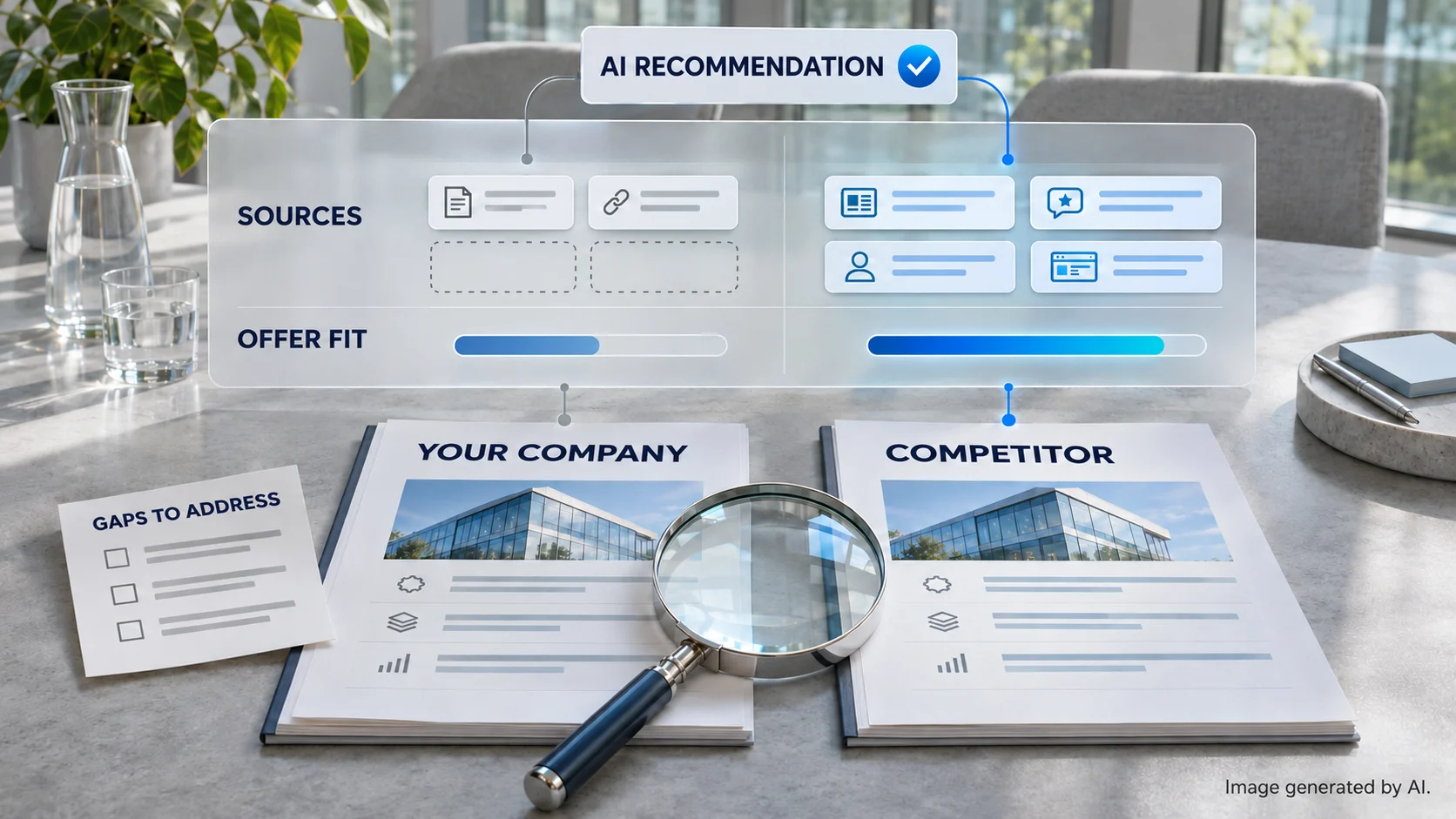
If you search your category in ChatGPT, Gemini, or Perplexity and see competitors listed repeatedly, that feels personal - especially when your organic traffic looks “fine”.
The problem is that AI is doing the comparison work a buyer used to do manually. It leans on public evidence that is easier to retrieve, summarize, cross-check, and map to the buyer’s exact evaluation criteria. If your evidence is harder to extract or incomplete in the right contexts, AI will default to competitors.
Below is a framework you can use to answer the real question behind this buying frustration: what is AI actually using, and what needs to change in the offer evidence - not just on your site?
The paradigm shift: from search links to synthesized answers
Traditional SEO helps people find pages. Generative Engine Optimization (GEO) helps AI systems recognize, cite, and recommend your information when a user asks a question.
Key idea for B2B leaders: AI recommendations are not a “rank this URL” problem. They are a “can AI reliably justify choosing this option for this buyer question?” problem.
Why classic SEO signals do not automatically translate to AI recommendations
It is tempting to treat AI visibility as “rankings minus noise”. Rankings, backlinks, and traffic can matter, but they do not directly answer the question AI is solving.
In practice, AI engines usually need four things:
- Sourceable evidence (information that can be extracted and attributed)
- Corroboration (consistency across third-party references to reduce hallucination risk)
- Structured relevance (your message can be mapped to a buyer’s evaluation criteria)
- Context fit (your brand is tied to the right buyer problem, stage, and constraints)
So even if your website looks healthy, AI may recommend competitors because their public evidence is easier to retrieve, summarize, and compare.
| Topic | SEO (classic) | GEO (AI recommendation readiness) |
|---|---|---|
| Primary outcome | Findability of pages | AI citations + justified option recommendations |
| What the system optimizes for | Ranking signals and page relevance | Extractable, corroborated, context-fit evidence |
| Common failure mode | More traffic but mismatched intent | AI sees you, but cannot describe your offer correctly for comparisons |
| How to diagnose | Keyword coverage, indexation, link profile | Source and offer mapping; citation patterns; message accuracy |
A practical communication insight (that saves budgets)
If your team debates “we need more content” for weeks, pause and ask one question: Is AI failing to cite us, or is it citing us but describing the offer incorrectly or too vaguely? Those are different problems with different owners and timelines.
The source & offer framework: why competitors win
To answer why AI recommends competitors, use a two-part framework:
- Source: how AI finds, trusts, and repeats evidence about a brand
- Offer: how AI can describe what the brand actually provides in buyer-relevant terms
Source: corroborated evidence beats isolated claims
AI has to minimize risk. It tends to trust brands that appear with consistent information across multiple third-party contexts.
Look for consistency in public signals such as:
- official company identity and service scope
- offer positioning (what you do and for whom)
- where you operate (when location/regional fit matters)
- proof signals (reviews, citations, press references, industry mentions)
Important: Do not assume your site is the “source of truth”. In many AI answers, the most repeated description across sources becomes the de facto summary.
Offer: contextual fit beats generic relevance
Your brand can be “in the right industry” and still lose if AI cannot tie you to a buyer’s specific evaluation criteria.
Ask whether your public evidence supports details like:
- buyer stage (evaluation vs implementation)
- a concrete use case (not just a category name)
- constraints (timeline, integrations, compliance needs)
- comparison dimensions (what buyers weigh when choosing)
Repeated observations matter - separate signal from randomness
AI answers can vary by prompt wording and model version. For decision-making, you want repeatable patterns, not a one-off screenshot.
A simple operating rule:
- run the same prompt set multiple times,
- record who appears and what AI says about each option,
- focus on the patterns that repeat across runs and wording variants.
Hypothetical comparison: communication gap vs real capability difference
Use this hypothetical scenario to test your own assumptions when AI lists competitors.
- You: A B2B firm with a strong implementation process, but your public pages use broad phrasing.
- Competitor 1: A firm whose third-party mentions consistently describe “implementation for X”, plus clear packaged deliverables.
- Competitor 2: A firm whose evidence is consistent, but whose offer overlaps only partially with your niche use case.
The buyer question is: “Which providers help with implementing [X] for [industry], and what should we consider?”
AI might recommend Competitor 1 for two reasons: their source evidence is easier to corroborate, and their offer framing matches the comparison language. Competitor 2 might appear because it is also consistently described, even if its capability is not a perfect fit - AI may still include it as a plausible option.
Now, the decision risk is confusing “AI can explain it better” with “they can deliver better”. That is why you need evidence mapping.
Claim-to-evidence matrix (what to test before you respond)
The matrix below helps you build a defensible response to AI recommendations without performing an unsupported ranking of specific agencies.
| AI/Recommendation Claim | What to look for (supporting evidence) | Information gap | Possible response you can test |
|---|---|---|---|
| “Competitor X can implement [X] for [industry].” | Third-party citations that consistently state scope + industry fit | Your public evidence is present but not extractable or not corroborated | Improve source consistency for scope/industry via verified external references and clearer offer naming |
| “Competitor X includes deliverables A/B/C.” | Repeated descriptions of deliverables across multiple sources | Your deliverables are real but described differently across pages | Align offer framing to comparison-ready language; make deliverables easy to extract |
| “Competitor Y is a better match for constraints (timeline/integrations/compliance).” | Evidence that addresses constraints in buyer language | AI is inferring constraints from partial mentions | Publish and corroborate constraint-specific evidence; add comparison language to the offer trail |
| “AI recommends them because they are experienced.” | Consistent proof signals (case references, third-party mentions) | Experience claims are not supported in a way AI can verify | Strengthen proof signals and clarify what “experience” means for your specific implementation model |
Practical insight: If your evidence is accurate but hidden behind complex navigation, PDFs, or inconsistent wording, AI may not extract it reliably. In that case, the gap is not capability, it is extractability + corroboration.
How to run an AI competitor analysis and visibility audit
If you want an AI competitor analysis tool framework that actually works for budget decisions, treat it as a structured audit - not a one-off prompt experiment.
Think of it as measuring AI brand presence and AI citations across the buyer questions that matter for your pipeline.
Step 1: Build a prompt set from real buyer questions
Start from buyer intent. For each priority market and service line, capture questions like:
- “What are the best options for [use case] in [country/region]?”
- “Which providers help with [problem] and what should we consider?”
- “Compare [category] options using criteria [X/Y/Z].”
Keep it limited. Around 10-20 questions per theme is usually enough to reveal patterns in which competitors appear and how they are described.
Step 2: Measure AI visibility as an upstream signal
AI visibility is an upstream signal for brand awareness inside AI systems. It does not automatically equal immediate sales, but it shapes what options buyers see and trust.
In the audit, track:
- mentions and citations (what AI points to or draws from)
- message accuracy (does AI describe your offer correctly?)
- context fit (are you connected to the right use case)
- share of voice in answers (which competitors dominate for your prompt set)
Rebell Way frames this through a GEO lens: you aim to become a recommended source, not just a ranked page.
Step 3: Compare sources and offers side-by-side
For each competitor that appears, create a comparison sheet with two columns:
- Source evidence: where the brand is mentioned and whether descriptions are consistent
- Offer framing: how services/products are presented in buyer language
Then audit your own brand the same way. The goal is not to “win the argument”, but to identify extractability and corroboration gaps.
Step 4: Identify thematic gaps vs evidence gaps
Teams often stop at “we need more content”. In GEO, that is usually too vague.
Split gaps into two buckets:
- Thematic gaps: AI does not associate you with certain use cases or comparison criteria
- Evidence gaps: even if you cover the theme, AI cannot corroborate or reliably extract it
How Rebell Way supports this diagnostic step
Rebell Way’s Google & AI Visibility Report and Growth Potential Assessment is designed for exactly this entry-point problem: understanding where you appear, where competitors appear, and what blocks AI recognition in terms of source and offer readiness. It is intentionally an assessment, not a promise of instant traffic or revenue.
If you want to reduce guesswork before investing into content or optimization, this kind of baseline helps you convert frustration into prioritized decisions.
Execution reality: who implements GEO and how to measure progress
Founders and Managing Directors do not need another theory. They need an execution answer: who does this, how long it takes, and how you know it is working.
Who implements GEO in practice
GEO is cross-functional because it touches both information architecture and external evidence trails.
- Marketing/content owner: owns offer framing, buyer-language mapping, and content that can be extracted
- Web/digital owner: ensures key offer details are reachable and consistent across core pages
- Partnership/PR owner (or agency side): helps build corroborated third-party evidence where required
- Founder/MD governance: sets priorities, approves scope, and validates whether the work targets qualified inquiry drivers
How long it takes (a realistic timeline expectation)
AI recommendations can shift when public web evidence changes and models update their interpretation. That means you should plan for:
- short diagnostic cycles to validate what is broken (usually days to a couple of weeks)
- content and evidence alignment cycles before expecting stable repeatability in answers (often weeks, depending on what must be published and corroborated)
- monitoring cycles to confirm changes are still present across repeated observations
Do not evaluate success after a single prompt run. Evaluate by whether the repeatable patterns improve for your prompt set.
How to measure ROI without falling for vanity metrics
Vanity metrics are tempting: “more AI mentions” or “a higher citation count”. They are not enough.
Track progress in layers:
- AI visibility quality: do answers correctly describe your offer and fit the use case?
- Recommendation composition: does your share of voice improve for priority questions?
- Pipeline signals: are qualified inquiries increasing in parallel (or do you need offer/landing alignment)?
Practical insight: If AI starts recommending you but your site does not convert those inquiries, you will still feel “nothing works.” In that case, the bottleneck is usually message-to-page alignment and proof clarity, not AI monitoring.
Where strategy turns into actions
Once you know what is missing, you need a plan, not just more pages.
Rebell Way’s SEO/GEO Visibility Strategy & Topic Planning helps translate your audit findings into priorities: what to build, how to structure it, and which external sources to target so AI can cite and describe your offer reliably. This separates decision-making from execution so you can manage budget and ownership clearly.
Protecting your position: ongoing monitoring and prioritisation
AI recommendations are volatile. Even when your strategy is solid, answers can shift due to changes in public web content, updates in source availability, or how models interpret prompts over time.
That is why ongoing measurement is not “extra reporting”. It is how you protect your investment and keep priorities aligned.
Why monitoring matters (and what it does not mean)
- More AI citations may indicate improved extractability or stronger evidence, but it does not guarantee immediate sales.
- Competitors appearing more often may mean they improved source consistency or offer framing, not necessarily that they became better at delivery.
- If accuracy declines, it often points to outdated third-party evidence or mismatched messaging across channels.
What to track in GEO monitoring
- AI citation patterns (which sources appear and how they describe you)
- context changes (do you start appearing for more use cases?)
- recommendation mix (which competitors appear for your prompt set?)
- message accuracy (are AI descriptions still consistent with your current offer?)
How Rebell Way supports ongoing interpretation
Rebell Way’s SEO/GEO Visibility Monitoring & Ongoing Prioritisation is built to interpret changes and update priorities. It focuses on the decision layer: whether your actions are actually improving AI citations and where the landscape is pulling you off-course.
Real-world decision examples (without guesswork)
Here are decision patterns you can use immediately. Each one ties back to the source and offer framework.
Example 1: You publish more content, but AI still recommends competitors
Do not assume “you need more pages.” The source and offer lens points to a more specific diagnosis:
- Source problem: third-party citations about competitor offers are more consistent and easier to corroborate than yours
- Offer problem: your public evidence uses broader category language, while competitors match buyer evaluation criteria more precisely
Action implication: prioritize evidence consistency and offer framing for comparison-ready language, not just volume.
Example 2: You appear in AI answers, but the offer details are wrong or vague
This is usually a message accuracy issue. AI may blend your current site with outdated or mismatched third-party descriptions.
Action implication: audit and correct the public evidence trail so AI can extract consistent details. This often requires coordination beyond the website itself.
Example 3: You are mentioned only for vague prompts
If your brand shows up for broad questions, AI may still not connect you to the specific comparison criteria buyers actually use.
Action implication: strengthen offer framing around comparison-ready dimensions (use case, stage, constraints, deliverables) so AI can map you to the buyer intent.
Practical insight: When you evaluate what changed after your actions, compare against the same prompt set. If the prompts change, you cannot confidently attribute improvement or decline to your work.
FAQ
Do we need a massive content budget to show up in AI answers?
Not always. Start with a GEO baseline to identify whether the issue is source corroboration, offer extractability, or context fit. Often the fastest wins come from aligning evidence and offer framing, not publishing more general content.
How long does it take for AI recommendations to change?
AI recommendations can shift when public evidence changes and models update their interpretation. Plan for short diagnostic cycles and then monitor repeatability over weeks, not days.
Who on our team should be responsible for GEO execution?
Typically marketing/content for offer framing, web/digital for information accessibility and consistency, and someone accountable for external evidence (partnerships/PR or an agency side). The MD should govern priorities and approve scope.
How do we know if AI visibility is driving qualified B2B inquiries?
Measure more than citation counts. Check whether AI describes your offer accurately for priority questions, whether your share of voice improves for those prompts, and whether qualified inquiry volume aligns with the changes you implemented.
How is this different from traditional SEO reporting?
Traditional SEO reporting focuses on page-level ranking signals and findability. GEO focuses on whether AI can cite, extract, corroborate, and recommend your offer for buyer evaluation questions.
Note: AI may recommend competitors even when you have strong delivery capability. The separating factor is often source-and-offer readiness - the evidence AI can reliably use.
CTA: If you want a clear diagnostic baseline for your Google and AI visibility, explore Google & AI Visibility Report and Growth Potential Assessment with Rebell Way.