
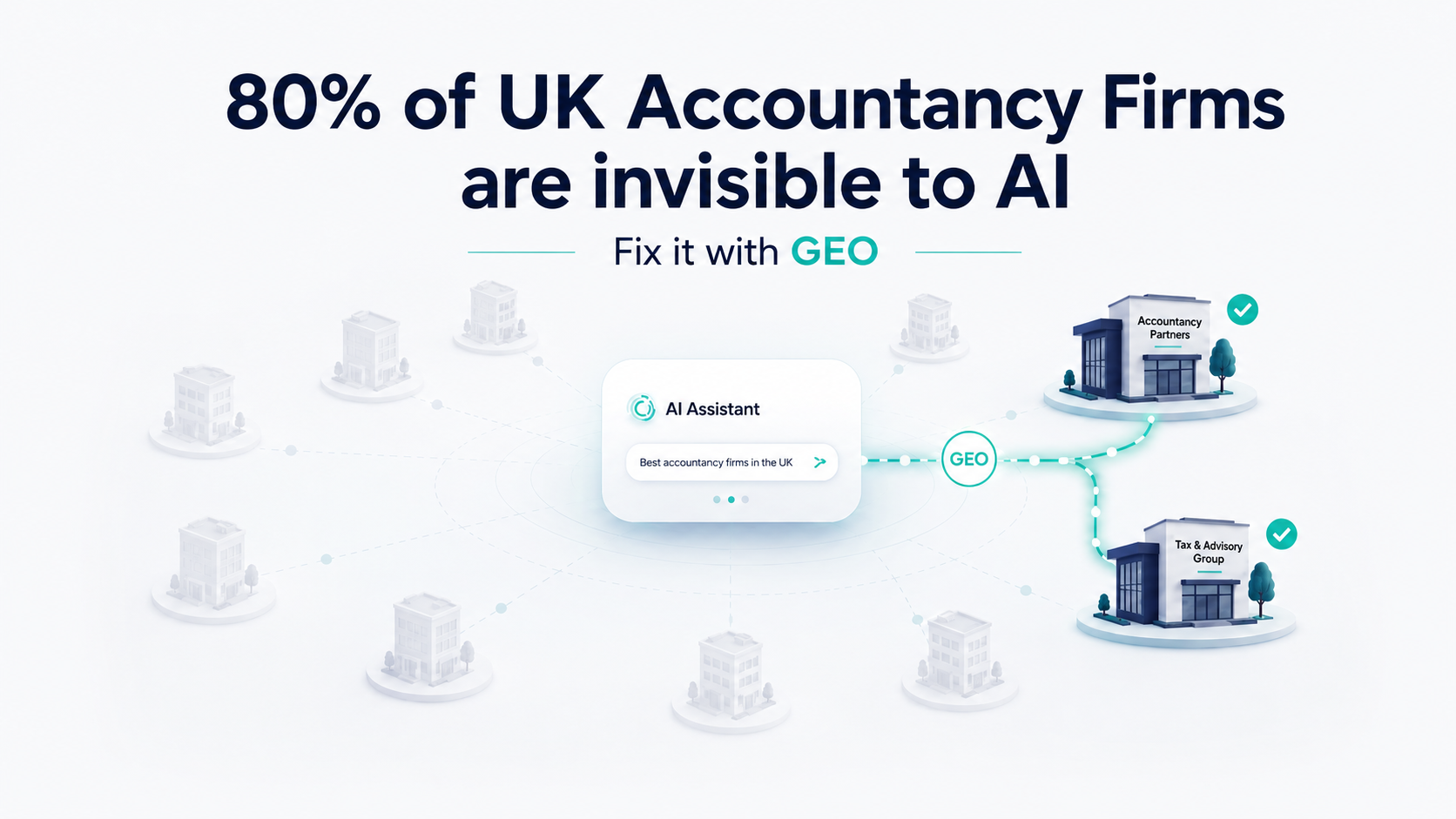
If you have ever asked ChatGPT something like “Recommend a good accountant in Manchester for a small e-commerce business” and your firm did not appear, it can feel confusing. You are doing decent work, you have a website, and you may even rank for a few local keywords on Google.
The uncomfortable truth is that many service businesses are still optimised for traditional search only. When the question is asked inside an AI assistant (ChatGPT, Gemini, Perplexity), the rules of being “findable” change. That is where Generative Engine Optimisation (GEO) comes in.
What Generative Engine Optimisation (GEO) means in plain English
Generative Engine Optimisation (GEO) is the practice of making your business easier for AI systems to understand, trust, and reference when they generate answers.
In traditional SEO, you mostly fight for rankings on a results page. In GEO, you want to become a “good candidate” for inclusion in an AI-generated response, especially for queries like:
- “Find a UK accountant specialising in contractors”
- “What should a dentist consider when choosing an accountant?”
- “Who can help with VAT for an Amazon FBA business in the UK?”
That does not mean SEO is dead. It means the output has changed: instead of “10 blue links”, the user sees one answer that summarises and cites sources.
Personal insight: Most owners I speak to do not want to become “AI experts”. They want one thing: when a prospective client asks an AI for a recommendation, the AI should not ignore them. The fastest path is usually not more blog posts. It is clearer service pages, clearer entity signals (who you are, what you do, where you do it), and content that directly answers specific client questions.
Why traditional SEO is not enough for AI answers
Traditional SEO tends to focus on keywords, rankings, and backlinks. GEO still values those signals, but it also rewards clarity and “answerability”. AI systems try to generate a confident response, so they prefer sources that are:
- Specific: clearly state services, industries, locations, and constraints (for example, “cloud accounting for Shopify and Xero”).
- Consistent: the same business facts across your site and other places online.
- Citable: content that can be quoted or summarised without guesswork.
- Trusted: mentioned alongside other reputable sources (co-citations) and supported by genuine references and links.
For accountants, the most common gap is that websites are written like brochures. They describe the firm, but they do not answer the questions people actually ask AI assistants.
SEO vs GEO: what changes and what stays the same
| Area | SEO (search engines) | GEO (AI assistants) |
|---|---|---|
| Main goal | Rank pages for keywords and get clicks | Be selected and referenced in an AI-generated answer |
| What is rewarded | Relevance, authority, technical quality, backlinks | Clarity, entity understanding, citable explanations, reputable mentions (plus SEO fundamentals) |
| Best-performing content | Optimised category/service pages and informational articles | Direct answers, structured explanations, credible citations, and pages that define your niche precisely |
| Local signals | Google Business Profile, NAP consistency, local links | Consistent business facts across the web and unambiguous location/service definitions the model can summarise |
| Measurement | Rankings, traffic, conversions | Mentions in AI answers, referral traffic, branded searches, assisted conversions |
How AI assistants “find” and mention local service firms
AI assistants do not “crawl the web like Google and then rank a page” in the same way. They typically combine multiple signals, such as:
- Training data (for some models): general patterns learned from large datasets. This is not something you can directly control quickly.
- Retrieval and browsing: some assistants pull in fresh information from the web or selected indexes.
- Knowledge graph-like understanding: recognising entities (your business name, location, services, people, tools like Xero/QuickBooks) and how they relate.
- Citations and sources: when models provide sources, they prefer pages that are easy to quote and verify.
Two official references that help frame this:
- Google guidance on helpful, people-first content (this overlaps strongly with what AI systems can summarise confidently).
- OpenAI documentation for understanding how AI systems are built and how outputs can depend on available context.
For a UK accountancy firm, the practical takeaway is simple: if your site does not clearly state what you do, for whom, and where, the AI has nothing solid to reuse. It will default to larger brands, directories, or generic advice.
Personal insight: A common mistake is assuming “AI visibility” means adding a chatbot to your website. That can help conversions, but it does not solve discovery. Discovery comes from your business being described consistently and specifically enough that an AI assistant can recommend you without guessing.
3 practical GEO steps for UK accountancy firms
Step 1: Make your firm’s “entity profile” obvious
Start with the basics an AI needs to describe you correctly. On your site (usually your homepage and contact page), make sure you clearly and consistently state:
- Business name (exact format you use everywhere)
- Primary location(s) served (towns/regions in GB)
- Core services (for example: personal tax, VAT, payroll, bookkeeping, year-end accounts)
- Client types (for example: contractors, e-commerce, medical professionals, local SMEs)
- Primary tools (for example: Xero, QuickBooks, FreeAgent)
If you serve multiple niches, choose one primary positioning for your main pages, and create supporting pages for secondary niches. Vagueness is the enemy of GEO.
Step 2: Create “answer-first” pages and articles (not brochure copy)
Think in prompts, not keywords. A prospect might ask:
- “Do I need to register for VAT if I sell on Amazon UK?”
- “How should a contractor set aside tax each month?”
- “What accounting records do I need for Making Tax Digital?”
Build content that answers these questions directly, with:
- A short definition at the top
- UK-specific context (HMRC terms, thresholds, the user’s situation)
- A practical checklist
- Clear next steps (what to prepare, what to ask your accountant)
Where relevant, cite primary sources. For UK tax and compliance topics, HMRC is the safest reference point, for example: HM Revenue & Customs (HMRC).
Personal insight: Owners often worry that detailed content will “give everything away”. In practice, the opposite happens: clear explanations filter out poor-fit leads and attract the people who value a specialist. For accountants, that usually means fewer time-wasters and better first calls.
Step 3: Build authority through co-citations, partnerships, and credible mentions
In GEO, it helps when your firm is mentioned in the same online neighbourhood as other trusted entities. That can include:
- Guest articles on reputable industry sites
- Partnership pages with complementary service providers (bookkeepers, payroll platforms, e-commerce agencies)
- Local business associations and events
- Podcast guest appearances or webinar recaps that include a link and a clear description of your niche
This is not about chasing random backlinks. It is about building a consistent footprint that a model can interpret as: “this firm exists, is specific, and is referenced by others”.
Realistic prompts: what you want the AI to say about your firm
Here are a few prompts your prospective clients may already be using. You can test them yourself and see what comes back.
Prompt 1: “Find a UK accountant specialising in e-commerce VAT and Shopify.”
What the AI often does today: returns generic directory suggestions or vague advice without naming a specialist firm.
What you want it to do: mention firms that clearly publish e-commerce VAT guidance, reference HMRC rules, show case-relevant checklists, and are consistently described across the web as “e-commerce accountants”.
Prompt 2: “Recommend an accountant in Leeds for a small limited company using Xero.”
What helps: a dedicated page like “Xero accountant in Leeds” is not enough by itself if it is thin. The page should explain your process (onboarding, bookkeeping cadence, management accounts), typical client size, and what outcomes you help with, in plain English.
Prompt 3: “What should I ask an accountant before switching from my current firm?”
Opportunity: publish a clear switching checklist. AI assistants love checklists because they are easy to summarise, and they position you as helpful before any sales conversation.
A simple workflow (and where Rebell Way fits)
You can do GEO without fancy tooling, but most business owners do not have time to manage a full content pipeline. A practical approach looks like this:
- Pick one niche and location focus (for example, “contractor accountants in Bristol” or “e-commerce VAT support in Manchester”).
- List 10 client prompts you want to win (the questions your best leads ask).
- Create or improve 3-5 core pages (homepage positioning, 1-2 service pages, 1 niche page, contact page clarity).
- Publish 2-4 answer-first articles that support those pages and cite primary sources where appropriate.
- Get 2-3 relevant mentions through partnerships or co-created content.
This is where Rebell Way can help as a provider, without replacing your expertise. The Rebell Way SEO/GEO Article Generator is designed to speed up drafting structured articles based on your company context and ideal clients, so you spend less time staring at a blank page and more time reviewing for accuracy and compliance.
And if you are working on authority building, the Rebell Way Content Marketplace can support finding content partners and collaboration opportunities that make sense for your niche, instead of random link chasing.
If you want to systemise GEO content and publishing (without turning it into a full-time job), explore how Rebell Way supports the workflow end-to-end on Rebell Way.
FAQ
What is the difference between SEO and GEO?
SEO focuses on ranking pages in search results. GEO focuses on making your business easy for AI assistants to understand and reference in generated answers. Strong SEO fundamentals still matter, but GEO prioritises clarity, specificity, and citable content.
Can I optimise my local UK accounting firm for ChatGPT?
You can improve the signals that AI assistants rely on: clear service and location definitions, consistent business details across the web, and content that answers real client questions. You cannot control every AI output, but you can make your firm a stronger candidate for mention.
How long does it take to appear in AI answers?
There is no guaranteed timeline because different systems use different sources and refresh rates. In practice, you may see early improvements after publishing clearer niche pages and a small set of strong articles, then building a few relevant mentions over the following months.
Do I need to publish lots of articles?
No. For most accountancy firms, a smaller library of highly specific, well-structured pages and a handful of genuinely helpful articles beats a large volume of generic posts.
Related reading: