
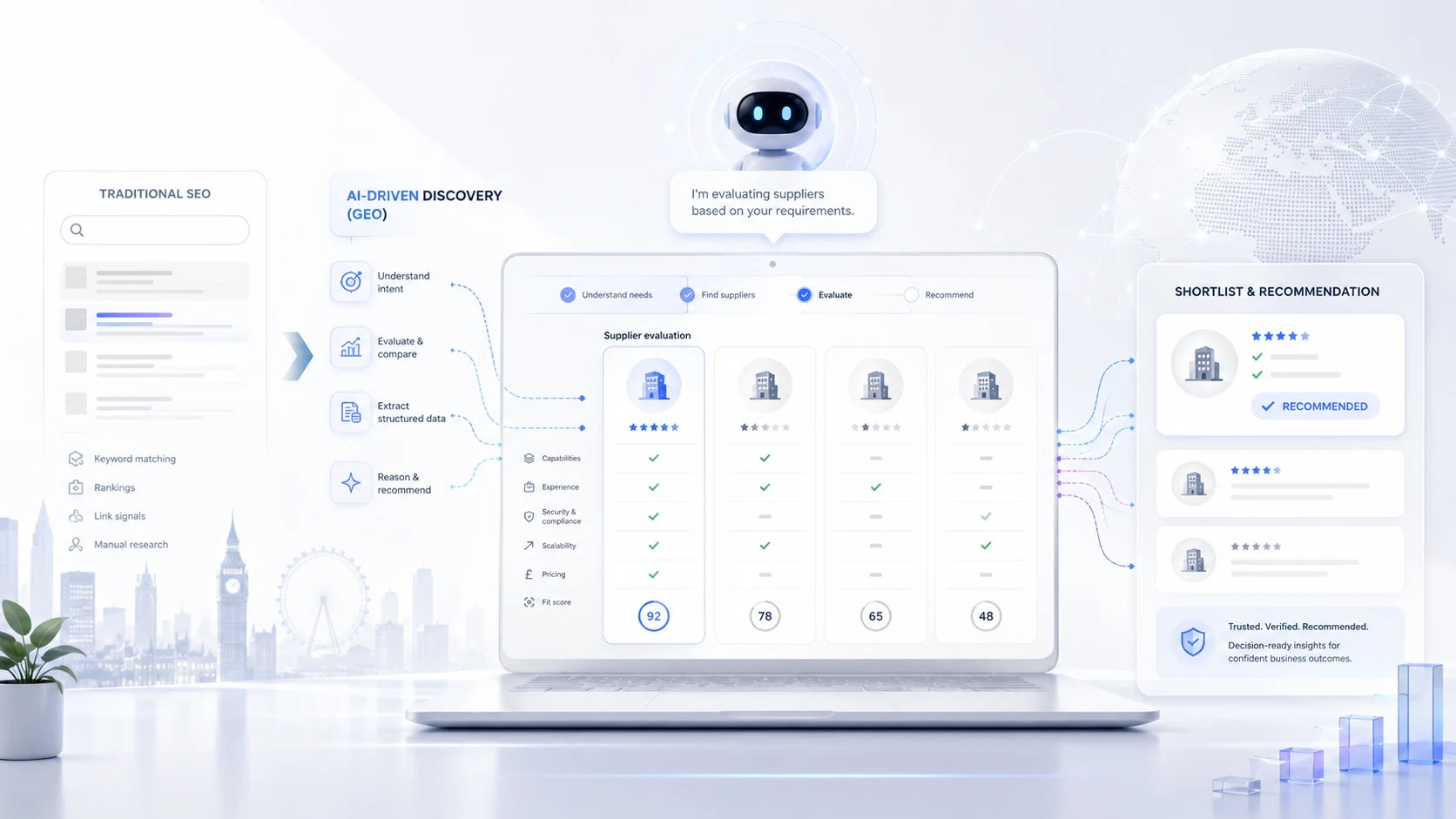
Search is shifting from “people clicking links” to “systems completing tasks”. In agentic commerce, an AI agent can shortlist suppliers, compare terms, ask follow-up questions, and even place an order with minimal human input. That changes what it means to be discoverable online, especially for UK founders who rely on organic leads and do not want to bankroll ads indefinitely.
For B2B, this is not just a retail story. If an agent is helping a procurement manager source a SaaS tool, a software house, or a premium local supplier, your visibility depends less on persuasive copy alone and more on whether your product and service data is structured, trustworthy, and easy for machines to evaluate.
What is agentic commerce and how does it work?
Agentic commerce is a model where autonomous or semi-autonomous AI agents act on behalf of a buyer or a business to research options, compare products or suppliers, negotiate constraints (price, delivery, compliance), and complete a purchase or hand over a ready recommendation.
Unlike a chatbot that only answers questions, an agent has a goal (for example: “find the best-fit CRM under £X with UK data residency”) and can execute a multi-step workflow: gather requirements, query sources, evaluate trade-offs, and take actions.
What an AI purchasing agent typically does
- Understands intent and constraints: budget, delivery timeframe, compatibility, security requirements, brand preferences.
- Pulls data from multiple systems: product feeds, websites, reviews, documentation, pricing pages, policies, and sometimes merchant APIs.
- Evaluates and ranks options: based on relevance, trust signals, and how clearly information is presented.
- Completes a transaction or next step: checkout, booking, quote request, or creating a shortlist for human approval.
Personal insight: When founders ask me “Will this replace our website?”, the more useful question is: “Can an agent understand us without a sales call?” If your key constraints (pricing model, onboarding time, integrations, service area, compliance) are buried in PDFs or vague pages, the agent will pick a competitor that is easier to evaluate.
To ground this in real infrastructure, payment networks and cloud platforms are actively exploring agent-driven flows. If you want a credible overview of where agent capabilities are heading, start with OpenAI’s public documentation on building agents and tool-using systems and Google’s overview of helpful, people-first content (still relevant because “helpful” increasingly means “machine-readable and verifiable”, too).
Agentic commerce vs traditional e-commerce: what changes?
Traditional e-commerce assumes a human will browse categories, scan product pages, and make the final selection. Agentic commerce assumes that a growing share of discovery and comparison will be delegated to AI. Your job becomes less about “getting a click” and more about “being the best structured answer”.
| Area | Traditional SEO and e-commerce | Agentic commerce and GEO |
|---|---|---|
| Primary goal | Rank for keywords to earn clicks and sessions | Be selected, cited, or recommended by AI agents and answer engines |
| Decision-maker | Human shopper or buyer | AI agent (plus human approval in many B2B cases) |
| What wins | Persuasive pages + competitive UX | Structured data, clear constraints, trust signals, and consistent facts across sources |
| Content format | Landing pages, blogs, category pages | Machine-readable product/service data, FAQs, policies, documentation-style pages, up-to-date comparisons |
| Measurement | Traffic, rankings, conversions | Mentions/citations in AI answers, qualified leads from AI-driven journeys, conversion rate from high-intent traffic |
| Risk | Competitors outbid you or outrank you | You become “invisible” to agents because data is unclear, inconsistent, or not trusted |
In practice, most businesses will run a hybrid model for years: classic SEO still matters, but the content and data foundations you build now will decide whether AI agents can safely recommend you.
Why UK founders should care (B2B and retail)
If you are a UK-based founder, CEO, or owner of a services business, software house, SaaS, or B2B e-commerce brand, agentic commerce matters for one reason: it changes how buyers create shortlists.
A realistic B2B scenario
A Head of Ops needs a development partner for a small internal platform. Instead of Google-first research, they ask an agent: “Find three UK-based teams experienced in X, with a track record in regulated industries, available within four weeks, and give me a risk checklist.” The agent pulls from websites, portfolios, public documentation, and third-party references. It filters out suppliers with vague case pages, missing security statements, or unclear engagement models.
This is where many “great businesses with low organic leads” get stuck: they have expertise, but their website does not present it in a way that machines (and busy humans) can quickly verify.
Personal insight: The fastest win I see for time-poor founders is not “more content”. It is fixing the handful of pages that shape evaluation: pricing or engagement model, delivery process, security and compliance posture, and a plain-English list of what you do and do not do. Agents reward clarity because it reduces uncertainty.
Market viability: what we can say without hype
No one can credibly promise timelines for mass adoption across every sector. What is clear is that major platforms are investing heavily in agent-like experiences, and buyers are already delegating research to AI assistants. The safe strategic stance is to prepare for “AI-assisted purchasing” as a growing channel, rather than waiting for a single mainstream switch to flip.
For background on how search engines interpret structured information, Google’s documentation on structured data is a useful baseline. Even if an AI agent is not Google, the discipline is the same: make key facts explicit and consistent.
From SEO to GEO: optimising for AI answers and agents
SEO is still the foundation: technical health, crawlability, information architecture, and authoritative content. But agentic commerce pushes teams towards GEO (Generative Engine Optimisation): optimising your content and data so generative systems can accurately summarise, cite, and use it in decision workflows.
What GEO changes in practical terms
- Precision over persuasion: Agents need exact constraints (pricing bands, delivery times, supported regions, integrations) more than brand fluff.
- Consistency across the site: If your “pricing” page conflicts with your FAQ, the model may hedge or exclude you.
- Source friendliness: Clear headings, explicit definitions, and up-to-date pages increase the chance of accurate summaries.
- Trust signals matter: Policies, terms, security notes, and contact details reduce ambiguity.
Think of GEO as making your business legible to machines without making your site feel robotic to humans.
How to implement agentic commerce: 4 practical steps
You do not need to rebuild your entire stack to start. Most UK SMEs can make meaningful progress by tightening data and content foundations first, then integrating agent-ready flows where it makes commercial sense.
1) Audit your “decision-critical” pages and data
Start with what an agent (or a rushed buyer) needs to make a decision:
- Clear offer definition: services/products, target customer, what is included and excluded
- Pricing model or at least pricing logic (fixed, retainers, usage-based, project ranges)
- Delivery process and timelines
- Proof assets you can stand behind (case summaries, references, portfolio, methodology)
- Policies that reduce risk (returns, support, SLAs where applicable)
For e-commerce, this includes product attributes, variants, shipping and returns, warranty, and accurate availability.
2) Structure your product or service information for machine use
Agents work best when information is explicit. Practical actions:
- Use consistent naming for products/services across pages.
- Make key attributes easy to extract (specifications, compatibility, delivery areas, compliance requirements).
- Answer common qualification questions directly on-page (not only via sales calls).
- Implement relevant structured data where appropriate.
Personal insight: A common mistake is writing “SEO blog content” that never connects to commercial reality. If an article does not help an agent answer “Are they a fit?” then it may generate traffic but not pipeline. For founders, that is the difference between vanity metrics and leads.
3) Prepare for tool-using flows (payments, identity, approvals)
Agentic commerce often requires guardrails: approvals, budgets, payment methods, and audit trails. Even if you are not integrating an agent today, map what “safe automation” would look like in your business:
- Who approves purchases or supplier selection?
- What data must be logged for compliance?
- Which steps can be automated without increasing risk?
This is especially important for B2B where autonomous purchasing is likely to be gated by policy for a long time.
4) Build a content pipeline that stays current
Agents will penalise stale or inconsistent information. You need a repeatable workflow to:
- Turn internal knowledge into publishable pages and articles
- Review for accuracy and consistency
- Update content as products, terms, or positioning changes
For founders who do not want to hire a full content team, the constraint is usually workflow, not ideas.
Where Rebell Way fits in (without building a huge content team)
This is the gap Rebell Way is designed to cover: turning company context, positioning, and source materials into publishable SEO and GEO content quickly, with a human review step so the final output matches what you actually sell.
Two parts are especially relevant to agentic commerce preparation:
- SEO/GEO Article Generator: helps you create structured drafts based on your actual offer, your target customer profile, and specific publication goals, so you can publish consistently without weeks of back-and-forth.
- Content Marketplace: helps you find content partners and collaboration opportunities that can strengthen authority and distribution, which still matters when agents look for trusted sources.
If your concern is “I do not want a monthly retainer with unclear outcomes”, that is a reasonable stance. The smarter approach is to focus on assets that compound: decision-critical pages, structured service/product content, and a publishing cadence that supports both SEO and GEO.
Explore Rebell Way and see how performance-focused SEO and GEO content can fit your workflow.
FAQ
What is the Agentic Commerce Protocol (UCP)?
It is a developing set of ideas and technical patterns for making commerce flows programmable for agents (for example: how an agent can discover products, confirm constraints, and execute a purchase). The exact implementations are evolving, so treat “protocol” discussions as directional rather than a single universal standard today.
How do AI agents make purchasing decisions?
They combine user constraints with available data sources, then rank options based on relevance, confidence, and trust signals. In B2B, they often stop at a shortlist with reasoning so a human can approve the final choice.
How does agentic commerce affect traditional SEO?
Classic SEO remains essential for discoverability, but it is no longer sufficient on its own. You also need GEO-style optimisation: consistent facts, structured information, and pages that answer qualification questions clearly so AI systems can summarise and recommend you accurately.
When will agentic commerce become mainstream?
Adoption will vary by sector. Consumer categories may move faster, while B2B will often require approvals and audit trails. The practical approach is to prepare now by improving data quality and decision-critical content, so you are ready as AI-assisted purchasing grows.