
You run a software house, agency, SaaS, or a B2B services business. Your offer is solid. You can deliver. But when a potential client searches, they either land on competitors in Google or they ask ChatGPT, Gemini, or Perplexity and get a shortlist that does not include you.
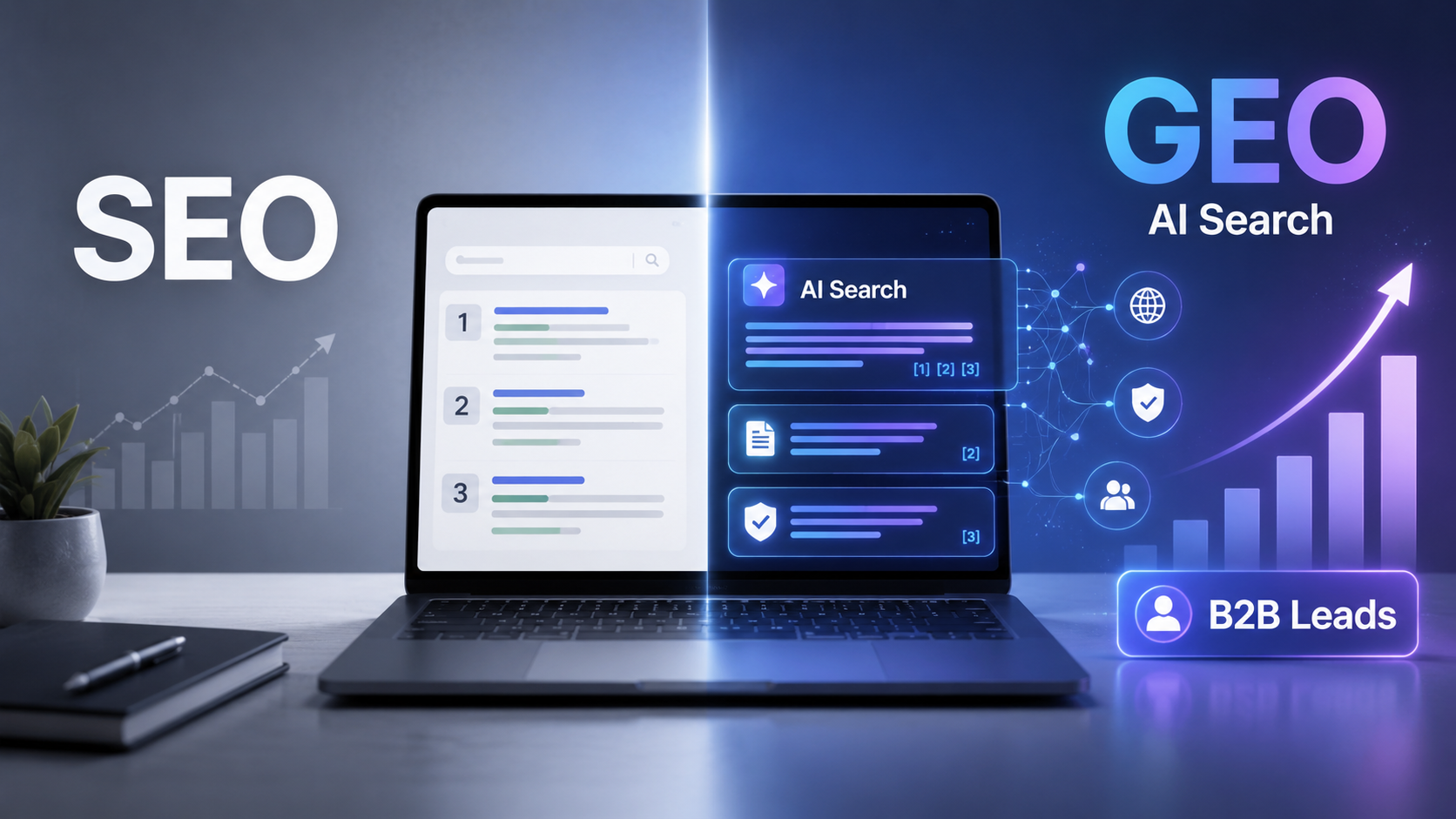
If you are tired of paying for "SEO" that produces activity but not qualified leads, you are not alone. The shift is simple: SEO fights for rankings. GEO fights for presence inside AI-generated answers. You need both, but you need them for different reasons and with different tactics.
Keep doing technical SEO and authority building, but start writing and structuring content so LLMs can confidently quote you. The winners will be the brands that are easy to retrieve, verify, and cite.
The CEO dilemma: great offer, invisible brand
Most B2B founders I talk to are not confused about their market. They are confused about execution:
- They know they should publish content, but they do not have time to manage writers.
- They have internal expertise, but it sits in Slack threads, sales calls, and docs.
- They have paid retainers before and got reports instead of leads.
The uncomfortable truth: your website can be technically fine and still be absent from AI answers. And if AI answers become the first touchpoint (often without a click), rankings alone stop being the whole game.
Personal insight: If you have limited bandwidth, do not start by "posting more." Start by deciding which 5-10 commercial problems you want to be found for (the questions a qualified buyer asks right before they shortlist vendors). Then build content assets around those problems with tight structure and evidence.
What is GEO (Generative Engine Optimization)?
Generative Engine Optimization (GEO) is the practice of making your content easy for AI systems to retrieve, understand, verify, and cite when generating answers.
In practice, GEO is influenced by how modern AI search works:
- LLMs (Large Language Models) generate responses, but increasingly rely on retrieval systems to pull facts from web sources.
- Many experiences are zero-click: users get an answer without visiting your site.
- Citations tend to favor sources that are clear, consistent, specific, and trustworthy.
AI search is not one thing. Google still matters, but so do conversational interfaces that can shape the shortlist before a buyer ever opens a SERP. For context, Google has publicly described how it uses AI in Search and how experiences evolve over time, including AI-driven result formats (Google Search updates).
Personal insight: GEO is not about tricking models. It is about removing ambiguity. If your positioning, service boundaries, and proof points are fuzzy, AI tools will either skip you or summarize you incorrectly. Clarity is a growth lever.
SEO vs GEO: the practical differences (table)
Here is the simplest way to remember it: SEO optimizes for rankings; GEO optimizes for being used as a source. You still want both because they reinforce each other.
| Category | SEO (Search Engine Optimization) | GEO (Generative Engine Optimization) |
|---|---|---|
| Main goal | Rank pages in search results (visibility + clicks) | Get cited/mentioned in AI-generated answers (visibility + trust) |
| Primary surfaces | Google SERPs, traditional rankings, featured snippets | ChatGPT-style answers, Perplexity citations, AI Overviews, conversational search |
| What you optimize | Technical health, internal linking, keyword mapping, backlinks | Entity clarity, factual precision, scannable structure, sourceability |
| Content format that wins | Comprehensive pages that satisfy query intent | Pages with explicit definitions, steps, constraints, examples, and references |
| Success metric | Rankings, organic traffic, conversions from clicks | Mentions/citations in AI answers, qualified referrals, brand inclusion in shortlists |
| Common failure mode | Lots of content, weak differentiation, slow results | Vague claims, inconsistent terminology, missing evidence, unclear service boundaries |
GEO does not replace SEO. Strong SEO fundamentals make your content more discoverable for retrieval systems. But GEO adds requirements SEO alone does not force you to meet: precision, verifiability, and "quotability."
How AI search changes B2B lead generation
Traditional B2B content assumed a linear journey: search - click - read - contact. AI changes that path:
- Summarization replaces browsing: buyers ask for comparisons, shortlists, and recommendations.
- Early filtering happens in-chat: your brand may be evaluated before your site is visited.
- Attribution becomes messy: you may influence the decision without a click, so you need to track outcomes differently.
Two concepts matter a lot here:
- Entity SEO: making your brand, services, and expertise unambiguous (consistent naming, clear definitions, strong "about" information, and aligned messaging across the web).
- RAG (Retrieval-Augmented Generation): many AI systems combine a model with retrieved sources. If your content is hard to parse or lacks concrete facts, it is less likely to be used.
For a high-level view of how retrieval-augmented approaches work and why sources matter, see the overview of retrieval-augmented generation in the ML community (Retrieval-augmented generation). You do not need to become an ML expert, but you should write like you want to be retrieved and quoted.
3 actionable steps to optimize for LLMs
If you want a plan that a founder can actually execute (without hiring a full content team), start here.
Step 1: Build a "prompt-to-page" map (not just a keyword list)
Keyword research still matters, but GEO starts with how buyers ask questions in natural language. Create a list of 10-20 buyer prompts that signal intent, for example:
- "Best software house for fintech MVP in Poland"
- "How to choose an agency for B2B SEO and AI search"
- "What is the difference between SEO and GEO for SaaS"
- "Alternative to monthly SEO retainer for lead generation"
Then assign each prompt to a specific page type:
- Definition pages (what it is, what it is not)
- Comparison pages (A vs B with constraints)
- Process pages (how you deliver, timelines, inputs)
- Risk pages (common mistakes, how to avoid them)
Personal insight: Founders often publish only "thought leadership". It feels safe, but it rarely converts. Your highest-leverage pages are the ones that answer uncomfortable commercial questions clearly: pricing drivers, trade-offs, who you are not a fit for, and what outcomes your process is designed to achieve.
Step 2: Make your content quotable (structure + specificity)
To make a page LLM-friendly, focus on conversational clarity and factual precision. A practical checklist:
- Define terms early in 1-2 sentences (SEO, GEO, entity, RAG).
- Use short sections with descriptive headings that match real questions.
- Add constraints: who it is for, who it is not for, prerequisites, timelines.
- Provide step-by-step lists that can be lifted into an answer.
- Keep claims measurable (avoid "best", "leading" without proof).
- Repeat core entities consistently (company name, service names, industries) across your site.
Also, do not ignore basics: clean HTML structure, fast pages, and clear internal linking still help discovery and comprehension.
Step 3: Strengthen trust signals beyond your website
AI systems tend to cite sources that appear credible across the web. You do not need endless backlinks, but you do need credible references and distribution. Focus on:
- Digital PR and mentions in relevant industry contexts
- Guest posts and co-created content with complementary brands
- Consistent founder and company profiles across key platforms
This is where a workflow matters. Rebell Way includes a Content Marketplace approach for finding content partners and collaboration opportunities, which can help you build authority without guessing where to start.
Why traditional SEO retainers fail (and why outcomes matter)
A lot of founders dislike SEO retainers for a rational reason: the incentives are often misaligned. You pay monthly for deliverables (articles, links, audits), but what you actually want is pipeline.
Common problems with the classic model:
- Output without strategy: content produced because "we need four posts a month".
- Slow feedback loops: weeks of work before you learn what converts.
- Low information gain: generic content that says what everyone already said, so AI has no reason to cite it.
In the AI era, generic content is not just ineffective. It can be invisible. GEO rewards pages that add something precise: a framework, a definition, a decision checklist, a clear process description, or a crisp comparison that reduces buyer risk.
Rebell Way is built around turning internal company knowledge into publishable SEO/GEO drafts quickly (so you are not blocked by content ops), then running an efficient review and publishing workflow. Importantly for skeptical CEOs, the philosophy is performance-oriented: we charge for results rather than selling endless activity.
Next steps and a realistic way to execute
If you want to capture B2B leads in the era of AI answers, treat this as a two-track system:
- SEO track (foundation): technical health, site architecture, intent mapping, internal linking, authority building.
- GEO track (visibility inside answers): entity clarity, quotable structure, verifiable claims, distribution that builds trust.
A practical way to start this month:
- Pick 5 core buyer prompts (the ones that lead to real sales calls).
- Create one strong page per prompt with definitions, constraints, steps, and a comparison table where relevant.
- Distribute 1-2 assets via partners (guest post, co-marketing, industry mention) to build credibility.
Ready to turn your firm’s expertise into content that can rank in Google and be cited in AI answers? Explore how Rebell Way supports SEO + GEO execution at Rebell Way.
FAQ
What is Generative Engine Optimization (GEO)?
GEO is optimizing your content so AI systems can retrieve it, understand it, verify it, and cite it in generated answers. It emphasizes clarity, entity consistency, and sourceable information.
Will AI search engines like ChatGPT replace Google SEO?
Not fully. Google remains a major discovery channel, but AI answer interfaces change how buyers shortlist vendors. SEO fundamentals still matter, while GEO helps you appear directly in AI-generated responses.
How can a software house generate B2B leads using GEO?
Focus on high-intent buyer questions, publish pages that are easy to quote (definitions, steps, constraints, comparisons), and strengthen trust signals through credible mentions and collaborations so AI systems are more likely to cite your content.
What should I measure if AI answers reduce clicks?
Track qualified leads and sales conversations first, then use assisted indicators like branded search growth, referral sources, and increases in mentions/citations across AI tools and industry publications.