
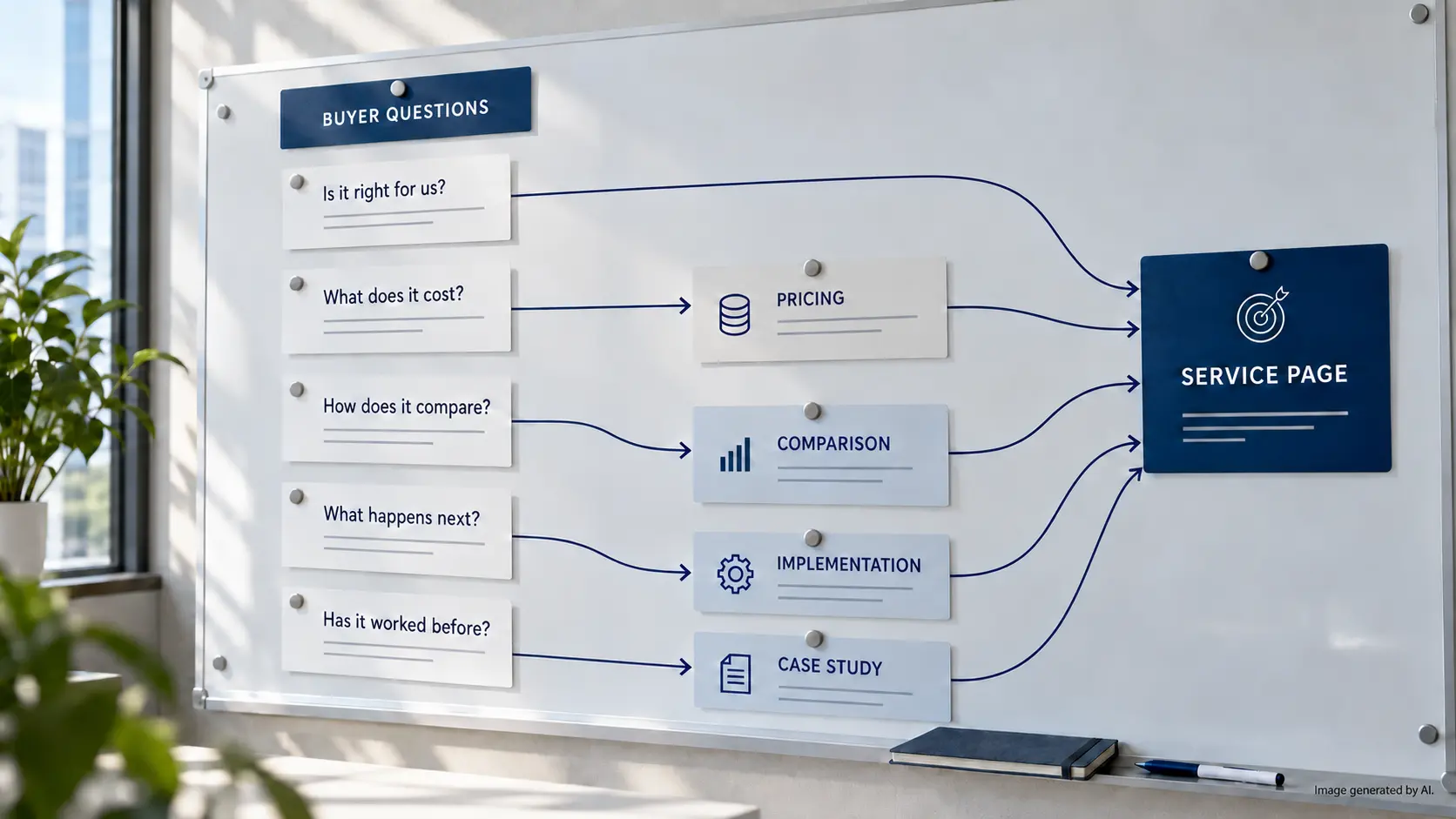
B2B buyers rarely arrive on your website thinking, “Show me your service page.” They arrive with questions from sales calls, internal meetings, procurement checklists and implementation worries. If those questions land on the wrong URL type (or on five URLs that all try to do the same job), your content becomes hard to rank and even harder to convert.
This article shows a practical way to take the questions your B2B sales team hears every week and map each one to the right page type: service page, pricing page, comparison/alternatives, implementation article or case study. The goal is simple: give every URL one primary purpose, then connect supporting content to the commercial page it should move prospects towards.
Definition (for clarity): B2B content mapping is the process of assigning real buyer questions to specific content types and URLs so each page matches a single intent (learn, compare, validate, buy) and supports the next step in the decision.
Start with real sales questions (and sort them by page type)
Start by collecting questions exactly as they’re asked. Don’t rewrite them into “marketing language” yet. Your first draft should sound like your pipeline: blunt, specific, sometimes awkward.
Here’s an illustrative set of questions a B2B sales team might hear across discovery calls, follow-ups and procurement:
- “What do you actually do, and who is this for?”
- “Is this SEO, content marketing, or something else?”
- “How do you price it? Monthly retainer or performance-based?”
- “What’s included, and what’s out of scope?”
- “How long until we see movement in Search Console?”
- “Do you work with UK B2B companies like us, or mostly e-commerce?”
- “How are you different from a traditional SEO agency?”
- “Do you use AI to write content? How do you stop it being generic?”
- “Can you work with our SMEs without dragging them into endless meetings?”
- “What do you need from us to get started?”
- “How do you handle approvals and brand voice?”
- “How do you measure success: rankings, traffic, pipeline?”
- “What happens if we already have content that’s not performing?”
- “How does this work with our existing dev and CMS setup?”
- “Can you show proof this works for a similar business?”
- “If we outsource publishing, who owns what and what’s the scope?”
Now sort each question into the page type that best answers it. You are not deciding what content to write first. You are deciding where each question belongs so the site stays clean.
- Service page: What you do, for whom, outcomes, approach, fit.
- Pricing page: How pricing works, what affects cost, packages/models, what’s included.
- Comparison/alternatives page: “X vs Y”, “agency vs in-house”, “SEO vs GEO”, “traditional retainer vs performance-based”.
- Implementation article: How delivery works in practice (process, inputs, timelines, governance).
- Case study: Proof, narrative, constraints, results context, what was done and why.
Practical insight: If your sales team repeats a question every week, it is not “just a sales objection”. It’s a search and evaluation task. The right content asset reduces repetitive calls and speeds up decisions.
Give each URL one primary purpose
The fastest way to dilute performance is to make every page do everything: educate, compare, sell, handle pricing, and explain delivery. That creates keyword cannibalisation and confused intent signals.
A better rule for B2B sites: one URL, one primary purpose. Supporting details are fine, but the page should be written to win one type of search intent.
How to decide a page’s primary purpose
- If the searcher wants to understand: article (informational) or implementation (how it works).
- If the searcher wants to evaluate options: comparison/alternatives.
- If the searcher wants to decide: service, pricing, or case study.
A quick “misfit” test
If you removed the CTA from the page, would it still make sense? If yes, it’s probably informational and belongs as an article. If no, it’s likely a commercial page (service/pricing) and should stay focused on decision support.
Practical insight: Most B2B service pages read like brochures. The ones that convert behave more like a calm, factual sales rep: they address fit, scope, risks, proof and next steps, without turning into a knowledge base article.
Check what you already have: merge, split, or redirect
Before creating new URLs, audit what already exists. Many marketing teams in the UK are operating with limited publishing bandwidth, so the highest ROI move is often consolidation.
Run a simple inventory
- Export all indexable URLs (from your sitemap, CMS export, or a crawl tool).
- Add columns: page type (service/pricing/comparison/implementation/case study/article), primary query, stage (learn/compare/decide), and “kept/merge/split/retire”.
- Highlight pages that target similar intent with overlapping keywords.
Common fixes
- Merge: three thin blog posts all trying to answer “what is X” become one strong guide.
- Split: a service page that contains 1,500 words of “how it works” becomes a focused service page plus a separate implementation article.
- Redirect: outdated posts that compete with your main comparison page are redirected to the best URL.
This creates a clear structure where supporting pages push authority and users towards the commercial page that should rank for the decision query.
Map questions to service, pricing, comparisons, implementation and case studies
Below is a practical mapping approach you can reuse. Take each buyer question and decide: what is the buyer trying to accomplish in their head?
1) Service page questions (decision: “Is this for us?”)
Best for: the core “what you do” query, fit, scope, outcomes, and how you work at a high level.
Buyer questions that belong here:
- “What do you actually do, and who is this for?”
- “Do you work with UK B2B companies with long sales cycles?”
- “What does an engagement look like month to month?”
What the page should contain:
- Clear service definition in plain English.
- ICP fit and non-fit (who it’s for, who it’s not for).
- Method overview (without drowning in delivery detail).
- Proof assets linked out (case studies, process articles, comparisons).
What it should not try to do: replace your implementation article or pricing page.
2) Pricing page questions (decision: “Can we afford this and how does pricing work?”)
Best for: pricing model explanation, what drives cost, what’s included, how measurement works, and procurement readiness.
Buyer questions that belong here:
- “How do you price it: retainer or performance-based?”
- “What’s included, and what’s out of scope?”
- “What do you measure and report on?”
Practical insight: Pricing pages reduce drop-off even when you can’t publish exact numbers. B2B buyers often just need enough clarity to know whether to progress and how to budget.
3) Comparison/alternatives questions (consideration: “Which option is best for our situation?”)
Best for: evaluation and differentiation, especially when buyers are shortlisting vendors or approaches.
Buyer questions that belong here:
- “How are you different from a traditional SEO agency?”
- “Should we hire in-house content people or outsource?”
- “Is this SEO, GEO, or both?”
Content pattern that works: define both options fairly, explain trade-offs, and give a decision framework. Comparisons often earn high-intent organic traffic because searchers include words like “vs”, “alternative”, “best”, “agency”, “in-house”, “retainer”.
You can also support this content with a relevant operational piece like Outsourcing B2B content publishing: what should be in the scope of work if the buyer question is really about responsibilities and process risk.
4) Implementation questions (post-signature anxiety: “How will this work in the real world?”)
Best for: explaining inputs, timelines, approvals, stakeholders, and the “day-to-day reality” of delivery. This is often the content type missing on B2B sites, even though it unblocks deals.
Buyer questions that belong here:
- “What do you need from us to get started?”
- “How do you handle approvals and brand voice?”
- “Can you work with our SMEs without dragging them into endless meetings?”
- “How does this fit with our CMS and dev process?”
What good implementation content does: reduces perceived risk. It should read like a clear internal handover doc, not a marketing page.
If AI-assisted production is part of your workflow, implementation content is also where you explain guardrails. A helpful supporting read is How to test an AI content platform before rolling it out across your marketing team.
5) Case study questions (proof: “Can you show this works?”)
Best for: credibility and specifics. A case study is not a list of deliverables. It’s a buyer’s “risk reducer”.
Buyer questions that belong here:
- “Can you show proof this works for a similar business?”
- “What happens if our existing content isn’t performing?”
- “How do you measure success beyond rankings?”
When you do have a story to share, link it as proof, for example: From 0 to 9k organic impressions.
Connect supporting content to the commercial page
Once each question has a home, connect the pages so the journey is deliberate.
A simple internal linking pattern that works
- Articles (learn): link to the most relevant comparison page (“If you’re weighing options, see X vs Y”).
- Comparison pages (evaluate): link to the service page (fit + approach) and pricing page (commercial clarity).
- Implementation articles (delivery): link to service and pricing, plus to 1-2 proof assets (case studies).
- Case studies (proof): link back to the service page and the implementation page (“what we did and how it worked”).
This structure helps SEO because it builds topical authority around a commercial area. It also helps buyers because they can self-serve the next question without booking another call.
Practical insight: When internal resources are tight, don’t aim to publish “a lot”. Aim to publish “connected”. Five pages that clearly support one commercial page often outperform 20 disconnected blog posts.
A compact before-and-after sitemap
Here’s what this often looks like in practice. The point is not to copy the exact URLs, but to see the shift: from overlapping pages to a structure where each URL has a job.
Before (common pattern)
- /services/seo
- /services/content-marketing
- /blog/what-is-geo
- /blog/seo-vs-geo
- /blog/our-process
- /blog/pricing
- /blog/ai-content
- /blog/outsourcing-content
After (one purpose per URL, supporting content connected)
- Service page: /services/performance-based-seo-organic-growth
- Pricing page: /pricing
- Comparison page: /compare/performance-based-seo-vs-traditional-seo-retainer
- Implementation article: /blog/how-our-seo-geo-content-growth-system-works
- Supporting articles: /blog/seo-vs-geo, /blog/how-to-test-an-ai-content-platform-before-rolling-it-out-across-your-marketing-team
- Case study: /from-0-to-9k-organic-impressions
Notice what changed: “pricing” and “process” are no longer buried as blog topics. They become purposeful pages that reduce friction for buyers who are close to a decision.
SEO vs GEO: how mapping helps Google and AI search
Many B2B teams now have to win in two environments at once: classic search results and AI-powered answers. Mapping buyer questions to the right content types helps with both, because it forces specificity, clear structure and unambiguous intent.
| Dimension | SEO (traditional search) | GEO (AI search and answer engines) |
|---|---|---|
| Main goal | Rank pages for relevant queries and earn clicks | Be referenced, summarised, and recommended in generated answers |
| What tends to perform | Pages tightly matched to search intent (informational vs commercial) with clear internal linking | Specific, well-structured explanations that address real questions with grounded details and clear definitions |
| Risk if content is unfocused | Keyword cannibalisation, weak rankings, low CTR | AI systems may ignore or misinterpret your positioning because signals are mixed or vague |
| How content mapping helps | Creates a clean site architecture where each URL targets one purpose and clusters support commercial pages | Creates a library of explicit Q&A-style content across decision stages, which is easier to summarise accurately |
| How to measure | Search Console impressions/clicks, rankings, organic sessions, assisted conversions | Mentions and citations in AI results (where available), branded query growth, and downstream organic performance |
If you want a deeper view on choosing a partner for AI visibility work, see How to choose a GEO agency or AI visibility partner (2026 guide).
How Rebell Way helps teams do this without a huge content team
At Rebell Way, we build content growth systems that start from company knowledge and real buyer questions, then turn that into a connected set of pages and articles designed to support commercial outcomes. In practice, that means:
- Content Strategy & Topic Planning: deciding what belongs on service/pricing/comparison pages vs supporting articles, and how they interlink.
- SEO & GEO Content Growth System: creating and publishing content on your site, then monitoring what gains traction and expanding what works.
- SEO/GEO Article Generation: producing knowledge-grounded drafts faster, while avoiding generic output and keeping alignment with your positioning.
For a B2B Marketing Manager with limited internal resources, the real win is not “more content”. It’s a repeatable way to keep the site coherent while increasing coverage of the questions that influence deals.
If you want to sanity-check your current structure and see the fastest opportunities to improve it, use Rebell Way’s Organic Website Potential Assessment to identify where you have gaps, overlaps, and pages that should be promoted from “blog post” to “commercial asset”.
FAQ
What is B2B content mapping?
B2B content mapping is assigning buyer questions to specific content formats and URLs (service, pricing, comparison, implementation, case study, or article) so each page matches one intent and supports the next step in the buying decision.
How do you find out what questions B2B buyers are asking?
Start with sales call notes, CRM fields, onboarding docs, proposal objections, and support tickets. Then confirm with Search Console queries and on-site search terms to spot the language buyers use before they convert.
Which content formats work best for the B2B consideration stage?
Comparisons and alternatives pages usually perform best because the buyer is evaluating options (“X vs Y”, “best approach”, “agency vs in-house”). These pages should link directly to the relevant service and pricing pages.
How does content mapping support SEO and GEO?
For SEO, mapping prevents overlapping pages and strengthens internal linking to your main commercial URLs. For GEO, it creates clear, specific answers that AI systems can summarise accurately, improving your chances of being referenced in generated results.