
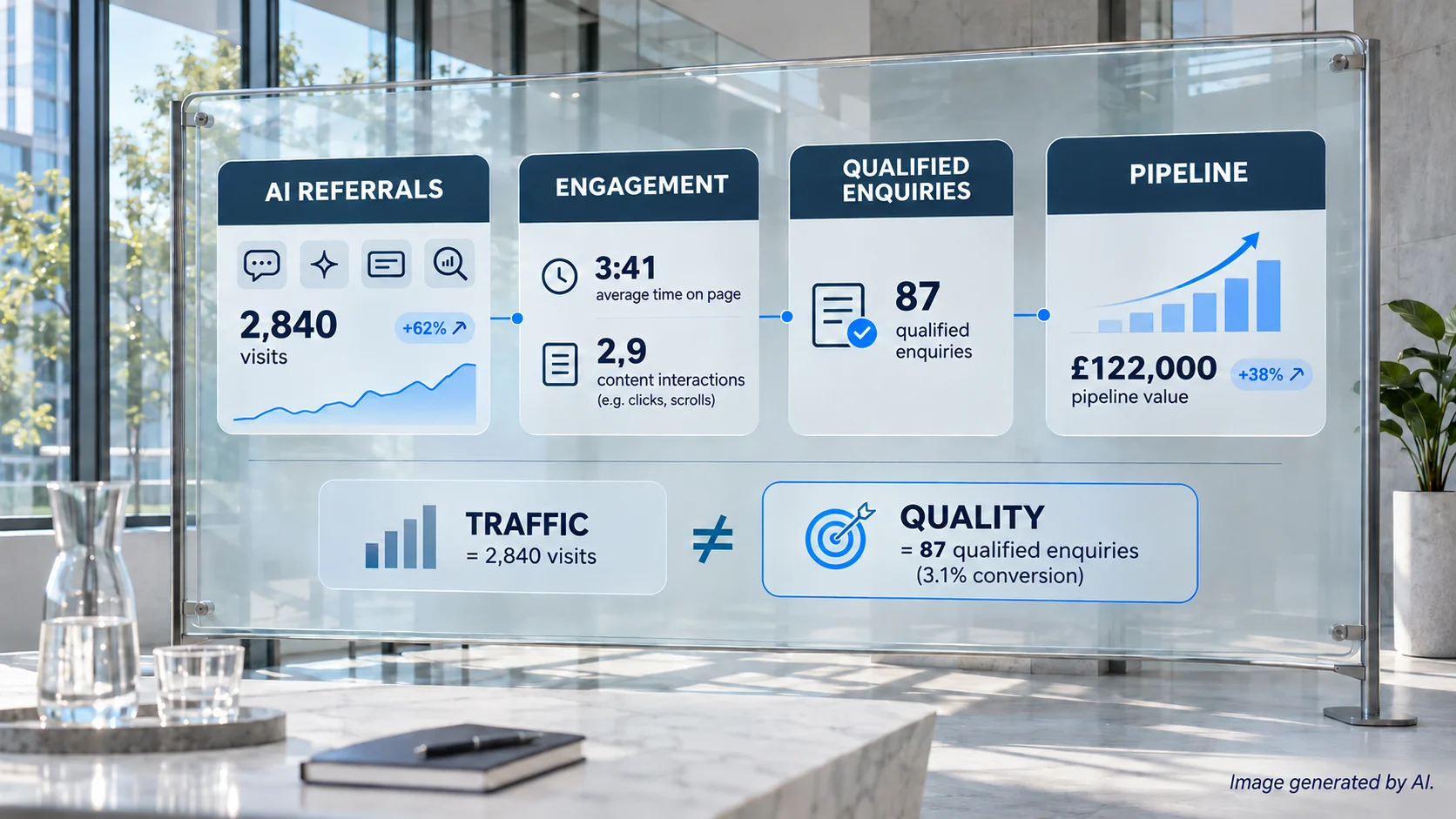
If you suspect ChatGPT, Perplexity, or Gemini are helping, but your GA4 reports show almost nothing - you are not imagining it. AI referrals create an attribution gap: a lot of influence happens before, during, or after a click that standard analytics can’t reliably capture.
This guide shows a measurement path you can implement with a busy B2B marketing team. You will track AI referrals in GA4, collect self-reported attribution from real buyers, and evaluate GEO performance using KPIs like AI Citation Frequency, Share of Voice, and Answer Inclusion Rate - then connect those signals to qualified enquiries quality.
Why AI breaks standard reports (and why clicks are not enough)
AI assistants change how people discover and decide. Instead of only searching, users often receive an answer summary and recommendations directly. That creates two separate effects:
- Trackable influence: sessions that you can identify as coming from AI referrals in GA4.
- Untrackable influence: AI’s role in shaping the decision even when there is no immediate, measurable click from the assistant.
In many setups, the trackable portion can be small compared to classic search traffic. But “small in GA4” does not mean “small in impact”. The missing part is that the decision journey can unfold across multiple steps and channels, sometimes with later return traffic that overwrites the original referral context.
Key practical point: measuring only sessions from AI will often understate value. Measuring only AI citations will not tell you whether those citations lead to qualified enquiries.
| Concept | What you can measure confidently | What remains uncertain |
|---|---|---|
| AI referrals (GA4) | Sessions/referrals you can identify; engagement and conversion events on your site | Whether AI influenced the buyer before landing, or after leaving |
| AI visibility (GEO KPIs) | How often your brand/content is cited or included in AI answers for defined query sets | Whether visibility translates into pipeline quality, not just mentions |
| Attribution gap | Captured via buyer self-report and structured intake questions | Exact causality and timing (what AI did vs what happened later) |
Treat AI measurement as a two-layer system: “where we can see the click” + “where we can learn the role”. If you do not plan both layers, the team will either overclaim or underuse AI findings.
How to track AI referrals in GA4 (technical setup)
Start with what you can measure immediately: isolate AI referrals in GA4 as a separate reporting path. The goal is not perfect attribution; it is repeatable visibility into AI-assisted sessions, landing pages, engagement, and on-site conversion events.
Custom Channel Group: build an “AI Assistants” channel
In GA4, you typically group traffic by source and medium. You want a dedicated group (e.g., “AI Assistants”) so you can compare:
- Sessions: AI referral-driven sessions
- Engagement: engagement rate, key user actions
- Conversions: leads, demo requests, contact form events
- Journeys: user paths from AI referral to your target pages
Implementation approach: use Custom Channel Group rules based on known referrer patterns (source/medium rules and/or matching conditions for AI assistant domains and parameters).
Use Regex to match variable referrers (a small example)
AI referrals can vary in how the referrer shows up. Sometimes the platform domain is stable; sometimes referrer values differ by parameters. Use Regex rules to catch known patterns without mixing unrelated traffic.
Example starting point (adjust to your referrer data):
.*(chatgpt\.com|openai\.com).*
Then create similar patterns for Perplexity and Gemini based on what you actually see in GA4 referrer source lists.
Practical tip: Before going broad, run a short data collection window (for example 7 days). Review the unique referrer sources and the landing pages they hit. If you see overlap with paid traffic, partnerships, or generic referral sources, tighten your Regex rules.
Define your “AI analysis landing page set”
AI-assisted sessions often start on different page types than classic search. For B2B, prioritize a set of URL types that match decision-stage intent, such as:
- Problem-solution pages
- Comparisons
- Process explainers
- Service/category pages
- Use-case guides
Practical plan: pick 10-30 URLs that commonly receive intended entry traffic. Then evaluate:
- Intent alignment: do AI referrals land on higher-intent pages (e.g., process, comparison, “how to choose”)?
- Intent shift: does the share of high-intent landings increase over time?
- Lead differences: are conversion rates or lead quality meaningfully different for those journeys?
Close the attribution gap with self-reported attribution
If you want to answer “Do AI referrals generate qualified enquiries?”, you must measure the role of AI in the decision. Click data alone will not deliver that reliably. The solution is structured self-reported attribution collected from real leads at the moment they show intent.
Ask immediately after a clear intent signal
The highest-quality buyer input comes right after intent appears, for example:
- After form submission
- During registration for a consultation
- In the first meaningful sales contact workflow
Keep it short. If you make this question too complex, you increase drop-off and reduce data quality.
Suggested question: “How did you find us?”
- Options: Google, LinkedIn, recommendation, event, AI assistant (ChatGPT/Perplexity/Gemini), other
Useful tip: Add a controlled free-text “Other” field, but keep it minimal. You want the team to code answers consistently, not debate them ad hoc.
Go beyond “source”: categorize AI’s role in the journey
One question should capture not only that AI was involved, but how it was involved. A practical categorization:
- AI as a starting point: AI led to your initial discovery
- AI as support: AI helped compare options, prepare questions, or confirm a shortlist
- AI as retarget: AI influenced later exploration, but was not the first entry source
This helps the sales and marketing teams interpret lead quality without pretending GA4 has the full truth.
Expect mismatches - treat them as diagnosis
You will see typical patterns:
- More AI citations, fewer leads: your brand may be present in answers, but not in contexts that trigger action
- More AI referrals, no quality leads: landing pages and content may not match the questions’ intent or decision stage
- Better lead quality, stable citations: AI may support evaluation in ways that citations don’t fully reflect (and clicks may happen later through other channels)
What you can report confidently: directionality (is the system improving), differences in lead quality, and changes in inclusion/visibility for defined query sets.
What stays uncertain: exact timing and causality (“AI caused this enquiry”) cannot be proven with click analytics alone. Your self-reported data reduces uncertainty, but it does not create perfect attribution.
GEO KPIs that matter more than mentions
Generative Engine Optimization (GEO) shifts focus from positions and classic clicks to how your brand appears inside AI answers. To evaluate whether AI referrals are worth the effort, you need visibility KPIs defined for measurable query sets.
AI Citation Frequency
AI Citation Frequency measures how often your brand or your content is cited in AI answers. Use it to track improvements after content updates and information-structure changes.
Share of Voice in AI
Share of Voice indicates how often your brand appears relative to competitors within chosen topical categories. This is most useful when you want a defensible competitive story, not just a “we got more mentions” narrative.
Answer Inclusion Rate
Answer Inclusion Rate shows whether your brand is included in responses for specific query types (e.g., comparisons, supplier selection, process steps). Define query sets that represent decision contexts, not only informational curiosity.
Practical insight: Keep query sets stable for reporting periods. If you constantly change which queries you monitor, you will struggle to interpret progress and will overreact to noise.
A measurement path from landing page to sales feedback
To answer your main question, build an end-to-end measurement path from landing page to sales-qualified enquiry, including what happens when referrer data is missing.
Illustrative measurement path
- AI discovery (GEO visibility): your brand is cited/included for decision-stage query sets
- AI referral (GA4): user lands on your site via identifiable AI referral and triggers engagement
- Intent action: lead event happens on-site (form submit, demo request, consultation)
- Self-reported role: lead answers “How did you find us?” and chooses AI assistant role (start/support/retarget)
- Sales qualification: CRM workflow assigns enquiry quality (fit, priority, next step)
- Closing feedback loop: sales records whether the enquiry progressed, stalled reasons, and whether AI was referenced in discovery calls
Qualification criteria (define with sales, in writing)
Before you analyze results, align on what “qualified enquiry” means. Example qualification dimensions:
- ICP fit: the company and use-case match your target segment
- Intent strength: urgency and readiness signal
- Capability fit: you can deliver the requested service/product scope
- Next step: meeting booked, technical scoping, proposal stage, etc.
Boundary note: This measurement plan focuses on acquisition measurement (whether AI referrals and GEO lead to qualified enquiries and pipeline progression). It does not cover pricing or contractual model details of performance-based partnerships.
How to handle missing referrer information and complex journeys
In practice, you will encounter several gaps:
- No referrer captured: browsers/app privacy settings, client-side redirects, or tracking gaps can remove the referrer. In those cases, rely on self-reported attribution rather than assuming “not AI”.
- Later visits through another channel: a lead may first land via AI, then return later via email, branded search, or LinkedIn. GA4 will often attribute conversions to the last measurable channel, not the original AI role.
- Journeys without a click: the user might read AI output, then only later search or contact you through another route. This is exactly why the self-reported question matters.
- Small samples: early-stage tracking often yields low counts. You should report changes directionally and avoid overinterpreting single-week fluctuations.
What you can report with confidence during small samples:
- Consistency of setup: referrals are being captured into “AI Assistants”
- Differences in intent landings: are AI referrals hitting decision-stage pages more often?
- Enquiry role patterns: does self-reported AI role correlate with higher enquiry quality?
What you should label as uncertain:
- Strict attribution: “AI caused pipeline value” cannot be proven without additional instrumentation
- Revenue attribution: do not equate citations or enquiries counts directly with revenue
Reporting template and qualification criteria (with sales)
Use a compact reporting approach so the Head of Marketing can track progress without drowning in dashboards. The aim is to connect GEO visibility and AI referrals to qualified enquiry outcomes.
Compact KPI table (example structure)
GEO visibilityGEO inclusionAI referralsOn-site intentBuyer roleSales qualificationPipeline feedback| Stage | KPI | How to measure | Confidence |
|---|---|---|---|
| GEO visibility | AI Citation Frequency | Monitor defined query sets and track citation changes over time | High for visibility; medium for causality |
| Share of Voice in AI | Compare brand mentions vs competitors within topical categories | High for relative presence | |
| Answer Inclusion Rate | Track whether brand is included in decision-type answer templates | High for inclusion; medium for conversion | |
| AI Assistants sessions (GA4) | GA4 Custom Channel Group + Regex matching | High for captured sessions; uncertain for “no-click” journeys | |
| Lead conversion rate (AI channel) | Compare lead event rate for AI Assistants vs baseline channels | Medium (last-click bias possible) | |
| Self-reported AI role (start/support/retarget) | CRM or form question coding into categories | Medium-high (subject to buyer recall) | |
| Qualified enquiry rate | CRM outcome based on agreed criteria | High if CRM coding is consistent | |
| Enquiry progression + stalled reasons | Sales notes coded into standard fields | Medium (depends on sales discipline) |
Qualification criteria with sales: keep it operational
Create a shared definition and a simple training checklist so your sales team codes consistently. Minimum recommendation:
- Fit categories: fit / partial / out of scope
- Next step outcome: meeting booked / technical scoping / proposal / no next step
- Stall reasons: missing requirements, timing, budget, competitor already chosen, etc.
Worth remembering: Report two numbers separately: (1) whether enquiries are qualified, and (2) whether they progress. AI-driven visibility may increase initial enquiries, but progression quality is what typically signals true GEO value.
Your 30-60 day implementation checklist
Here is a realistic plan you can run without waiting for perfect analytics or an unlimited content calendar.
Days 0-15: data foundation
- AI identification: collect observed AI referrer patterns in GA4 (sample window) for ChatGPT, Perplexity, Gemini
- GA4 setup: create “AI Assistants” Custom Channel Group and tighten Regex rules
- Landing page set: define 10-30 URLs that represent higher-intent decision stages
- Conversion events: confirm lead events and ensure they fire reliably
Days 15-30: self-reported attribution
- Form question: add “How did you find us?” at the moment intent appears
- AI role categories: code AI as start/support/retarget
- CRM alignment: define who codes responses and how (fields, categories, and standard options)
- Sales briefing: explain why you ask and what “qualified enquiry” means operationally
Days 30-60: interpretation and prioritization
- Weekly snapshots: review AI referrals, landing intent alignment, and self-reported role distribution
- GEO KPI updates: track AI Citation Frequency, Share of Voice, and Answer Inclusion Rate for stable query sets
- Diagnosis: use mismatches (visibility vs leads vs quality) to decide what to change next
- Priorities for content and structure: adjust page types, internal linking, and information structure based on where qualified enquiries are coming from
If you want a structured starting point (for example, deciding what to fix first and which query gaps matter), Rebell Way supports teams with a Google & AI Visibility Report and Growth Potential Assessment and turns results into a practical SEO/GEO Visibility Strategy & Topic Planning workflow. This helps you focus efforts on the decision-stage topics most likely to support qualified enquiries.
One clear next step: Talk to Rebell Way about a GEO visibility strategy and measurement plan for your company.
FAQ
How do I track AI referrals in GA4 for ChatGPT and Perplexity?
Create a GA4 Custom Channel Group for “AI Assistants” and use source/medium rules and Regex matching for the referrer patterns you observe in GA4. Verify your landing pages during a short data collection window.
What is the attribution gap in AI search measurement?
How should I collect self-reported attribution from leads?
Ask a short question right after an intent event (form submit, consultation registration). Offer an “AI assistant” option and categorize the role (start/support/retarget) to help interpret lead quality.
Which GEO KPIs should we track to evaluate AI-driven value?
Use AI Citation Frequency, Share of Voice in AI, and Answer Inclusion Rate for stable, decision-stage query sets. Then connect them to enquiry conversion and sales qualification outcomes.