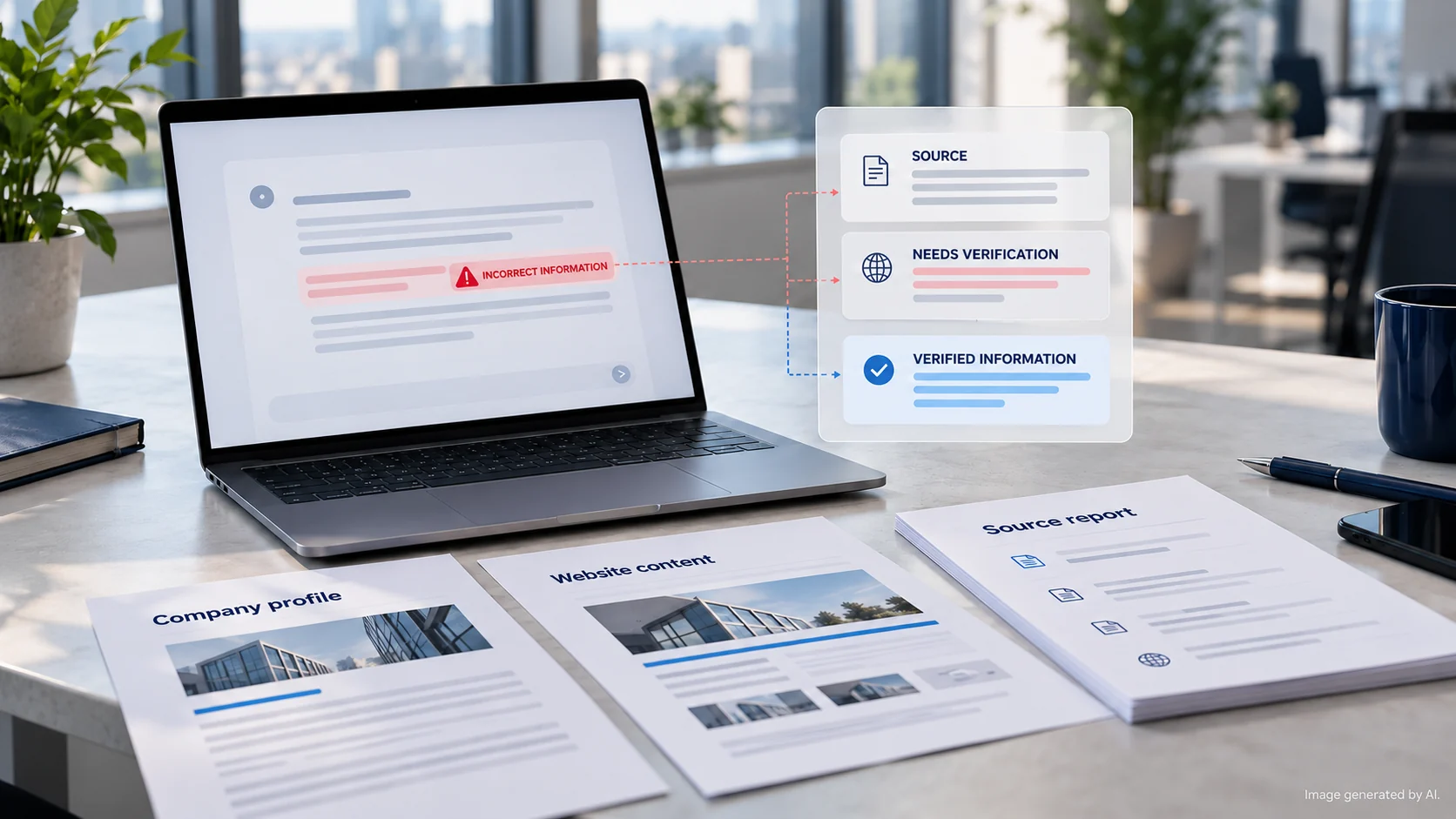
If ChatGPT, Gemini, or Perplexity states wrong facts about your company, treat it like a brand risk - not a harmless glitch. The same error can reappear after model updates because AI answers often combine multiple inputs, including sources you do not control.
To fix it properly, you need an investigation process that records what was said, when it was said, and where it likely came from. Then you correct the underlying sources and publish grounded content that makes it harder for AI to guess.
Why AI Wrong Facts Are a B2B Risk
B2B buyers use AI assistants to speed up early research. They ask questions such as:
- What does your company offer?
- Where are you located and how can they contact you?
- How do your services work and what is your pricing model?
- Who are your competitors and what are you compared against?
The issue is not just “confusing” answers. AI responses can be confident and wrong. When incorrect details reach a decision-maker early, the damage often happens before your team gets a chance to clarify - and the fix later becomes harder because the incorrect narrative may already be remembered and repeated internally.
Why LLMs Get Your Company Wrong
Large language models can generate an answer even when they do not have reliable, up-to-date grounding. In practice, errors usually come from one or more root causes:
1) Incomplete or ambiguous info on your side
If your website does not clearly cover a buyer’s key question (scope, pricing model, delivery constraints, locations, ownership), AI may infer missing parts. Even when your homepage looks correct, the specific details the buyer asks for may not be stated unambiguously.
2) Outdated or low-quality third-party inputs
AI systems often pull from structured databases and indexed web content. When those inputs are stale or incorrect, AI may “choose” one of the conflicting versions.
Common examples of external sources include structured company datasets and directories such as Wikidata, Crunchbase, LinkedIn profiles, and review/agency platforms like G2 or Clutch, as well as business directories and syndicated pages.
3) Fragmented entity signals
AI tries to connect mentions into a single “entity”. If your brand appears with inconsistent naming, mixed location details, unclear ownership, or mismatched service descriptions across channels, systems can merge signals incorrectly.
4) The format of the answer doesn’t match the facts you publish
You can be accurate overall, but still fail a specific query format. For example, you may explain your services well, but if the buyer asks for a “pricing range” and your site does not provide it (or provides it differently), AI may respond with something plausible - and wrong.
Key takeaway: There is rarely a single “edit” switch. The effective fix reduces ambiguity and strengthens the sources AI relies on - owned pages and credible external references.
| Channel / System | What it does for company facts | Why wrong answers can persist |
|---|---|---|
| Ranks and surfaces indexed pages and structured signals | Indexing and snippet logic can differ from AI grounding | |
| ChatGPT / Gemini (LLMs) | Generates answers using training + retrieved/available sources | Retrieval may use outdated third-party data; caching and reprocessing take time |
| Perplexity (AI search) | Answers with web-grounded browsing behavior | It may cite sources that were updated elsewhere, but not yet in the browsing index |
| Your website & profiles | Owned “source of truth” and entity clarification | AI may not access the exact page fragment needed for the buyer’s question |
How to Investigate (Without Guessing)
Before you change anything, record the evidence. This step prevents expensive “patches” that fix the wrong thing, or corrections based on unsupported assumptions.
1) Record the question exactly
Copy the exact prompt the stakeholder used (including wording like “price”, “location”, “competitors”, “company closed”, or “does not exist”). If you can, include the context from the user (e.g., “for a B2B supplier in PL”).
2) Record the response exactly
Save the full answer text, bullet points, and any claims about ownership, locations, services, or pricing. Capture citations if the tool provides them.
3) Record the date and the tool configuration
Note the date, the AI engine used, and any mode (default vs. “search/browse” where applicable). If you are using more than one tool, record each separately.
4) Record the tool’s cited sources (if shown)
If the system provides links or sources, save those URLs. If it does not show sources, still record that fact; you will need to verify likely inputs through other steps.
5) Record your own “ground truth” reference
Link internally to the pages that should be considered authoritative (e.g., your service pages, contact details, pricing model page, or ownership/company profile pages). Do not rely on memory.
Practical insight: If you only screenshot the incorrect sentence, you may miss the real root cause. AI answers can be built from multiple fragments - the “headline” claim may be the least important part.
Step 1: Run an AI & Google visibility diagnosis
Monitoring only Google is not enough. AI answers may rely on different inputs and can change. A structured Google & AI Visibility Report and Growth Potential Assessment helps you see:
- where your brand appears in AI answers today,
- where it is missing,
- which details appear incorrect or incomplete, and
- which areas of your owned content and external signals are likely responsible.
Use the diagnosis to set priorities. It is a starting point for investigation - not an instant guarantee of AI wording changes.
Step 2: Compare “what AI says” vs. “what you actually publish”
When you find an incorrect answer, map the error to likely source categories:
- Wrong offer scope: verify your service definitions, delivery model, and positioning pages.
- Wrong pricing model: check whether pricing structure is explained clearly (and consistently) across relevant pages.
- Wrong location/contact details: verify core business information across your authoritative references.
- Wrong competitors or comparisons: review how your content defines your category and differentiators in grounded terms.
Practical insight: A “Google looks fine” outcome does not prove that AI is grounded in your latest pages. AI may summarize older third-party content, cached pages, or structured datasets that still contain outdated fields.
Step 3: Distinguish - and document - what can and cannot be corrected
This is where many teams waste time: they try to “correct” the AI output inside the chat. In reality, correcting a response in a conversational thread does not reliably update the underlying model’s knowledge, its retrieval behavior, or the upstream sources used for grounding.
Practical insight: Treat chat-based corrections as communication, not as data updates. The work needs to target source-level inputs (owned pages and credible external references), plus an evidence-backed content plan.
Also set expectations: there is no guaranteed timetable for when AI systems will reprocess, recrawl, and update answers. Your goal is to reduce the probability of incorrect outputs by improving the source signal quality, then verify results over time.
Correction register (use this template internally)
Maintain a simple register for every incorrect claim you find. It prevents repeated work and makes ownership clear between marketing, web, and external profile owners.
| Observed claim (from AI) | Response date & tool | Likely source owner | Evidence / cited URLs | Proposed action | Retest status |
|---|---|---|---|---|---|
| Example: “Company offers X service” | 2026-11-12, ChatGPT | Third-party directory + your site | Cited URL A, and your updated service page | Update directory listing; update service page scope language; align entity details | Not retested / retested - results pending |
When possible, verify your reporting or correction mechanisms against current official documentation for each platform. If a directory or dataset has a new process, older instructions can lead to delays or failed submissions.
How to Respond in the Right Order
Once you have evidence and likely source categories, fix in an order that reduces downstream confusion.
Step 1: Identify the source behind the wrong fact
Do not patch symptoms without changing the cause. Ask: which input category can explain the AI answer?
- Outdated third-party listing (owned by someone else)
- Outdated page (owned by you, but still publicly accessible or referenced elsewhere)
- Missing explanation (your site lacks the needed detail/format)
- Inconsistent entity signals (your brand details differ across channels)
Step 2: Correct public business facts and update your website
For most issues, the fix includes two parallel tracks:
- Correct public business facts on external sources where they are wrong (so independent inputs can align with reality).
- Update your own site so the specific buyer question is answered clearly and consistently.
After changes, allow time for reprocessing. Crawling, re-indexing, and model retrieval behavior are not instant - and AI answers can change in either direction as systems evolve.
Step 3: Build an “AI-friendly” content ecosystem
AI summarization works better when your content includes the parts that buyers and models need to answer precisely:
- Clear service definitions (what you do and for whom)
- Documented scope and process (how delivery happens)
- Proof of expertise grounded in what you actually do
- Consistent brand and business details across pages
Important: This is not about flooding the internet. It is about having the right pages and the right wording so AI can summarize accurately.
What to Publish Next (GEO-Style)
Fixing one page at a time can work, but teams often lose momentum. A more effective approach treats AI misinformation as a content planning and authority-building problem.
Choose direction with SEO/GEO Visibility Strategy & Topic Planning
Rebell Way’s SEO/GEO Visibility Strategy & Topic Planning translates your diagnostic findings into a plan. It links:
- business goals, personas, and products/services,
- buyer questions and decision criteria,
- content gaps and competitive coverage, and
- where content should live (owned vs. external sources).
You get a structured action map for your team, including which topics and clusters to build, refine, or update. Planning is not the same as execution - you still need a content workflow for delivery and ongoing updates.
Practical insight: If AI keeps getting “competitors” wrong, do not only add a “competitors” section. Consider also category accuracy pages that define the space and differentiators using factual delivery constraints, typical deliverables, and buyer selection criteria.
Where external profiles are part of the root cause, connect the content plan with those sources. Where it is missing, update the specific question the buyer asks (not just a general service overview).
One clear checklist for “what to publish”
- Pages that define your offering and scope in one place
- Pages that match key buyer questions (including pricing model explanation)
- Pages that clarify geography/contact and ownership details consistently
- External confirmations that align with your updated owned content
The Long Game: Ongoing AI Reputation Management
After you fix today’s incorrect answers, you are not “done”. Models update, external sources change, and new mentions appear. Ongoing monitoring helps you catch regressions and keep your priorities grounded in reality.
Visibility monitoring & ongoing prioritisation
Rebell Way’s SEO/GEO Visibility Monitoring & Ongoing Prioritisation supports continuous decision-making by checking changes in:
- Google visibility signals,
- mentions and citations in AI contexts, and
- how AI answers evolve over time for the same or similar prompts.
Practical insight: Do not equate “more AI mentions” with “more sales”. Mentions can increase even if the content quality is not aligned with buyer intent, or even if the answers mention the wrong offering scope.
Use monitoring to update priorities for content and external source alignment. It should complement - not replace - diagnosis and content production.
FAQ
Why does ChatGPT say my company is closed or inactive?
Most often, the answer is driven by outdated third-party signals or directories, not by your current website. Verify your business details across the external sources that may feed AI, then update and retest over time.
How long does it take for AI to update after we fix our website or profiles?
There is no guaranteed timetable. Reprocessing depends on crawling, indexing, and each AI system’s retrieval behavior. Plan for a retest window and track changes with an evidence register.
Can I correct the information inside the chat and rely on it permanently?
Chat corrections do not reliably update the underlying grounding sources or the system’s retrieval behavior. The stable fix is source-level correction (owned pages and credible external references), followed by verification.
What should we do when AI cites wrong external links?
Start by saving the cited URLs and recording the tool/date. Then verify whether the sources are outdated, misattributed, or missing ownership context. Correct the source if you control it, or submit an update through the source provider’s current process.
Next steps
Begin with an evidence-led diagnosis: capture the exact prompts and AI responses, identify likely source categories, then prioritize corrections in owned content and credible external references. If you want a structured starting point for what to fix first, use Rebell Way - Google & AI Visibility diagnostic support to align investigation with a GEO-ready plan.