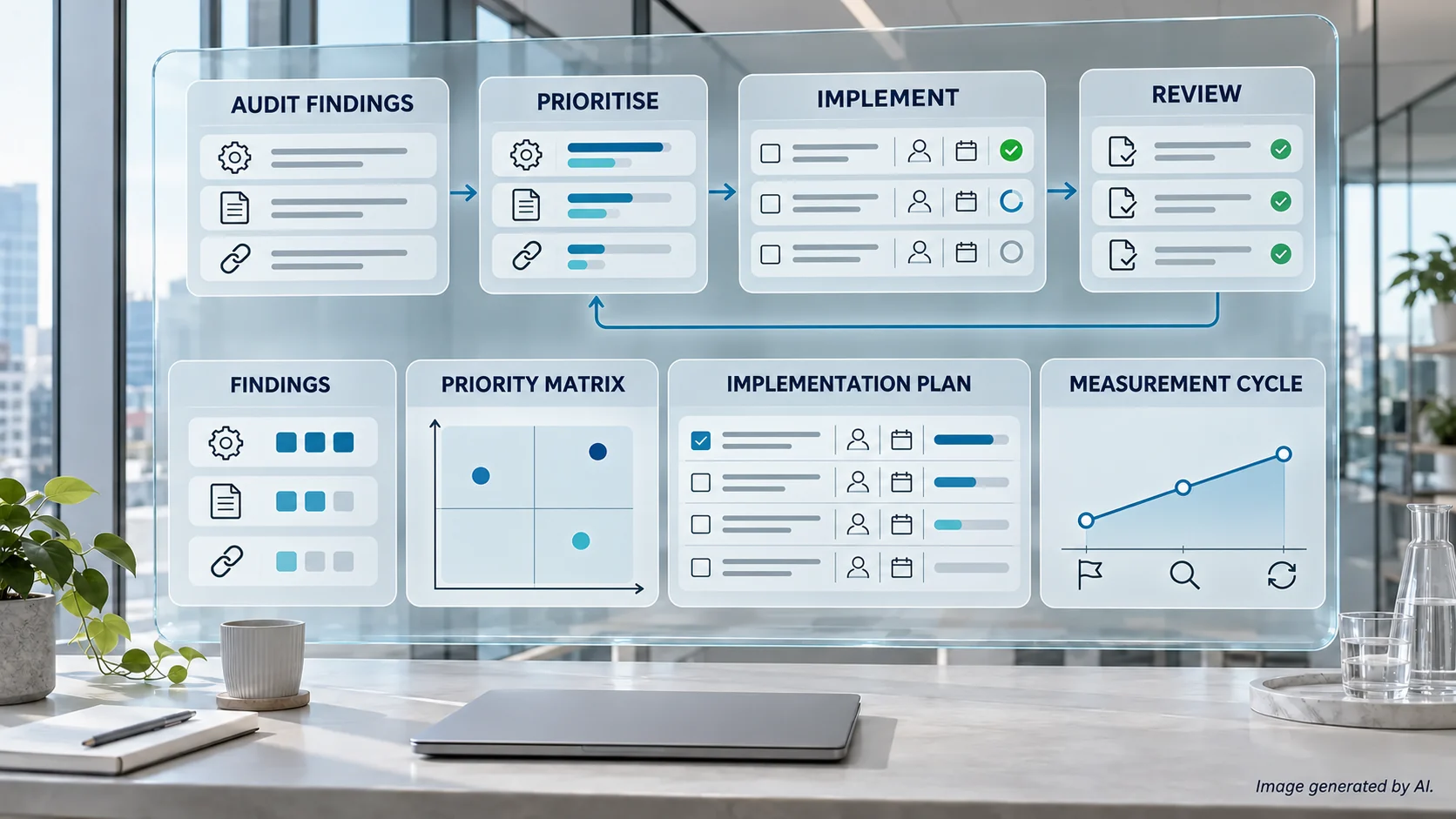
An AI visibility audit tells you where you are missing or misunderstood in Google and AI answer engines. The real work starts when you convert those findings into decisions: what to fix first, what to build next, and who owns each step.
If you are a Head of Marketing or Marketing Manager coordinating internal experts (technical SEO, content, PR) and sometimes external partners, this guide focuses on the implementation layer - especially when your team is overloaded and the report needs to become something your C-level stakeholders can trust.
Executive summary: you will turn audit findings into a prioritized 90-day plan, starting with entity and source trust, then GEO topic clustering, and only afterward regular content execution - with clear delegation and measurable definitions of “progress”.
Decoding your AI visibility audit findings
Use the audit to answer one operational question: when an answer engine needs to respond, do they have enough reliable “source signals” to use you correctly?
Audit outputs usually combine multiple signals. The danger is treating them like a checklist. Instead, map each signal to an action your teams can execute.
| Audit signal | What it usually means in practice | Typical implementation direction |
|---|---|---|
| AI citations | Whether your brand/content appears as a referenced source in AI responses | Build missing source signals: entity accuracy, external references, and GEO-ready content coverage |
| Message accuracy | Whether the information attributed to you matches your real offer and scope | Fix inconsistencies, tighten “source of truth” pages, and align naming/categories across the web |
| Share of voice / presence | How often you appear versus competitors in AI responses and related visibility signals | Close coverage gaps for priority buyer questions and strengthen external verification patterns |
| Competitor advantage | Where competitors are easier for answer engines to verify or summarize | Use competitor evidence as a hypothesis for what AI can access, then rebuild it with your correct positioning |
| Missing entities & inconsistent information | Often the hidden reason AI avoids you or mis-maps your services | Entity cleanup first (directory + profile + on-site consistency) before scaling content production |
Practical insight to reduce wasted effort: if the audit shows you are cited with incorrect wording, don’t rush to “publish more”. Fix accuracy and entity mapping first. More content will not solve trust problems if the underlying identity story is inconsistent.
What to write down before any planning
For each priority business topic from the audit, capture three items:
- What is missing? (citations, correct mapping, coverage, external verification)
- What is wrong? (accuracy issues, conflicting descriptions/categories)
- What is the fastest next correction? (entity fixes often beat content writing early on)
This creates a “triage board” you can use for delegation and sequencing.
The strategy gap (and how to delegate)
A diagnosis is not an implementation plan. The order of work depends on your business priorities, investment capacity, and dependencies like third-party directory updates or profile changes.
To make this real for a marketing team, separate:
- Decision work (what to fix first, which topics matter, which offers each cluster supports)
- Execution work (entity cleanup tasks, site structure adjustments, content drafting and publishing)
Delegation model you can use immediately:
- In-house marketing / Head of Marketing: confirm business priorities, align topic clusters to offers, approve editorial standards and buyer prompt coverage, and own C-level reporting.
- Technical SEO or website owner: implement readiness items (schema readiness where applicable, internal linking rules, on-site “source of truth” alignment) and coordinate any site-structure changes.
- Content editors / external partners: draft and update content assets according to cluster briefs, maintain accuracy against the “source of truth”, and document what was changed for audit traceability.
Practical insight to avoid placeholder planning: if your 90-day timeline is split into neat symmetrical chunks, it likely ignores where work actually stalls (e.g., waiting for third parties to accept profile updates). Build friction into the plan so owners know what they can control.
Now use a realistic example to keep the plan grounded:
Hypothetical scenario: A Polish B2B services company is often mentioned by name in Google search, but AI answers ignore them for “shortlisting criteria” topics. The audit shows missing/unclear entity mapping: the company name and service category are described differently across directories and third-party profiles. In this case, the biggest improvement comes from aligning service categories and descriptions across external sources - before expanding content volume.
That is exactly why the plan should start with entity and source trust, not bulk publishing.
Phase 1: Entity cleanup and source trust (Weeks 1-3)
Goal: make it easier for AI answer engines to verify who you are, what you offer, and how you should be mapped to relevant buyer topics.
Expected outputs: a triage list of inconsistencies, prioritized external source updates, and on-site “source of truth” alignment requirements for the next phases.
Week 1: Consolidate findings into an action-ready triage
- Turn the audit signals into a prioritized list of gaps (citations missing, accuracy issues, entity inconsistencies).
- For each top gap, decide whether it is primarily an entity problem, an external source problem, or an on-site mapping problem.
- Assign owners (marketing for prioritization, tech/content for execution tasks).
Acceptance criteria:
- Every priority gap has a named owner and a “type” (entity/external/on-site mapping).
- The team agrees on editorial truth: which pages or documents define your service categories and scope.
Week 2: External verification and identity alignment
- Update company profiles and directories where your company/service categories are inconsistent or outdated.
- Align company naming, service descriptions, and categories so they match what appears on your site.
- Document the “before and after” for traceability (screenshots/notes are enough).
Friction to plan for: third-party directory updates can take days to weeks to propagate - especially if there is manual review.
Acceptance criteria:
- At least the top priority external sources are updated to match the agreed “source of truth”.
- Any sources that cannot be updated within 30-90 days are logged as constraints (hypothesis: how they affect AI mapping).
Week 3: On-site mapping readiness
- Confirm that your key service/offer pages clearly state category terms used by the buyer questions in the audit.
- Set internal linking priorities needed for later clustering (what will link to what, and why).
- Prepare a shortlist of content updates that will be required once cluster briefs are defined.
Acceptance criteria:
- Owners have a clear list of which pages must be edited and which can remain unchanged.
- Editorial standards for accuracy are documented (what must be verified before publication).
Where Rebell Way fits: Rebell Way’s Google & AI Visibility Report and Growth Potential Assessment helps you identify the entity/presence gaps first, then the SEO/GEO Visibility Strategy & Topic Planning turns those gaps into an ordered workload - so your cleanup does not become guesswork.
Phase 2: Topic clustering and GEO framing (Weeks 4-8)
Goal: translate the audit into GEO-focused topic clusters that map buyer questions to your offers with clear “source of truth” narratives.
Expected outputs: cluster briefs, evidence requirements, a content-to-offer map, and an execution backlog that avoids rework.
Weeks 4-5: Build topic clusters around buyer decisions
- For each priority gap, select the buyer question type (definition, comparison, selection criteria, implementation steps).
- Group related questions into clusters so teams can build cohesive answers instead of isolated pages.
- Map each cluster to the specific offer or product/service it supports.
Practical insight to reduce ambiguity for writers: each cluster should include the “answer shape” you want the AI to summarize: what the response must cover, which terms must be used consistently, and which evidence links back to your source of truth.
Weeks 6-7: Define content briefs and verification rules
- Create briefs that specify: target buyer prompts from the audit, required sections, and proof/evidence expectations.
- Include a quality checklist: accuracy against your agreed definitions, consistency of service categories, and clarity of positioning.
- Decide what will be content edits vs. net-new assets.
Acceptance criteria:
- Every planned asset is traceable to a cluster and a priority gap.
- Briefs include verification steps (what must be checked and by whom).
Week 8: Finalize the execution backlog (with sequencing)
- Assign work in an order that matches dependencies: entity fixes first, then GEO-ready content structure, then expansion.
- Lock the “definition of done” for drafts: not just writing quality, but evidence alignment and consistency checks.
Acceptance criteria:
- Execution backlog has owners, estimated effort ranges, and dependency notes.
- The team agrees on how to report progress within the 90-day window (what counts as evidence of movement).
Where Rebell Way fits: this is where SEO/GEO Visibility Strategy & Topic Planning becomes practical. It connects priorities, clusters, and external source planning to your actual offers so your marketing team can coordinate internal and external contributors without losing control of the narrative.
Phase 3: Execution and C-level reporting (Weeks 9-12)
Goal: publish and optimize the highest-leverage cluster assets while keeping reporting useful for business decisions.
Expected outputs: executed asset updates, a lightweight reporting cadence, and updated priorities for the next cycle.
Weeks 9-10: Create and verify cluster assets
- Draft or update content assets based on briefs.
- Run editorial verification: accuracy, category/service mapping, and internal linking consistency.
- Publish within the agreed scope - avoid expanding the backlog mid-sprint.
Acceptance criteria:
- Published assets meet the verification rules defined in Week 6-7.
- Internal linking and on-page “source of truth” alignment are in place for each asset.
Weeks 11-12: Report progress in a way your stakeholders can use
- Summarize what was fixed (entity/external alignment) and what was executed (cluster assets and their intent).
- Include AI-visibility indicators you can observe directionally (citations, presence shifts, message consistency), without claiming guaranteed growth.
- Update next-quarter priorities based on what was learnable within 90 days.
Acceptance criteria:
- C-level receives a prioritized “what changed and why it matters” summary, not a list of tasks.
- Dependencies and constraints are documented (what took longer and what remains a hypothesis).
Important boundary: a first 90-day sequence is about building the foundations and executing the highest-leverage cluster plan. It should not be framed as a promise of ranking or AI visibility improvements within the same period.
If your team needs execution support: Rebell Way can also help operate the content creation, publishing, and optimization workflow (or, if you prefer in-house drafting, you can use a knowledge-grounded SEO/GEO Article Generator as part of your internal process). In both cases, the key is keeping verification and editorial standards under your control.
Defining success: AI metrics vs. rankings
Traditional SEO reports often center on rankings. AI visibility requires a different definition of “progress”. Use both, but don’t confuse them.
During the 90-day plan, align your stakeholders on indicators like:
- AI citations for priority topics (directional movement)
- Message accuracy and consistency of information attributed to your brand
- Share of voice / presence in AI responses compared with competitors
- Sentiment and positioning patterns where your audit flagged differentiation
Practical note: if you improved entity alignment and cluster coverage but see no change yet, treat it as a timing and dependency hypothesis. That is normal - especially when third-party sources are involved.
If you want to turn this into an ongoing decision system, Rebell Way’s SEO/GEO Visibility Monitoring & Ongoing Prioritisation can help you interpret changes over time and update priorities for the next iteration.
Clear CTA: Talk to Rebell Way about your visibility strategy and topic plan - and turn audit findings into a 90-day execution roadmap tailored to your offers and buyer questions. Discuss your SEO/GEO visibility plan with Rebell Way.
FAQ
What is the difference between an SEO audit and an AI visibility audit?
An SEO audit focuses on how search engines can crawl and rank your pages. An AI visibility audit focuses on whether answer engines can verify your entities and correctly use your information in responses, plus how you compare to competitors in AI contexts.
How long does entity cleanup take to reflect in AI responses?
It depends on how quickly third-party directories and profiles propagate changes. Expect delays when updates require approval, and plan your 90-day sequence to include external propagation time.
Which team should own GEO topic clustering?
Marketing usually owns the prioritization and mapping to offers and buyer decisions. Technical SEO helps with on-site readiness and structure. Content editors (internal or external) execute drafts based on cluster briefs and verification rules.
Can we use our existing SEO content plan for ChatGPT and other AI answer engines?
You can reuse parts, but GEO topic clustering and entity/source trust often require additional framing. The audit should guide what to adjust first so content supports the answer engines’ summarization needs.