
If you run B2B marketing, you already know the real problem is not writing. The real problem is everything around writing: pulling knowledge from busy SMEs, aligning on positioning, surviving approvals, and still shipping on time with a small team.
AI can help, but if you feed it a vague prompt, you get a vague article. Worse, you risk confident-sounding inaccuracies, off-brand phrasing, and content that your sales team will never share. A scalable B2B content creation process needs a workflow, not a “write me a blog post” button.
Why traditional AI content fails in B2B
Most B2B teams try AI like this: pick a keyword, ask for an outline, generate 1,200 words, then edit. It feels fast until review starts. Then it slows down because the content is:
- Too generic - it repeats common knowledge instead of your point of view.
- Context-free - it doesn’t reflect your product realities, constraints, or positioning.
- Hard to approve - legal, product, and sales see risky statements and request rewrites.
- Inconsistent - tone and terminology drift from one article to the next.
There’s a simple reason: B2B content is not only information. It is judgment, trade-offs, and credibility. And credibility comes from specific sources: your internal docs, customer objections, product capabilities, and how your team talks.
Personal insight: If your SMEs only show up at the end to “approve,” they will rewrite the whole thing. If they show up early to supply the raw inputs (examples, objections, constraints), approvals get dramatically easier.
The fix: a knowledge-base-first workflow
The most reliable process flips the order. Instead of generating first and verifying later, you build a small, living knowledge base from your company materials first, then you generate drafts grounded in that context.
This is also where a platform like Rebell Way fits naturally. Rebell Way is built around a knowledge-base-first workflow: you provide company context, client profiles, and source materials, and only then generate and manage an SEO/GEO article draft within a review and publishing process (rather than treating AI as a standalone writer).
To make the difference concrete, here is how a “prompt-first” approach compares to a “knowledge-base-first” approach.
| Aspect | Prompt-first AI | Knowledge-base-first AI (grounded) |
|---|---|---|
| Input quality | Relies on a brief prompt and general web patterns | Uses your internal sources and defined positioning |
| Brand voice | Drifts between articles | More consistent terminology and tone |
| Accuracy risk | Higher risk of “confident” inaccuracies | Lower risk when constrained to provided materials |
| SME effort | Late-stage corrections and rewrites | Early-stage input, fewer late rewrites |
| Approval speed | Slow, because reviewers find many issues | Faster, because reviewers validate known claims |
| SEO/GEO alignment | Often superficial, keyword-only | Better structure and intent mapping when planned upfront |
Note: no AI approach removes the need for human accountability. What changes is where you spend your scarce time: early structure and sources, instead of late firefighting.
For guidance on managing AI risks in content workflows, it’s worth reviewing NIST’s AI Risk Management Framework to align internal expectations on review, accountability, and controls.
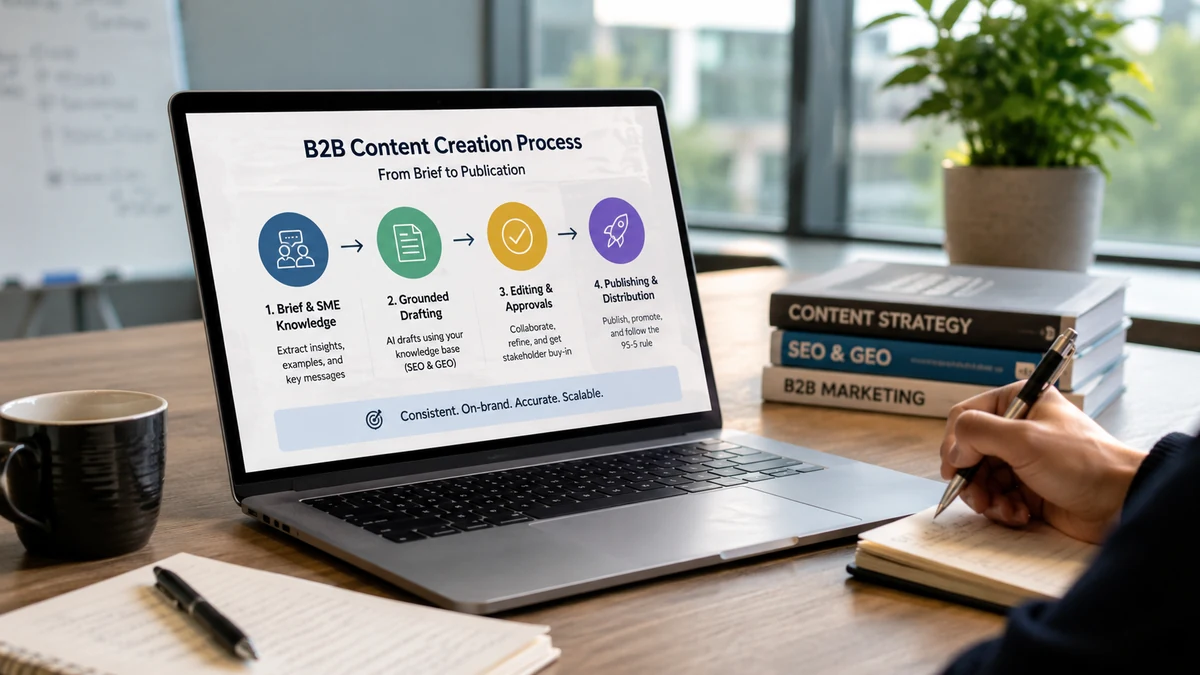
Step 1: Briefing and SME knowledge extraction
In B2B, the brief is not a formality. It is a contract between marketing, product, sales, and whoever approves. A good brief prevents two common failures: “we wrote the wrong article” and “nobody will approve this.”
What a strong B2B content brief should include
- Target persona and stage: who exactly is the reader (marketing manager, CFO, IT lead) and are they problem-aware or vendor-evaluating?
- Search intent: informational vs commercial. (This article is typically informational with a commercial undertone.)
- Primary query and supporting angles: not just one keyword, but the decision questions behind it (approval bottlenecks, SME constraints, quality control).
- “Must-say” and “must-not-say”: approved claims, forbidden claims, regulatory constraints, and naming conventions.
- Internal proof points: which assets we can cite (sales deck, product docs, onboarding guides, previous thought leadership).
- CTA and next step: what you want the reader to do after reading (newsletter, demo request, resource download), without forcing it.
How to extract SME knowledge without endless meetings
You don’t need a one-hour call for every article. You need a repeatable extraction method. Pick one:
- 15-minute “voice note” interview: ask 5 fixed questions (common objections, real examples, mistakes, best practice, red flags). Transcribe and store.
- Async SME form: two short fields: “What do people get wrong?” and “What would you do differently?”
- Sales call mining: pull recurring questions from notes, call transcripts, or CRM snippets (sanitize as needed).
Personal insight: The fastest way to get SME cooperation is to ask for correction, not creation. Give them a short outline and 5 questions, not a blank page. It feels smaller, so they respond.
Finally, decide upfront who approves what:
- Marketing: structure, SEO intent, readability.
- SME/Product: technical correctness and nuance.
- Legal/Compliance (if needed): claims, disclaimers, regulated wording.
Step 2: Drafting with grounded AI (SEO and GEO)
This is where many teams go wrong. They start drafting before they have sources. Instead, treat drafting as synthesis of approved materials.
Build your “source pack” first
Before generating a draft, compile a lightweight source pack:
- Product one-pagers, help docs, or internal wiki pages
- Positioning notes (who you’re for, who you’re not for)
- Case-relevant snippets from sales decks (no confidential details)
- Prior high-performing articles and preferred internal terminology
Then constrain the draft to those materials. This is the logic behind Rebell Way’s workflow: ingest company context and source materials first, then generate a draft that is much closer to your real voice and offerings. The goal is not “more content,” it’s fewer revisions.
SEO and GEO: plan for both discovery paths
Modern discovery is split across classic search (Google) and answer engines (AI assistants). Your process should support both:
- SEO basics: clear headings, intent coverage, internal logic, and metadata that matches the query.
- GEO (Generative Engine Optimization): scannable definitions, explicit steps, and source-grounded statements that are easier for AI systems to quote accurately.
Google’s own guidance on creating helpful, people-first content is a solid baseline for quality control: Creating helpful content.
Draft checklist (what to generate)
- A practical outline tied to the brief’s intent
- Section-by-section draft with clear claims and examples
- A short list of “needs SME confirmation” items (so review is focused)
- Draft title, meta title, and meta description
Personal insight: Ask the AI to produce a “red-flag list” at the end: any statements that sound like facts but are not supported by the source pack. It’s a simple way to reduce accidental overclaims before legal or product sees the draft.
If you want to operationalize this step, you can generate drafts and manage the workflow using the Rebell Way SEO/GEO Article Generator as part of a controlled process rather than a one-off prompt.
Step 3: Editing and approvals without bottlenecks
Editing is not one step. It’s three different jobs, and separating them speeds everything up.
1) Substantive edit (meaning)
- Does the article match the brief and persona?
- Are claims accurate and source-backed?
- Does it reflect how your company actually solves the problem?
2) SEO/GEO edit (structure)
- Is the H2/H3 hierarchy logical and scannable?
- Are key questions answered directly (so content is quotable)?
- Are internal terms consistent (product names, feature names, categories)?
3) Copy edit (polish)
- Remove repetition and “AI tone”
- Shorten long sentences
- Replace vague phrasing with specific language from your sources
How to design approvals so they don’t stall
- Set a review window: e.g., 48 hours for SME comments, otherwise publish with tracked notes.
- Ask reviewers to comment in one place: avoid feedback across email, Slack, and documents.
- Give reviewers a checklist: accuracy, risk, missing context. Not “make it better.”
- Resolve conflicts fast: one decision-maker finalizes when sales and product disagree.
Tools help here, but the real win is clarity: what kind of feedback you want, and when.
Step 4: Publishing, distribution, and the 95-5 rule
Publishing is where many workflows end. In B2B, it’s where ROI begins.
The 95-5 rule (and why distribution matters)
The 95-5 rule is often summarized like this: most of your B2B market is not actively buying right now (the larger “95%”), while a smaller group is in-market (the “5%”). Your content process should serve both:
- For the 95%: build memory and trust with clear, educational content that matches real pains.
- For the 5%: provide comparison-ready content, concrete steps, and implementation details that support vendor evaluation.
This connects directly to your publishing plan. If you only publish, you rely on luck. If you distribute, you deliberately reach both groups over time.
For a deeper, research-backed overview of B2B buying behavior and long cycles, see Gartner’s research on the B2B buying journey.
A practical distribution checklist
- On-site: publish with a clear CTA and internal links to related articles and product pages (where appropriate).
- Sales enablement: send a short summary to sales with “when to use this article” guidance.
- Newsletter and LinkedIn: one post for the lesson, one for the common mistake, one for the step-by-step.
- Partnerships and backlinks: co-create or contribute where your audience already reads.
If backlink partnerships are part of your plan, the Rebell Way Content Marketplace is designed to help teams find content partners and guest post opportunities in a more structured way.
Real-world scenario: what “faster” looks like in practice
Here’s a realistic scenario that matches what many B2B marketing managers face (without pretending it’s a formal case study).
A marketing manager at a B2B SaaS company needs two expert articles per month. The team is small: one marketer, a designer shared across teams, and product managers who are rarely available. Past attempts at AI content created extra work: generic drafts, lots of corrections, and long approval cycles.
They rebuild the workflow around a knowledge-base-first approach:
- Week 1 (setup): collect a source pack (product docs, a positioning doc, sales objections, 2-3 strong existing articles). Define “must-say/must-not-say.”
- Each article: do a 15-minute SME extraction (async or short call). Add 3-5 concrete examples and “red flags.”
- Drafting: generate an outline and draft grounded in the source pack, then route to SME with a checklist (“Confirm these 6 statements”).
- Approvals: set a 48-hour SLA for comments; marketing resolves edits; legal only checks marked claims.
- Distribution: publish, repurpose into a sales-ready summary, then seek one partnership placement per quarter.
The result is not magic. It’s fewer loops. SMEs spend time where they add value (accuracy and nuance), marketing spends time on structure and distribution, and AI does the first synthesis.
When this is set up, platforms like Rebell Way can support the operational side (context + sources + generation + review workflow) so you’re not rebuilding the process in spreadsheets each month.
If you want to see how Rebell Way approaches knowledge-base-first article production end-to-end, explore Rebell Way and map the workflow to your current bottlenecks.
FAQ
How do I prevent AI from writing generic B2B content?
Start with sources, not prompts. Build a small source pack from your internal materials (docs, decks, objections, terminology) and require the draft to stay grounded in those inputs. Then run an SME accuracy check focused on a short list of statements.
How can I speed up content approvals with limited resources?
Separate editing into meaning, structure, and copy. Give SMEs a checklist and a strict review window (for example, 48 hours). Route only high-risk claims to legal, and assign a single decision-maker to resolve conflicts.
What should be included in a B2B content brief?
At minimum: persona and stage, search intent, primary query and angles, “must-say/must-not-say,” approved proof sources, internal terminology, and a clear CTA. The brief should make it easy to approve the final article, not just write it.