
If you run an online store, you already know the real challenge: it’s not adding one more product - it’s keeping hundreds (or thousands) of categories and SKUs visible in Google without relying only on paid ads. In 2026, e-commerce SEO is still one of the highest-ROI channels, but it demands a system: strong technical foundations, scalable on-page optimization, and content that helps customers decide.
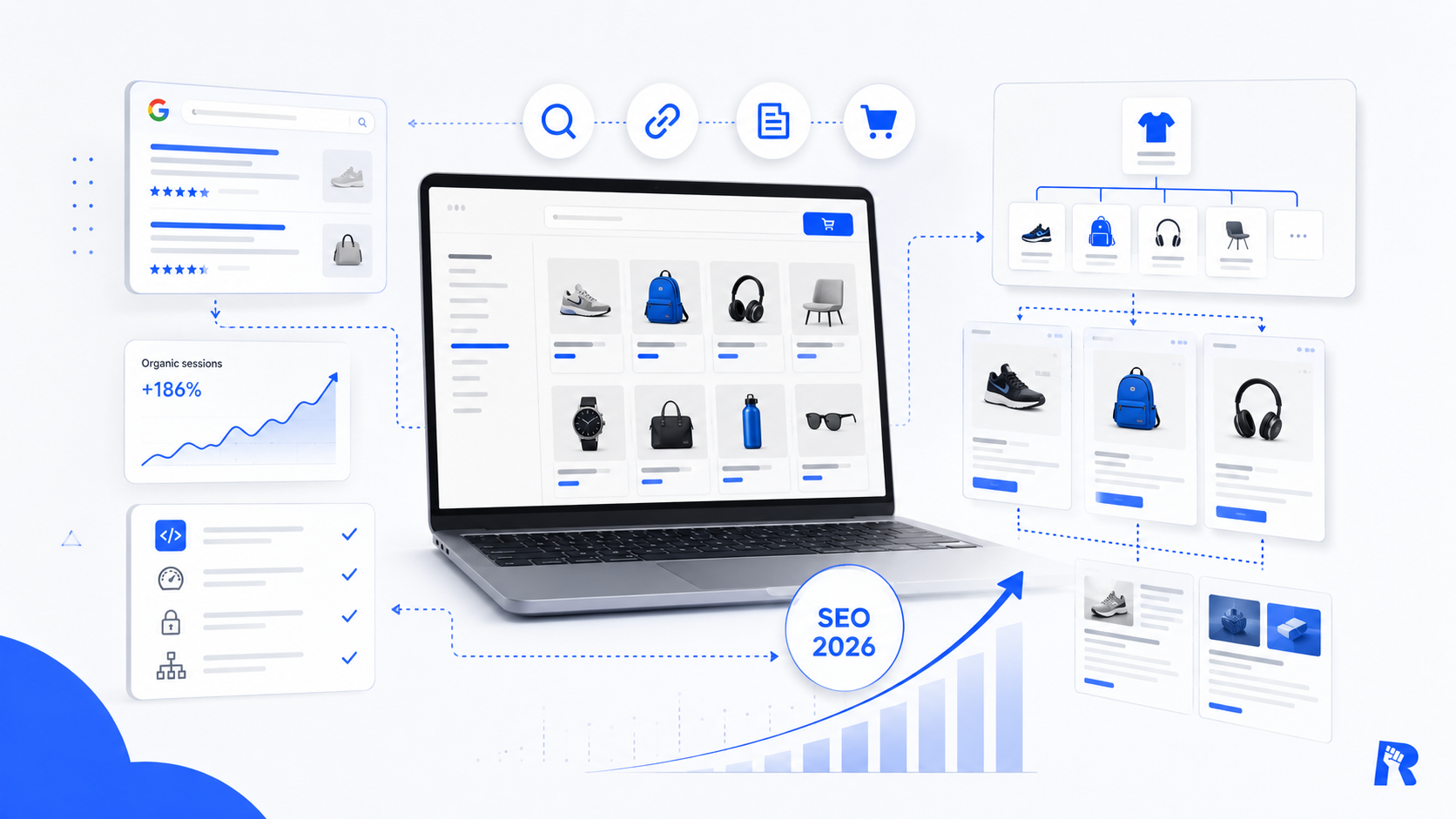
My insight: The blog is not “nice to have.” For many stores it is the most scalable way to capture informational searches (before purchase), educate customers, and guide them to the right category or product page. The key is publishing repeatable formats - guides, rankings, comparisons, problem-solving posts and seasonal content - and linking them to the exact pages that convert.
What is e-commerce SEO (and what changed for 2026)?
E-commerce SEO is a set of practices that increase your store’s visibility in organic search for queries related to your categories, products and customer problems (eg “best running shoes for flat feet” or “how to choose an air purifier for allergies”).
In practice, it’s two connected areas:
- Content and on-page SEO - what you publish and how well it matches search intent (category copy, product descriptions, blog posts, internal links).
- Technical SEO - how efficiently Google can crawl, understand and index your store (architecture, faceted navigation, speed, structured data, canonicals).
What changed for 2026? Customers are using more comparison-style queries, and Google’s systems reward pages that demonstrate real usefulness: clear buying guidance, unique product context, and a strong internal linking structure.
Does SEO “die” in 2026 because of AI?
No - but low-effort content does. AI can help you scale, but your store still needs: (1) helpful information, (2) a clear structure, (3) proof that you know your products and customers.
Used properly, AI speeds up planning, drafting and refreshing content for many product categories - especially when you feed it your real knowledge (product PDFs, brand specs, return reasons, customer questions, internal guidelines).
The 5C framework for e-commerce SEO (practical version)
This framework helps you build content and pages that rank and convert:
- Customer - who buys and why? What are their fears, constraints and “must-have” features?
- Content - do you have the right formats for each stage (guides, comparisons, rankings, problem-solving, seasonal)?
- Context - are you targeting the intent behind queries (informational vs commercial vs transactional)?
- Convenience - can users filter, compare, understand shipping/returns and choose quickly?
- Conversion - do pages lead naturally to a category, product, or bundle?
The 80/20 rule: what usually drives most of the revenue
Most e-commerce stores get disproportionate results from a few SEO actions. If your time is limited, prioritize:
- Category pages (high-intent, scalable traffic)
- Top products (high-converting pages with long-tail potential)
- Internal linking (the easiest “multiplier” across the store)
- One content cluster per key category (blog posts that answer pre-purchase questions)
How to optimize category pages (with a copy template)
Category pages often win the most valuable non-brand traffic. The mistake is treating them like a product grid only. In 2026, a category page should also be a buying guide.
Category page checklist
- Title (H1) that matches the core query (eg “Air Purifiers”) + optional qualifier (eg “for Allergies”).
- Intro copy (80-140 words) that explains what the category is and who it’s for.
- Buying criteria section (bullets) that helps people choose (coverage area, HEPA grade, noise, filter costs).
- Subcategory links to reflect your taxonomy (eg “For bedrooms,” “For pets,” “Compact”).
- FAQ based on real questions from support and search suggestions.
- Internal links to comparisons, rankings and problem-solving posts.
Example: SEO-friendly category copy (short and helpful)
H1: Air Purifiers for Home
Intro: Air purifiers help remove dust, pollen and odors - and can be a great option if you have allergies, pets or live in a city. In this category you’ll find models for small rooms and large spaces, with different filter types and noise levels.
How to choose (bullets):
- Room size (m2) - match the purifier’s coverage to your room
- Filter type - true HEPA for fine particles, carbon for odors
- Noise level - important for bedrooms
- Filter replacement cost - check availability and pricing
Internal linking tip: Under the intro, add a line like: “Not sure what to choose? Read our air purifier buying guide or see the best air purifiers ranking.”
How to optimize product pages (what to write beyond manufacturer specs)
Thin product pages are one of the biggest SEO leaks in e-commerce. If your descriptions are identical to the manufacturer’s, Google has little reason to rank you.
Product description structure that supports SEO and conversion
- Who it’s for (1-2 sentences): “Best for small apartments and bedrooms.”
- Top benefits (3-5 bullets): focus on outcomes, not only features.
- Key specs: formatted cleanly (table or bullet list).
- Trust builders: warranty, shipping, returns, what’s in the box.
- Comparison links: link to alternatives (“Compare with Model X”).
Example: benefit-first product copy snippet
Instead of: “Power: 45W. CADR: 240. Filter: H13.”
Write: “This purifier is a strong match for bedrooms and home offices up to 25 m2. It runs quietly at night mode and uses a true HEPA filter to capture fine particles like pollen and dust.”
Internal linking tip: Add links like: “Not sure if you need HEPA? See HEPA vs carbon filters explained.”
Blog content that generates organic traffic and supports buying decisions
Most store owners think blogging means writing random articles. In reality, your blog should function like a sales assistant that answers questions before customers add items to cart.
5 content types to plan for every major category
- Buying guides (eg “How to choose…”): explain criteria and link to the category page.
- Rankings (eg “Best X in 2026”): include scenarios (“best for small rooms,” “best budget”).
- Comparisons (eg “X vs Y”): perfect for high-intent searches.
- Problem-solving articles (eg “How to remove…”): top-of-funnel traffic that you convert with internal links.
- Seasonal content (eg “Back to school essentials,” “Winter maintenance checklist”): recurring traffic spikes.
How to turn blog traffic into revenue (simple internal linking model)
- At the top: link to the main category (eg Air Purifiers).
- Mid-article: link to subcategories or filters (eg Purifiers for bedrooms).
- Near the conclusion: link to 3-5 recommended products or a ranking page.
Author insight (Paweł Karczewski): If you have many categories, you don’t need “more inspiration” - you need a repeatable system. For each key category, build one pillar guide and 6-10 supporting posts (ranking, comparisons, FAQs, problems, seasonal). This is how you scale without losing consistency.
Technical SEO essentials for e-commerce (what to verify first)
You don’t need to become a developer, but you should know what to audit and what to delegate.
High-impact technical checks
- Indexation control: prevent thin filter/facet URLs from being indexed when they create duplicates.
- Canonical tags: ensure variants and filtered pages point to the correct canonical.
- Core Web Vitals: optimize images, scripts and templates (especially on mobile).
- Structured data: add Product schema (price, availability, reviews) and BreadcrumbList.
- Pagination: handle category pagination cleanly and keep internal links crawlable.
- XML sitemaps: include key categories/products, exclude junk URLs.
For official guidance, use Google Search Central documentation: https://developers.google.com/search/docs
The ultimate 7-step e-commerce SEO checklist (2026)
- Keyword research by intent (category vs product vs informational)
- Site architecture (clear category tree, breadcrumbs, crawlable internal links)
- Technical SEO basics (indexation, canonicals, speed, schema)
- Category page optimization (helpful copy + subcategories + FAQs)
- Product page optimization (unique value, benefits, comparisons, trust info)
- Content marketing system (guides, rankings, comparisons, problems, seasonal)
- Analytics and iteration (measure, refresh, expand winners)
How to scale SEO content across many categories (without burning out)
If you manage an e-commerce catalog, your constraint is usually not knowledge - it’s time. You might have 30 categories that each deserve 10+ articles, plus regular updates.
Rebell Way AI Content Workspace is designed to speed up this workflow: define your business once, upload source PDFs (eg product manuals, brand decks, buying criteria), build a knowledge base, generate drafts, review them, and publish to platforms like WordPress, Shopify or WooCommerce.
The practical way to use it in e-commerce is not “publish more.” It’s to publish systematically:
- Create a template for each content type (guide, ranking, comparison, problem-solving, seasonal).
- Generate a topic map per category (eg 1 pillar + 8 supporting articles).
- Refresh top posts quarterly (prices, models, availability, new features).
Backlinks and authority: how to build trust without spam
For competitive categories, content alone may not be enough. You also need authority signals - especially quality backlinks from relevant sites.
Instead of random outreach, focus on partnerships where both sides get value (guest posts, product tests, expert quotes, shared rankings). If you want to streamline partner discovery and placements, Rebell Marketplace helps you find vetted content partners, exchange guest posts and build a healthier backlink profile over time.
Next steps: a practical plan for the next 30 days
- Pick 3 priority categories (highest margin or highest demand).
- Optimize those category pages using the template above.
- Improve 20 top product pages with benefit-first copy and internal links.
- Publish 1 pillar guide + 2 supporting posts per category.
- Set up tracking in Google Search Console and define KPIs (clicks, impressions, top queries, pages).
If you want to scale this plan across dozens of categories, build your workflow in Rebell Way AI Content Workspace and support authority growth via Rebell Marketplace.
FAQ: e-commerce SEO in 2026
How long does e-commerce SEO take to work?
For existing stores, you can often see improvement in 4-12 weeks for on-page and internal linking changes. Competitive categories and new domains may take longer.
Should I write blog posts or focus only on category pages?
Do both, but start with category pages first. Then use the blog to capture pre-purchase questions and funnel users to categories and products.
What is the biggest SEO mistake in e-commerce?
Leaving category and product pages thin or duplicated - and not building internal links from informational content to revenue pages.